

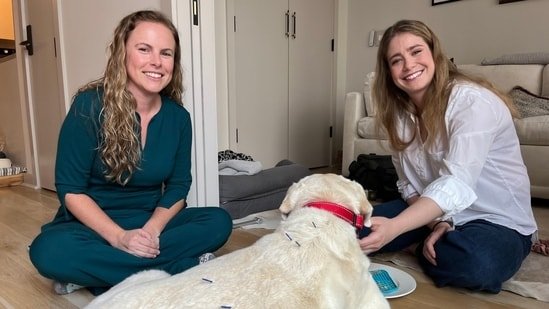
A 12-year-old Labrador retriever named Sugar was sprawled on a hardwood floor of a Brooklyn apartment.
Kneeling beside her, Dr. Kristen Miller swiftly tapped hair-thin needles into the dog’s back and haunches. Sugar didn’t flinch. She was laser-focused on licking organic peanut butter off a mat, a treat reserved for her biweekly acupuncture sessions.
Miller began her career as a conventional veterinarian. After discovering veterinary acupuncture a decade ago, she eventually left Western medicine behind to launch a mobile practice sticking needles in dogs and cats. She charges up to $500 for house calls and now has a wait list.
Depending on your point of view, Miller is either at the forefront of a promising medical specialty or a practitioner of a pseudoscience that is being propped up by humans who will do anything for their pets.
Acupuncture—for animals or humans—isn’t recognized as a board-certified medical specialty, and skeptics say there is no rigorous scientific evidence backing the practice. They point to studies suggesting a strong caregiver placebo effect, with the only real change being the owner’s perception of their pet’s condition.
Miller says she became a believer when her own aging golden retriever, Murphy, had arthritis and his medication stopped working. She took him to an acupuncturist and said Murphy regained both his mobility and vitality with weekly visits.
“He could get up more easily,” Miller said.
Miller enrolled in a Florida-based school now called Chi University that trains vets in traditional Chinese medicine. After graduating, she began practicing conventional Western medicine at a clinic by day, and needling animals in their living rooms on evenings and weekends.
Early on, Miller had a hard time distracting her patients. They would occasionally perform a vigorous wet-shake in the middle of a session, sending needles flying across the room.
“You’re spending all this time searching for needles,” Miller said. She has learned to use treats to make patients forget they’re being poked full of holes and needles with bright-colored handles that are easier to find.
Miller is now a full-time practitioner of Chinese medicine, navigating Manhattan’s gridlock and Brooklyn’s brownstones carrying a doctor bag of needles and laser equipment. Her fees range from $300 to $500, a premium she said allows her to provide undivided attention to each animal in the comfort of its home.
Sarah Kusnetz, Sugar’s owner, said she was a doubter. But when the lab became almost immobile because of pain in her legs, she gave it a shot. Following Miller’s first house call, Sugar spent the rest of the day in a deep sleep. On the next morning’s walk, the dog was doing the pulling.
“It was a full 180 from where she was,” said Kusnetz, 32, who’s been seeing Miller regularly ever since.
About 4% of the roughly 127,000 veterinarians in the U.S. are certified to perform acupuncture, according to the American Board of Veterinary Acupuncture. The group has sought to have the practice officially recognized as a medical specialty by the American Veterinary Medical Association.
A group of skeptical vets have argued that a similar push was denied a decade ago for lack of scientific evidence, and that nothing has changed since.
“Acupuncturists, in general, still rely very heavily on tradition and personal experience to validate their practices,” said Dr. Brennen McKenzie, a veterinarian and member of the opposition group.
Many pet owners aren’t sold, either. In Boston, Marybeth Oskowski turned to acupuncture as part of a treatment plan for her terrier mix, Maddie, following a spinal injury. But after a dozen sessions, Maddie began ducking under a chair the moment her veterinarian reached for the needles.
“She didn’t like being pricked anymore,” said Oskowski, 44, adding that Maddie was happy to stay for a cold-laser treatment. Maddie is doing better, but Oskowski doesn’t know if it’s because of the acupuncture or something else.
Dr. Huisheng Xie, founder of Chi University, acknowledged that scientific research has historically been a secondary focus among acupuncturists. “It’s our weakness.”
As pets live longer, their chances of developing diseases increase. Veterinary acupuncture may not cure them, but it can help mitigate pain while boosting mobility and appetite, Xie said. “Acupuncture works very well for the terminal life situation,” he said.
That’s what led Emily Kurlansik, who works in a medical field, to try acupuncture for her aging cat, Wing. After the removal of a cancerous salivary gland tumor, Wing’s oncologist recommended chemotherapy and radiation.
“It would have been very, very stressful on him. We’re talking about daily radiation and having to go up to Midtown,” recalled Kurlansik, a Brooklyn resident. “And it’s pretty cost-prohibitive.”
Kurlansik contacted Miller. On a recent afternoon nearly four years later, Wing, now 19, enjoyed lickable treats while Miller inserted needles into his body.
“The oncologist gave Wing four to six months to live without chemo and radiation,” said Kurlansik. “So I was determined to make them the best, most comfortable four to six months ever.”
Write to Akiko Matsuda at akiko.matsuda@wsj.com
