

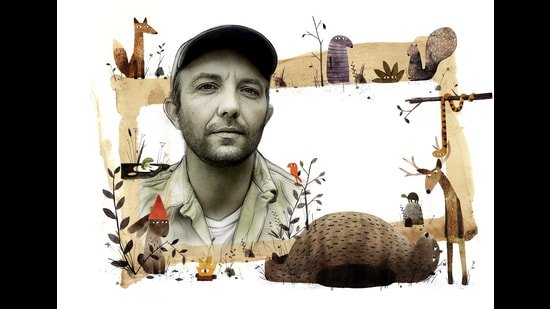
The aim with board books, says Jon Klassen, is to create worlds in which nothing happens. “Babies don’t need stories. They need a reason to turn the page.”
Well, something has happened.
Klassen’s body of literary work — eight titles aimed at readers aged three to nine — has won the Swedish government’s $500,000 Astrid Lindgren prize for children’s literature.
“I had felt like I was hiding out a little in these books,” says Klassen, 44, a Canadian writer and illustrator now living in Los Angeles. “I wonder what made the jury choose me over the other writers in the running?”
The citation more than answers that question. “Through his subtle and evocative storytelling… Klassen opens new perspectives on our place in the universe. What happens when a rock falls from the sky, when hats disappear or a skull begins living a life of its own?” the citation notes. “With precision, emotion and inventive wit, life’s challenges of uncertainty and hopefulness are portrayed in an interplay of colour and form.”
Take The Rock from the Sky (2021). In this marvellous, minimalist and mildly surreal book, a range of bowler-hatted animals stand in static drawings, as a boulder whooshes down from the sky and into their lives.
There is no explanation, and very little additional detail in the sparse art.

Instead, the book extends an invitation to its young reader to fill in the blanks. The illustrations are the first sign of such enticement, inviting the child to add their own art to the page. The faint glimmers of a plot allow them to slowly flesh out the story in their own minds, as they read it too.
This turns reading into more of an active, participatory process than usual, allowing a child to return to a tale multiple times without necessarily having the same experience.
“Children this small do not necessarily seek explanation,” Klassen says. Instead, they are willing to sit with unresolved ideas and construct meanings of their own.
The real creative challenge, he adds, is: How gentle can I get; how quiet can I get? “You can have more aggressive stories, as a children’s writer,” he adds, “if your storytelling is gentle.” His stories are certainly unexpected in that respect.
In his best-known book, I Want My Hat Back (2011), a bear searches the forest for his missing red hat, politely asking every animal he meets if they have seen it. Then, a dark twist: he doesn’t just get that hat back, he eats the rabbit that took it. It is a twist, Klassen says, that was shaped by the strange emotional logic that governs animal tales (think, for instance, of Red Riding Hood).

In this way, even though each tale unfolds in 30 lines or less, Klassen’s books manage to serve as introductions to ideas such as deception, loneliness, fear, anger, friendship — and, vitally, ambiguity.
I Want My Hat Back was an instant hit, a New York Times bestseller. Together, it and its sequel, This is Not My Hat (2012) had sold over a million copies worldwide by 2014.
That second title follows a tiny fish who steals a hat from a larger fish, and ends up learning about self-delusion, consequences and inevitability. The book ends with the big fish following the little fellow into his hiding place in the reeds, and emerging with his hat, while a crab looks on.
The trilogy ended with a gentler tale. In We Found a Hat (2016), two turtles discover a bonnet that suits them both, and share it, exploring ideas of desire, restraint, compromise and care.
He struggled a bit with that one, Klassen says. Now that he knew so many were waiting and watching to see how it all turned out, he didn’t know how to end the series.
The determination to deliver something unexpected led to one draft in which both characters died in the snow. The writer eventually decided to manifest a different kind of world for his young readers: one in which friendship outweighs conflict.

The real challenge, he says, was “making readers believe these guys believably like each other.” The tone is set at the point when one turtle says to the other, half awake and half asleep, as the other sneaks up on the hat to steal it: “I am dreaming that I have a hat. It looks very good on me. You are also there. You also have a hat. It looks very good on you too.”
The second turtle hears this and asks: “We both have hats?”, thinks a moment, and then gets back into bed.
The conflict is never truly resolved, Klassen points out. “When they wake up, there will still only be one hat.” But in that brief moment, it is replaced by something deeper, that can perhaps be called upon again.
“This is, after all,” Klassen says, “what a lot of relationships are like.”
***
Interestingly, even if you’ve never seen any of his picture-books, chances are you have encountered at least some of Klassen’s work.
His career began with Dreamworks Animation, 20 years ago, where he contributed as an illustrator to the animated worlds of Kung Fu Panda (2008) and Coraline (2009). More recently, he co-created the Apple TV series Shape Island (2023), in which a circle and a triangle make their way through the world, having adventures and learning to accommodate each other.
He has lived in Los Angeles since 2006 and movies gave him his first canvas, but he soon became determined to pursue personal projects of a very different kind, he says. He likes to explain the difference with an example.
He would choose to depict an explosion by moving the camera to a quiet corner of an animated scene, letting the audience hear a boom, and having a single flower float into the frame, Klassen says. “That’s not what big studios want,” he adds, smiling. “They want to show the explosion. ‘Show it. We can afford it,’ they would say.”
So he took his quieter side into children’s books. In his first such project, he provided the art for Caroline Stutson’s Cat’s Night Out (2010), about cats singing and dancing during a night out on the town. When it won the Canadian Governor General’s Award, everything shifted for him, Klassen says.

He gained confidence in his art, and in his chosen medium. By 2011, he had released the first of his hat trilogy. His most recent titles are a trilogy too. Your Farm, Your Forest, and Your Island, all released in 2025, build simple worlds step by step (a tree, a tent, a bonfire), exploring ideas of presence and ownership.
***
It is a precious feeling, knowing one is part of a child’s formative years; and a big responsibility, Klassen says.
Even in the tales of conflict, for instance, he is careful to avoid intensity, leavening the tension of the storyline with simple, repetitive dialogue and calm, uncomplicated art.
What he is trying to build, he says, is a controlled emotional experience: a heightened state, a sense of release, an exhalation. Quite unusual for a children’s picture-book.
The release doesn’t have to be morally neat; in fact, he prefers that it isn’t. “I am interested in the uneasy satisfaction of something that feels complete even if it’s troubling,” Klassen says.
He believes that the ambiguity of this offers his young readers a sense of resonance. They can project onto the book their own lived tensions, whether about lost toys, physical discomforts or a world they do not really understand. The story doesn’t aim to tell them what to think, but how to feel when things don’t seem to add up. And that’s a useful skill, at any age.
