

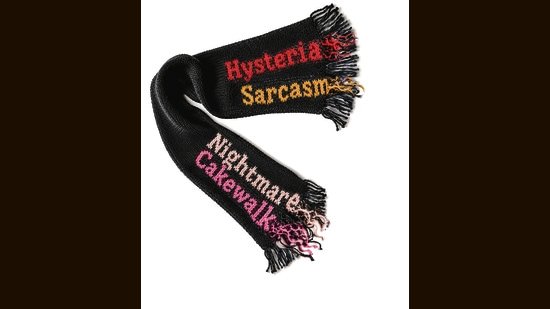
Some English words seem to make no sense, until one realises that, in a sinister way, they do; their dark roots largely hidden, but visible with just the slightest digging.
Extreme prejudice, for instance, gave us “hysteria”, “gypped” and even “tipping point”.
The misogyny inherent in “hysteria” can be traced all the way back to ancient Greece.
Hippocratic theory stated that a type of hystera (Greek for uterus) called the “wandering womb” moved around the body looking for sperm, disrupting other organs in the process. This condition was thought to be particularly prevalent among unmarried women, and was thought to cause strange behaviour. So, symptoms ranging from “excessive” emotion and irritability to anxiety, breathlessness and fainting spells were all diagnosed as “hysteria”.
The prescription generally involved marriage, and child-bearing.
This approach to emotional distress in women lasted about 2,500 years. As recently as the 20th century, hysteria was still diagnosed only in women, and was widely used to explain away almost any kind of unrest. “Treatment” evolved, and sometimes included the removal of the uterus. From this, we get the term “hysterectomy”.
It was only in 1980 that hysteria was formally removed from the American Psychiatric Association’s Diagnostic and Statistical Manual of Mental Disorders (DSM), which informs psychiatric treatment around the world.
Oddly, the procedure hasn’t been. Millions of hysterectomies continue to be performed around the world, for sound medical reasons but still bearing the quite-loaded term.
Scholars, many of them women, are now studying the origins of such phrases, and how it is that so many of them survive in everyday use. “Once you start seeing the stories behind the words, you want to keep pulling at the threads,” says Australian- American writer Karen Stollznow, author of On the Offensive: Prejudice in Language Past and Present (2020) and Bitch: The Journey of a Word (2024).
That second book traces its term from English kennels to medieval morality, and modern misogyny to feminist reclamation. “It’s not just the story of a word, it’s a mirror held up to the culture and society that keeps reinventing it,” Stollznow says.
Terms like these can be a bit like archaeological digs, she adds. The further one excavates, the more one uncovers about attitudes, assumptions and power structures of earlier societies, “many of which still echo in how we use them today.” What are some of the choicest such words still hiding in plain sight?
* Pause to think about it and it’s positively shocking that “gypped” is still casually used to indicate one has been defrauded, swindled or cheated. Most of us have at least a vague idea that the word has some links with “gypsies” but there hasn’t been much of a movement to phase it out. The term is drawn, in fact, directly from the word “gypsy”, which was itself a derogatory phrase used in Europe to describe the nomadic Romani people. Gypsies were said to kidnap children, thieve, burgle, lie and cheat. This one really ought to be retired.
Don’t say: I’ve been gypped.
Do say: It feels like the colonisers were here.
* “Cakewalk” indicates something easy and effortless, right? Well, the actual cake-walk originated as a set of dance steps performed by enslaved Black people on plantations, as a mockery of the way White people danced. Plantation owners interpreted the steps as unsuccessful attempts to imitate them. They even held contests at which such dancers competed for a cake. The dance, and the events, were later popularised through minstrel shows, characterised by a “a high-leg prance with a backward tilt of the head, shoulders and upper torso.” The whole mess was still one of the easier ways for an enslaved person to get hold of a cake. Which is all we are left with now: the idea of ease. (See also: Take the cake.) So…
Don’t say: That was quite a cakewalk.
Do say: High five! (Incidentally a gesture that was born, or so the legend goes, when two Black baseball players slapped hands after a home run, in the 1970s).
* The seemingly harmless term “sarcasm” has a violent etymology traceable to the Greek “sarkázein”, which meant to rend flesh or rip with the teeth (from “sarx”, which was Greek for “flesh” or “piece of meat”). Sarkázein indicated a desire for violence; a wish to wound and draw blood. It entered Latin as sarkasmos, which meant to sneer, taunt or mock in ways designed to cause pain and humiliation. The word had made its way into English by the 1570s. Its roots may be why sarcasm has traditionally been described as “biting” or “cutting”; it was intended to hurt. It still can. So…
Don’t say: the first smart thing you think of.
Do say (quietly and to yourself): Is that joke worth the pain it might cause?
* In the 13th century, saying one had a “nightmare” implied that one thought an evil female spirit had tried to suffocate you in your sleep, “mare” being Old English for “succubus”. By the 1800s, the term simply meant “bad dream”. Isn’t it interesting, though, that each time we use the word, we are invoking the idea of a cursed woman trying to destroy people as they slumber?
Don’t say: God, what a nightmare.
Do say: Is there no escape from this dreadful tech-bro world?
* We know the phrase “tipping point” to indicate the pivotal moment when a series of small changes reaches a threshold, triggering a rapid, often-irreversible shift (usually for the worse). It first entered common usage not in the contexts of business, economics or conflict, but in a US in the throes of desegregation, in the 1950s. A tipping point marked the juncture at which White families began to sell their homes and move out of an area, because they didn’t wish to live and raise their children alongside Black families.
Terms that evolved at the same time, and are also still used (albeit in whispers) include “White fight” (for the struggle to keep a neighbourhood all-White) and White flight (the phenomenon in which Caucasians choose to flee posh neighbourhoods in large numbers, rather than live alongside people of other races).
Don’t say: I’ve really reached a tipping point.
Do say: I’ve had it up to here with this bulls**t.
