

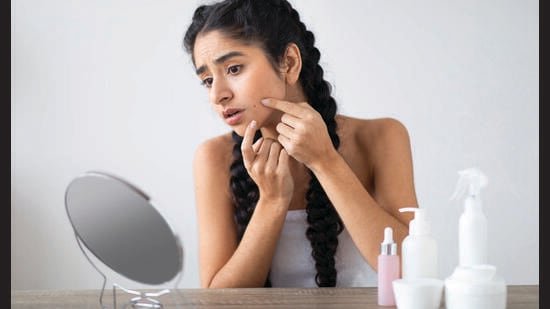
All you need to do to feel worse about yourself right now is to stroll down the beauty aisle. Among the new drops is a roll-on to get rid of “extreme pigmentation” specifically on your bum and thigh. There’s another new advanced serum to reshape and firm up the bosom. Hair trimmers come with targeted lights to catch fine strands that the human eye can’t see and didn’t know existed in the first place. There’s a special acid that promises to lighten armpits and reduce sweat odour (something to do with pores and dead cells, as usual). And there are, at any given time, 20 patented molecules that target chin discolouration, ageing hands, bumpy arms and short eyelashes. Order now and they’re throwing in a freebie: A tube of insecurity.
How far we’ve come! Our parents’ generation worried about looking 10X fairer. Our worries go beyond skin tone, and there’s a handy little potion for every problem. Brands are feeding us the science, and we’re lapping it up and treating ourselves like lab animals. AHA is different from BHA and PHA? Got it. Curly hair comes in 3A, 2B and other coil patterns, not just wavy and more wavy? Got it. Retinol should go over moisturiser AND under it? Got it. Vitamin C should be applied at night and if it goes bad it makes you darker, not lighter? Sigh. Got it.
“These days, the concept of care has become about choosing the right rituals and products,” says Chetna Chakravarthy, a relationship coach. If you’re not obsessed with your skin, it’s seen almost as an act of neglect. Why do you have dark underarms when there’s an acid-based product for it? Why are your eyes crinkling up when there’s a cream specially designed to eliminate that sign of being human? Why haven’t you booked a microneedling or microblading session yet when the Before and After videos have already popped up on your feed? And have you checked your face in the new white-light 5X magnifying mirror? it displays in HD, all the problems that were invisible to you and the world thus far.
Beauty has always made the most of human insecurities and self-loathing. What’s different now is how specific the problems are and how tailor-made the solutions claim to be. There’s a dedicated cream for the elbow and knee, another one for feet, a separate one for hands and nails, a different one for the face, and a different one for body acne. None of these are the right one to use after you shave your legs, though. There’s a separate one for that.
In the beauty-industry fantasy, everyone looks like they were manufactured in a Mattel factory. No pores, no breakouts. Those arm bumps are strawberry skin – resolved with an enzyme scrub. The bumps on your face that never graduate to a pimple are closed comedones and need daily chemical exfoliation so they never develop in the first place. The dark edges on your lips? They haven’t found a “cure” but you should use a lip scrub, anyway.
Skincare is even taking over make-up’s jobs: Mascara isn’t enough; there are lash and brow growth serums to buy. There are moisturisers that fill pores just like a primer would. Everything has SPF, offering coverage, but never enough to do any actual sun protection. There’s even micellar in your shampoo, and anti-ageing wonder ingredients in your concealer.
It’s all curated paranoia, with one common goal: So you can look at yourself and see not a fully formed human, but a perpetual work in progress. You have to be a problem, because how else will a brand get rich by selling you a solution? Take any skincare or haircare quiz. Notice how none of the answers say that your skin and hair are just fine? Every one of us is somehow lacking, all the time.
Besides, what the beauty industry calls concerns, the medical fraternity terms as normal. It’s all right for arms to be bumpy, for armpits to be dark, for lashes to be short, for your upper lip to be darker than your lower one. No doctor believes that dyeing greys, extending lashes or moisturising elbows solves any real medical problem. It might actually weaken the job that skin does for the body.
Dr Geetika Srivastava, dermatologist, is probably holding your hand as she says this: “Your skin’s purpose is to act as a barrier against the environment. Your focus should be healthy skin that prevents reactions and sensitivity.” Most of us only need a moisturiser; a high SPF sunscreen, and a face cleanser that is not loaded with unnecessary acids and active ingredients. For problems such as acne, get a doctor to examine you and suggest a remedy.
Sure, be presentable for yourself and for the world. But don’t let a bum cream come in the way of you and your self-worth. Don’t obsess over a 3% TXA serum for pigmentation that no one else but you has noticed. Don’t believe that a ₹8,999 serum will fix your problems just because it’s endorsed by Japanese monks you’ve never met.
Here’s a small tip to stay grounded in reality: For every skincare flaw that’s made obvious to you, keep a mental note of every feature you also appreciate. “Most people don’t want drastic changes in how they look; they want to improve on the little things,” Chakravarthy says. “Write down what you want to change about yourself, and see what can be practically changed. Every time you pass a mirror, compliment yourself. Daily habits help build a shield against criticisms and expectations. It helps with your confidence.”
From HT Brunch, April 25, 2026
Follow us on www.instagram.com/htbrunch
