

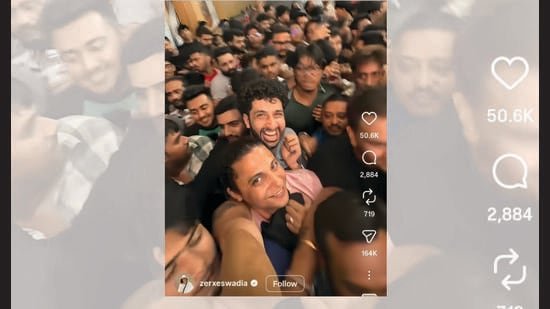
It doesn’t matter if you’re not into watches. It doesn’t matter if you’ve never even worn a wristwatch. You can’t have missed the Audemars Piguet x Swatch drama unfolding on your socials over the weekend. Because, like the Indian influencers at Cannes, the algorithm made sure you saw it.
The TL;DR: Big-ticket collab between luxe AP and more affordable Swatch. New Royal Pop (the colourful $400 rendition of AP’s $25,000-on-the-waitlist Royal Oak design) drops at Swatch stores. Reels of people camping out at NYC Swatch stores even four days ahead, long queues at stores in cities that have civic sense, crowds everywhere else. And then what? Videos of people pushing barricades to enter (to buy a watch), angry hordes chanting to be let in (to buy a watch), stores cancelling the launch, citing public-safety concerns (over buying a watch) and spokespersons announcing that the watches aren’t so limited-edition after all, that they’d remain available for months, so don’t rush.
It’s a bad look for both the brands in the collaboration. MBA students around the world are gleefully adding the case-study to their branding/marketing strategy decks. But zoom out for a bit. The watch market is tanking globally. We’re all looking to our phone screens for the time and the alarm clock. School kids can’t even tell the time from the hands of the clock. Why was everyone so happy to queue up, crowd and share that experience online?
Lifestyle influencer and investment banker Rizwan Bachav was tracking the collab days before the launch. He knew there would be crowds. Not because waiting in line for a product drop is a status symbol. But because “participating in the frenzy makes them feel part of something exclusive or culturally important, even if they are not particularly fans of the brand”. It’s why young people line up for newly launched iPhone 17 Pro Max, Air Jordan 1 Retro High ‘85 OG ‘Bred / Banned’ sneakers, and other hyped-up products.
Boomers will cringe. They’ve lived through an era when food was scarce, and people queued up at ration shops for rice, oil and sugar because subsidised staples were all they could afford. Millennials will remember dragging their parents to bookstores at midnight because every kid wanted to read the new Harry Potter book the day it came out (not because the book was limited edition). But at a time when anything can be ordered online, waiting to buy a thing in person is the experience to chase. No ration card needed.
Bachav says that launch/drop queuing used to foster a sense of community. You found your tribe as everyone queued up for that one thing the rest of the world didn’t care about. “I would never queue up to buy something, though,” he says. “Maybe for a restaurant that does not have a reservation system, but never for a product.”
Besides, brands have found ways to turn your experience into their marketing content. “Videos of this sort perform extremely well online through shares, comments, and visibility,” Bachav says. “Being seen at a launch, cameras everywhere, a chance to go viral, is often more important than owning the product.” Brands welcome it – crowds generate content, which generates publicity, which generates hype. And it sets the playbook for the industry. “The AP x Swatch launch showcased how powerful hype can be in making a brand culturally relevant and globally talked about almost instantly,” says Vibhuti Munjal, manager of marketing and product at L’Occitane India. “The key is to ensure that the energy around the launch feels curated, enhancing the brand’s exclusivity while bringing luxury into regular conversation.” The collab did that well. You, who may not even buy a watch this year, knew about the launch.
As for the brand, their store-only launch minimised one retail problem: Resellers who bulk-buy items online, hoard, create scarcity and sell their stock for a huge profit. Sure, many of the people in the queue around the world were probably resellers and their agents, but that’s still a crowd, in videos that’s it’s still hype.
Hate on the hype machine and the queues, by all means, says Bachav. But “what happened shows how participation in the frenzy has, for many people, become more important than ownership.” You’re no closer to buying a watch, but you recognise it now. The brands are happy. “Very few industries today can create this level of global conversation overnight around a watch launch.”
From HT Brunch, May 23, 2026
Follow us on www.instagram.com/htbrunch
