

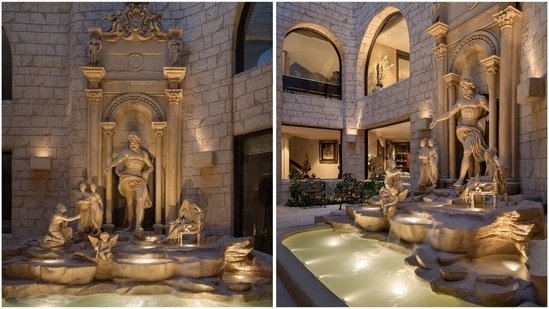
Like many of the most compelling architectural works of the early twenty-first century, Fonte D’Amore does not announce its significance through monumental scale or spectacle. Instead, this intimate 60-square-metre courtyard, delicately carved into the heart of a Delhi residence, reveals how a thoughtful interplay of memory, structural logic and digital craftsmanship can elevate the everyday into something quietly extraordinary.
Also Read | Step inside a unique tree-shaped office in Delhi inspired by Himalayas and Ganga with a waterfall inside
Designed by Manish Gulati, principal architect at M:OFA Studio, Fonte D’Amore – or the “Fountain of Love” – was conceived as an intimate wedding gift from a husband to his wife. Drawing inspiration from the memory of a proposal at Rome’s iconic Trevi Fountain, half a decade earlier, and the couple’s many conversations about the works of Antoni Gaudí in Barcelona, the project reimagines an unused courtyard into a poetic and enduring tribute to their shared travels.
Manish Gulati transforms memory into a spatial monument that bridges the grandeur of the Italian Renaissance with the garden-home legacy of Lutyens’ Delhi. Rather than replicating the Roman edifice within the compact 60-square-metre courtyard, the architect distilled its emotional essence into an immersive and deeply personal retreat, using AI-powered mood boards to craft a surreal, climate-responsive escape.
Where Renaissance grandeur meets the fluid language of Gaudí’s architecture
At ground level, Fonte D’Amore’s plan retains a sense of classical symmetry, while sculpted stone walls rise and unfurl into a cloud-like canopy, merging the disciplined geometry of Renaissance architecture with the fluid, organic language associated with Antoni Gaudí. In an interview with HT Lifestyle, Manish Gulati shared, “The client’s lone, consistent request was the sound of a fountain and a sculptural milieu ‘that feels Renaissance’.” At the heart of the courtyard stands a dramatic fountain installation anchored by Baroque-style sculptures of Roman deities, led by Oceanus, evoking the theatrical grandeur of classical Renaissance architecture.
The architect explained, “At the ground level, symmetry prevails, an ode to Renaissance sensibilities. But as the structure rises through three levels, it dissolves into expressive, cloud-like geometry. Where the base registers tall Renaissance arches, the upper tiers warp into catenary curves, creating a dreamlike transition reminiscent of Dali’s worlds melting into one another. The transformation is seamless: stone surfaces twist and arc, forming a sculptural envelope that visually connects each floor of the home.”
Alcoved balconies overlook the courtyard, while carved apertures in the ceiling – strategically positioned oculi – allow daylight to filter through in shifting patterns, casting a dynamic play of light and shadow across the sculpted stone walls. Jasmine creepers trail along tiered green walls, while layered planters spill across the ground level, intermediate terraces and rooftop trays, superimposing the cold stone surfaces with the softness of life. A meditative retreat, the space replaces the city’s noise and chaos with the soothing rhythm of flowing water, birdsong and soft glow of shifting natural light.
How is the structure climate responsive?
Given the searing intensity of Delhi’s summers, the courtyard uses layers of passive strategies to keep the place cool without mechanical interventions. Manish explains, “The four oculi in the dome act as wind catchers, drawing in the breeze. The stone fountain offers more than a mere allusion to the Trevi; its mist facilitates evaporative cooling, reducing the perceived temperature by some six to eight degrees Celsius. The tiered planting further reinforces this, while softening the tactile presence of the stone surfaces. Passive strategies like stack ventilation, evaporative cooling, and strategic landscaping are not merely functional ‘add-ons’, but are woven into the very formal and experiential fabric of the design.”
The design process and the use of AI
Elaborating on the design process, Manish noted, “For some reason, AI and craft are generally pitted against each other. For Fonte d’Amore, we opted for a continuous conversation between the two instead – an evolving process in which AI served as a means to efficiently explore iterations and a framework for the craft.” The project relied on AI-generated mood boards that reimagined the Trevi Fountain within a surrealist Catalan-inspired landscape. Through more than 200 iterative interactions between art, architecture and context, AI enabled the studio to test and refine ideas at a speed and scale that traditional hand sketching alone could not have achieved.
The architect recalled, “The architectural backdrop was forged through an intensive iterative process. Stone surfaces underwent more than 25 refinements via AI exploration and computational modelling to achieve the ideal aesthetic proportion, a balanced interplay of light and shade, and a functional harmony between privacy and visibility. These digital iterations informed 3D-milled formwork, providing the structural logic for the hand-crafted stone elements.”
“In parallel, the sculptures and fountain – integrated as bespoke ‘Art Inserts’ – followed a rigorous ‘phygital’ pipeline. AI-generated compositions were first realised as 3D-printed miniatures before being scaled up into life-size clay prototypes. These physical models were 3D-scanned back into the digital environment for precision refinement, creating a continuous feedback loop between the digital model and the physical mock-up,” Manish continued.
Shersingh, a Delhi-based artisan belonging to a distinguished lineage of visual artists, drew formal cues from the AI-generated concepts, allowing them to guide and inform his craft. Translating each composition by hand, he meticulously carved the final forms in stone, infusing the digitally conceived ideas with the integrity of human touch. This constant dialogue between algorithm and artisan ultimately produced what Manish describes as a fluid creative system, resulting in forms that neither could have achieved independently. “Using the aid of AI in analytical reasoning, material selection, and optimising structural systems, the entire project was completed within six months. Without AI and computational technologies, the same process might have needed at least 24 months,” he concluded.
