

When players tell Priya Goswami they find her game exhausting, “it makes me oddly happy,” she says. “That’s exactly what I’m aiming for.”
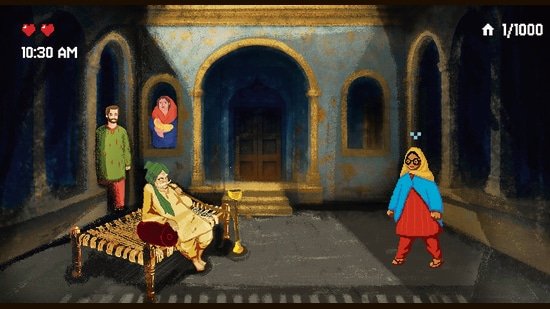
Super Asha, about a day in the life of an Indian health worker, seems like a game of choice at first. It soon becomes clear the choices are often just dilemmas, and they come in an endless stream.
Players start by making their way through what is a typical morning for the fictitious health worker named Asha. She wakes at 5 am and rushes through chores and chaotic traffic to make it in time for her first house visit.
Such workers typically manage 700 to 1,000 households each, so there is plenty to do on an average day. As government intermediaries, they must track vaccination schedules and maternal and child health, flag issues with nutrition, healthcare or sanitation, and occasionally administer first-aid.
It is rarely as simple as it sounds. At her first house, Asha may find, for instance, that the women won’t talk with men or elders in the room. Ask the elders too many questions and they may not invite you back into the home.
Say the others step away and the woman can finally speak freely, does one ask her about the infant girl she recently, mysteriously, lost? What information should one upload to the government portal, given that everything one logs could have implications for her future care, and the future of her family?
The videogame was created by Goswami, supported by artists, Basim and Ranjitha Rajeevan, and a team of eight others, as part of an 18-month Mozilla Foundation fellowship (her chosen subject was digital public infrastructure). It is inspired by real accounts drawn from the lives of workers operating under the Accredited Social Health Activist or ASHA scheme, launched by the Government of India in 2005.
If every conversation in the game feels exhausting, that is by design. The creeping sense of helplessness is what most ASHA workers talked about, Goswami says. “So this is what we wanted players to sit with.”
Super Asha was released at the ACM Conference on Fairness, Accountability, and Transparency (ACM FAccT) in Athens a year ago, as part of a multimedia exhibition by Goswami featuring stories from 56 ASHA workers and daily wage labourers.
The 38-year-old researcher and filmmaker has previously won a National Award for her documentary A Pinch of Skin (2013), on female genital mutilation in India. In 2019, she co-founded Mumkin. The free AI-based app aims to facilitate conversations around gender, culture and society, by letting users role-play with avatars that pose as a loved one, to help them navigate discussions about issues such as FGM.
Back in the game, Asha continues to struggle. What will it take to convince a hesitant family to immunise a newborn? How does one respond when a woman in the midst of high-risk pregnancy is told by her family that she should not seek hospital care? Conversely, what can one say to a household that has discovered their data doesn’t stop at you, and you don’t really know where it may end up?
“What happens when care labour extends to data labour, without consent or the ability to opt out? That’s one of the questions that intrigued me,” Goswami says.
She was collating stories of women farmers in drought-prone regions when the idea for Super Asha was born out of her ground research. The farmers will form the heart of her next project.
Super Asha, meanwhile, is in the midst of an upgrade. The five-level game with a runtime of about 15 minutes is being rereleased with three more levels. Here, players can discover how their choices from the previous rounds shaped the lives of the people they were trying to help.
