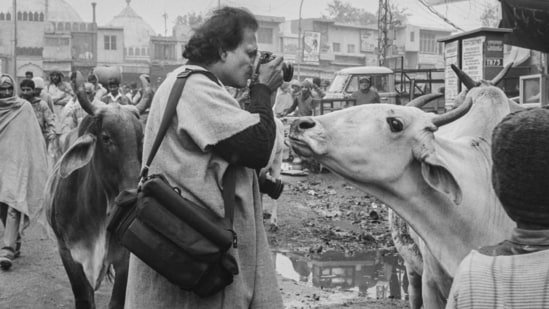
It was hard to walk down a street with Raghu Rai. One friend estimated that, in a ten-minute trot to tea, he had stopped at least 100 times. He had seen what others did not see. A shadow on a wall that dramatised a woman passing, and the way her sari fell. Three sleeping dogs composing the centre of a terrace. Two commuters at a railway station standing stock still, reading their newspapers, while the crowd surged past them. Two old men walking in opposite directions, one a well-suited businessman, the other a bent, ragged beggar. This was seeing that did not miss an inch of space; seeing, or darshan, that recognised the connection between all things. Through his camera he met his god.
Renowned photographer Raghu Rai while taking photographs on a winter morning near the Fatehpuri Mosque in Old Delhi, January 11, 1992 (PTI)
Out in the fields he could spend hours too, enjoying the elegance of humped Zebu cattle and the texture of churned-up soil. He haunted Mughal ruins and the modern flats they sat beside. He celebrated the magnificent rivers. Avidly he kept an eye on the weather to catch changing light, gathering clouds and beautiful downpours of rain. It was in rural Haryana that this had all begun, when he was struck by the way light fell on a donkey foal in a field. At the time he was a civil engineer, like his father. Wielding his brother’s camera he chased after the donkey until it tired, and stopped to face him. He took the shot; the Times in London published it. His instinct had told him to grasp a moment, and that was the end of civil engineering.
India in every aspect was his canvas, but it was the people who enchanted him. Throughout his more than 18 books of photo essays, there was barely a frame that did not show their intensity and energy. He was not an intrusive photographer. Only one camera, usually his faithful Nikon Z8 with a zoom lens, hung round his neck, and he carried no bags. His movements were leisurely. Over the years he had learned patience. Mud-sculptors making goddesses, near-naked wrestlers relaxing under Kolkata’s Howrah bridge, the boy splashing paint and running off laughing, mourning women raising their arms, did not try to pose for him, and he did not want that. Humbly he preferred to merge with his people, a part of the beating whole, seeing them with a pure and unsentimental eye that was led not by his mind, but by his heart.
Only an Indian could do this, someone who understood from the inside his country’s many layers. He could have been a photographer of the world, but when he was invited to join the Magnum agency in 1972—on the recommendation of Henri Cartier-Bresson, no less, who had seen his work at an exhibition in Paris—it took him five years to reply. Meanwhile he went to work for various Delhi-based magazines, especially India Today, where he stayed for a decade, showing India to itself.
He became famous though, outside India as well as in, for chronicling two of its worst moments: the Bangladeshi war of independence in 1971, followed by the plight of its unsuccoured refugees; and the explosion in December 1984 of a Union Carbide pesticide factory at Bhopal, in Madhya Pradesh. He was ordered by his editor at India Today to catch the first flight from Delhi and arrived, bleary, to find a war zone. Eight thousand people had died at once from inhaling toxic gas; 12,000 more were dying slowly all around him. His own feelings were close to suffocation. He did not know how to record something as huge as this; too much lay outside the frame. Yet he had a responsibility to do so, for photography alone could pick up the truth and ensure it lived for ever.
He captured what he could: the bodies of children lined up in rows, with funeral pyres burning behind them; the blinded sitting on walls, pressing rags to their eyes; mist, or maybe smoke, hovering among the huts and palms. Nothing satisfied him, for no single image could encapsulate the tragedy. Then, at one death-site, he saw a man brushing earth away from the small face of a child who had just been buried. The swollen eyes were open, staring. Mud and gravel framed the face. The touch of the hand was tender. This became the image of Bhopal that went round the world.
To catch that one moment of revelation was already his mission. For photo-shoots of celebrities he insisted on continuing until he found it: until the actress Aparna Sen laid her head on the table in mock frustration, or the actor Satyajit Ray, still smoking his pipe, suddenly twisted round to gainsay him; or until his favourite tabla-player, Zakir Hussain, entered a trance of silence. With the very famous he did the same. He caught tiny Mother Teresa slowly negotiating stairs, her sari filled with light; his friend the Dalai Lama, with an untroubled smile, taking a screwdriver to his TV; Indira Gandhi, in a moment of anxiety, contorting her face with her hands. An evening visit to a friend’s house produced one of his favourite images, achieved only when he turned to look one last time: a view of the whole of Delhi, spread out under a darkening sky, with at its heart a small lit room in which a woman prayed.
Though his relations with Indira Gandhi, over many years, were warm, in his photo essays he held India’s government firmly to account. Several times in the 1990s and 2000s he went back to Bhopal, returning with images of wasted survivors, still living near the toxic site, struggling to see and breathe. He chastised India for failing to protect wildlife and the environment. His motivation was simple love for his country, a place where everything was possible but, because of its inherent chaos, nothing was.
His favourite city was Varanasi, the shining one, where the Ganges was revered and the dead were burned. Here he found subjects on every ghat and lane. A priest carefully carrying through crowds a small metal pot of Ganga water; young women offering marigolds; the wondrous glowing sun rising over the boats. Varanasi was the physical form of dharma, the dutiful acceptance of the flow of spirit and life. Most pilgrims found it by bathing in, or drinking from, the great mother-river. He found it by simply walking there with a camera in his hand.
सिद्धभूमि के लेखक एक प्रमुख समाचार लेखक हैं, जिन्होंने समाज और राजनीति के महत्वपूर्ण मुद्दों पर गहरी जानकारी और विश्लेषण प्रदान किया है। उनकी लेखनी न केवल तथ्यात्मक होती है, बल्कि समाज की जटिलताओं को समझने और उजागर करने की क्षमता रखती है। उनके लेखों में तात्कालिक घटनाओं के विस्तृत विश्लेषण और विचारशील दृष्टिकोण की झलक मिलती है, जो पाठकों को समाज के विभिन्न पहलुओं पर सोचने के लिए प्रेरित करते हैं।
एक ऐसे समय में जब प्रिंट एवं मुद्रण अपनी प्रारंभिक अवस्था में था ,समाचार पत्र अपने संसाधनो के बूते निकाल पाना बेहद दुष्कर कार्य था ,लेकिन इसे चुनौती के रूप में स्वीकार करते हुए स्वर्गीय श्री शयाम सुन्दर मिश्र “प्रान ” ने 12 मार्च 1978 को पडरौना (कुशीनगर ) उत्तर प्रदेश से सिद्ध भूमि हिंदी साप्ताहिक का प्रकाशन आरम्भ किया | स्वर्गीय श्री शयाम सुन्दर मिश्र “प्रान ” सीमित साधनों व अभावों के बीच पत्रकारिता को मिशन के रूप में लेकर चलने वाले पत्रकार थे । उनका मानना था कि पत्रकारिता राष्ट्रीय लोक चेतना को उद्वीप्त करने का सबसे सशक्त माध्यम है । इसके द्वारा ही जनपक्षीय सरोकारो को जिन्दा रखा जा सकता है । किसी भी संस्था के लिए चार दशक से अधिक का सफ़र कम नही है ,सिद्ध भूमि ने इस लम्बी यात्रा में जनपक्षीय सरोकारो को जिन्दा रखते हुए कर्मपथ पर अपने कदम बढ़ाएं हैं और भविष्य के लिए भी नयी आशाएं और उम्मीदें जगाई हैं । ऑनलाइन माध्यम की उपयोगिता को समझते हुए सिद्ध भूमि न्यूज़ पोर्टल की शुरुवात जुलाई 2013 में किया गया |
हमसे संपर्क करने और जुड़ने के लिए मेल करें -
siddhbhoomi@gmail.com
Subscribe to Updates
Get the latest creative news from FooBar about art, design and business.