

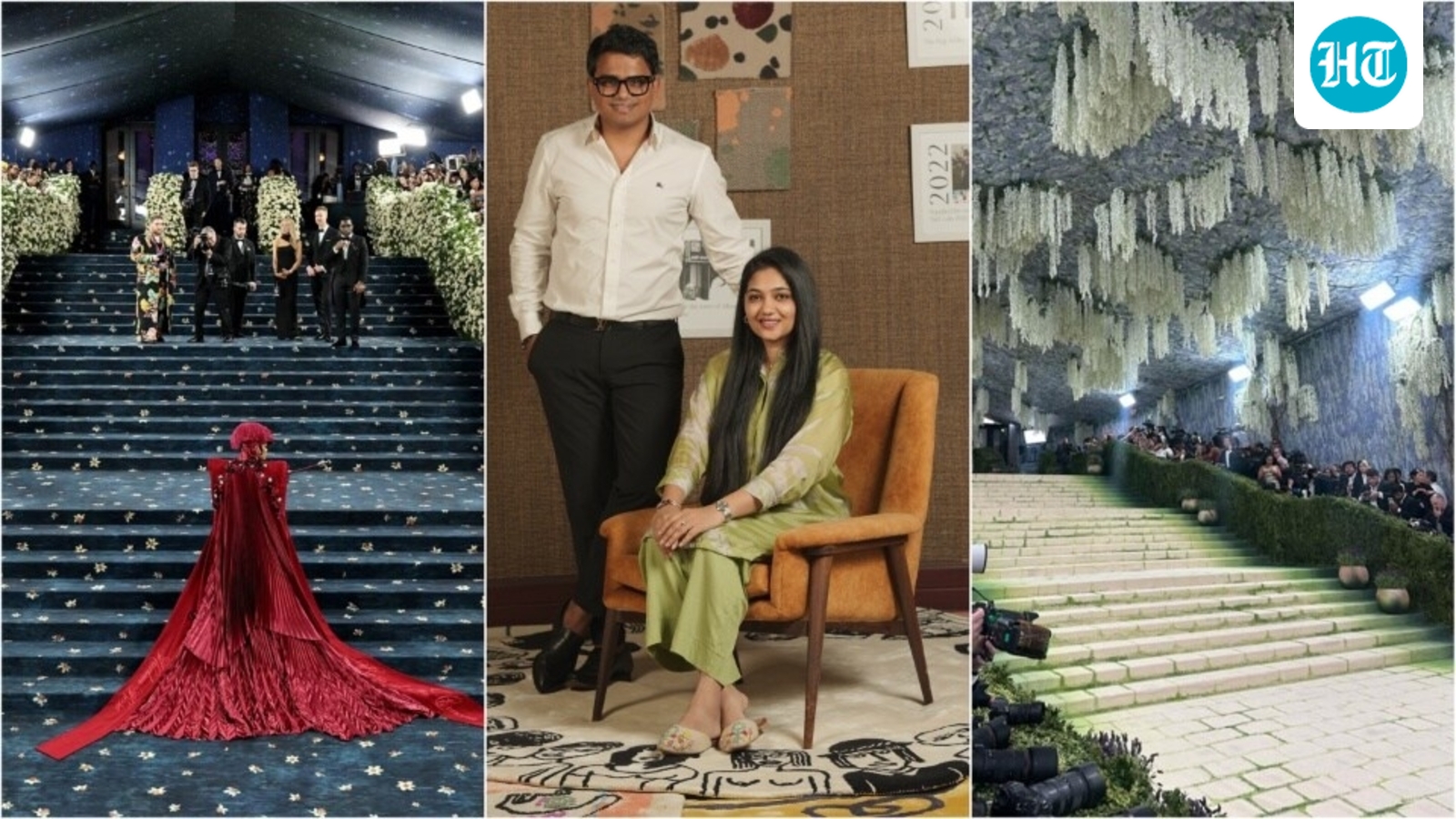
If you watched the Met Gala at any point in the last four years, you saw their work. Beneath the iconic looks — every custom gown, every meme-worthy train, every Rihanna umbrella moment — was a massive, flawless carpet. It wasn’t made in Milan or Jaipur. It was made in Cherthala, Kerala. Also read | Did you know the dreamlike ‘made in India’ Met Gala 2026 carpet was created in Kerala by 500 artisans in 90 days?
In a solar-powered factory surrounded by coconut trees and a two-million-litre fish pond, Neytt co-founders — husband-and-wife duo Sivan Santhosh and Nimisha Srinivas — turned a 100-year-old family mat business into the brand that holds up fashion’s biggest night.
The story starts way before Neytt
Sivan is a fourth-generation heir to Extraweave — a company his great-grandfather started in 1917 to make coir mats. For decades, Extraweave was that classic Indian textile story: world-class craft, anonymous export. India makes almost 40 percent of the world’s handmade carpets, but most of them leave the country in bulk and end up with a fancy European label sewn on. That’s exactly what was happening in Cherthala.
“For over a hundred years, our family had been making beautiful rugs and carpets that travelled across the world, but always under someone else’s name,” Nimisha, who is the creative director of Neytt told Hindustan Times, adding, “We were creating at the backend, fulfilling another brand’s vision, while the story of our craft was being told through someone else’s voice.”
Sivan actually tried to escape the loom at first. He was a software developer at BNY Mellon in the US. When he came back, he spent two and a half years working on the factory floor — every department — and it hit him. He shared, “Our name was never on it. Why should we keep on doing good, making these beautiful products for others when we ourselves can start a brand of our own?”
So he did the most extra thing possible to prepare. At 26, while working full-time, he took the GMAT three times, got a President’s Merit Scholarship, and did his MBA at Babson College. His inspiration? Shoe Dog by Phil Knight, The Luxury Strategy,Start with Why, and Jiro Dreams of Sushi. Not business textbooks. Obsession stories.
Launched their luxury brand with literally one rug
Nimisha brought the other half of the brain. She has a bachelor’s in mass communication, a master’s in broadcast communication, two years in advertising, and a certification in digital media communication and strategy from Harvard, which she did while living in Boston and teaching art to kids part-time.
So when they launched Neytt in late 2021, they didn’t do what every other brand does — print a 100-page catalogue and pray. They went to a major design show in Delhi with one rug. “I still remember how vulnerable that felt — we were surrounded by brands displaying entire catalogues, while we stood there with a single piece,” Nimisha said. “It may have looked reckless, but for Sivan and me, it was a very conscious decision. We did not want Neytt to be seen simply as another manufacturer showcasing its range,” she added.
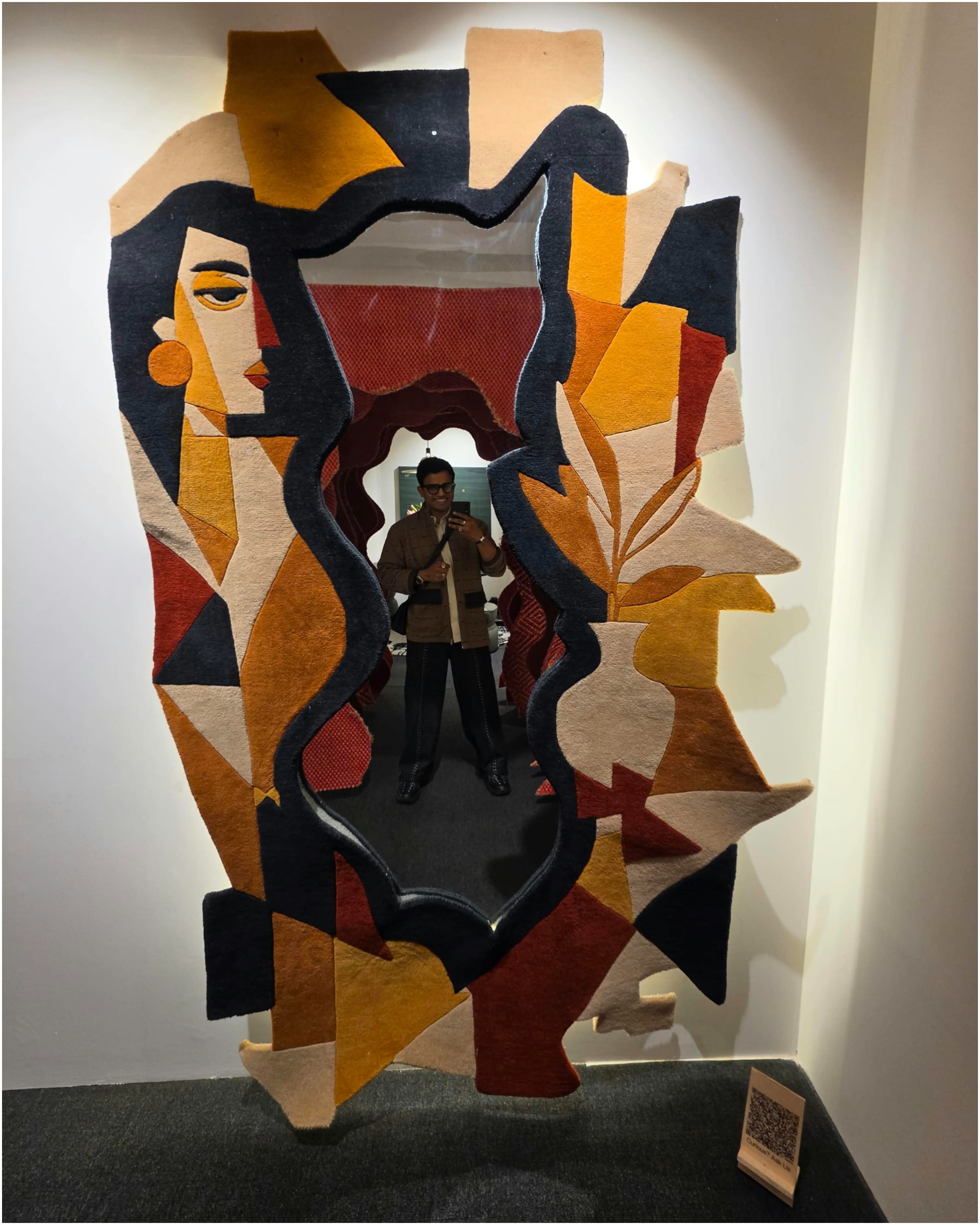
That one rug? It was about the Kerala floods of 2018 and 2019. Sivan still remembers the details: “We used, other than sisal, the actual silver-coated Kasavu yarn for the first time. That was the first innovation we did. We had this gold-kara design going on, inspired by what men and women wear in Kerala for festivities — the saree. Then we have smaller fishing boats in the rug design, showcasing how the fishermen helped in the rescue efforts… and a smaller human chain, showing how people joined hands together.”
It was grief, resilience, and unity — woven. And it worked. That single rug got nominated for the Elle Deco International Design Award, and people got it instantly — Neytt wasn’t a manufacturer, it was a design house.
The biggest flex? Being a south Indian luxury brand
But there was the perception problem they had to break. Sivan explained that when the world thinks ‘Indian luxury rugs’, it thinks Rajasthan, UP, Kashmir, Agra. Nobody thinks Kerala. South India has unique textile heritage, but it was never allowed to be ‘luxury’ on the global stage.
“Being a south Indian brand, I think the biggest challenge was probably perception. We were not coming from one of the traditional centres associated with luxury rugs. We had to prove that a contemporary luxury brand could come from South India and compete globally,” Sivan said.
Nimisha’s approach was to stop copying north India or Europe and start translating what she actually grew up seeing — but abstractly. Her references aren’t literal elephants and paisleys. They’re the rhythm of vallamkali, the snake boat races — not the boat itself, but the feeling of 100 people moving as one. The geometry of the aranmula kannadi, those mysterious metal mirrors made only in Kerala. The gold kasavu border from Kerala sarees. The raw texture of Alleppey coir.
“For me, it always begins with understanding what a cultural reference makes me feel, rather than simply reproducing how it looks,” she said, adding, “My personal test is that someone from Kerala should feel a sense of recognition, while someone who has never been here should still feel emotionally connected to the piece.”
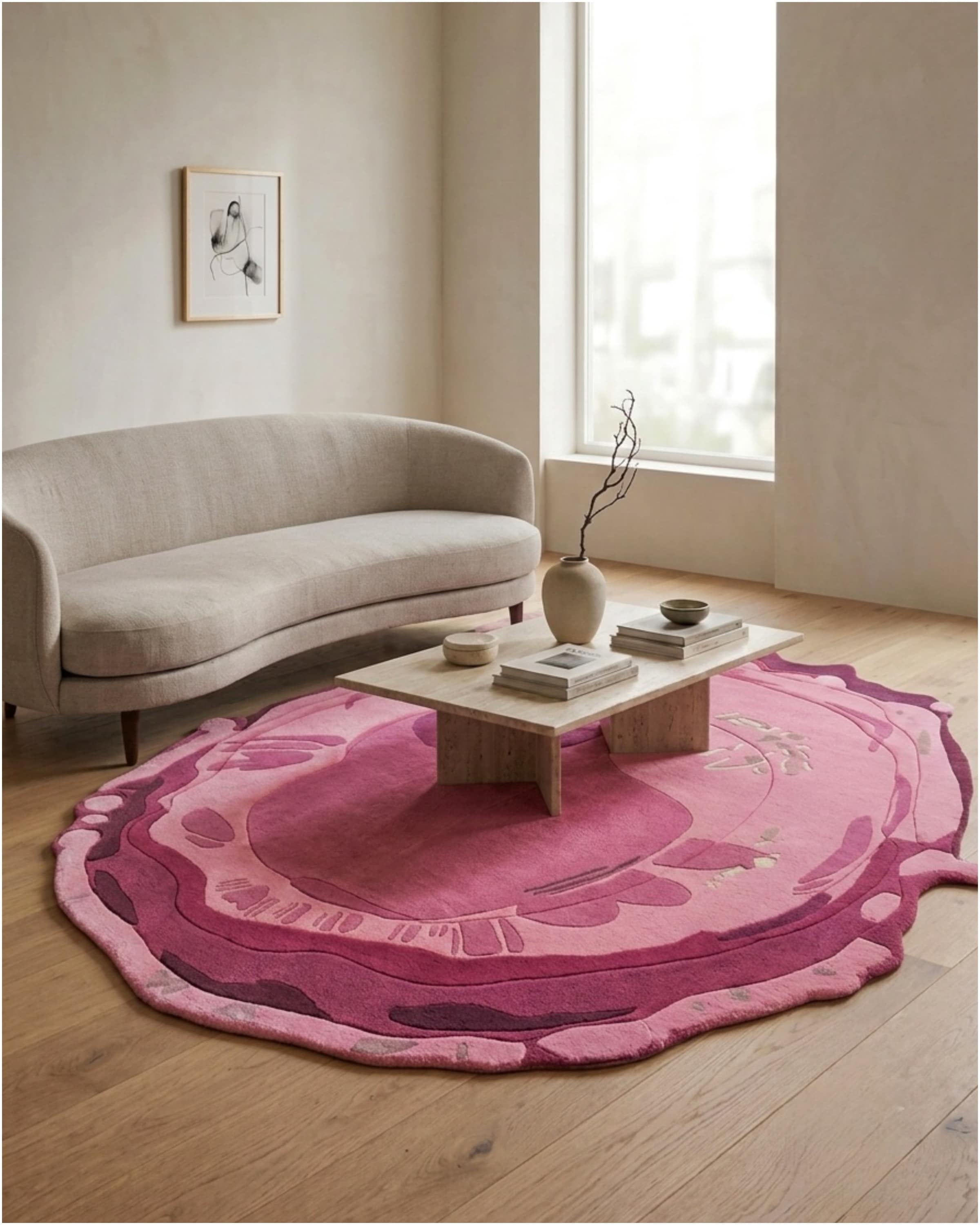
And now they’re going full pan-India. They shared that Neytt works with artisan clusters across the country to create a new material language: sisal and jute from the south, woven with metallic kasavu yarns, eri silk, the ethical ‘peace silk’ from the Northeast that is handspun and naturally dyed, banana and hemp and water hyacinth — super durable, super textural fibres from Kerala’s backwaters that luxury had ignored until now. “We are deep in indigenous fibres that the luxury world has not taken seriously yet, and that is precisely why they interest us,” Nimisha said.
The Met Gala plot twist they didn’t see coming
So how did a brand from Cherthala end up carpeting the Met Gala for four years straight? It started as a secret project. “A long-term customer reached out to us and they had a special project for which we had to make a carpet,” Sivan recalled. “We didn’t know who it was for or what it was for. All we knew was we had to put in our best work. After a lot of iterations, a lot of pilot errors — it had to go back to the loom, we failed several times — we finally managed to get the approval. And only after which we came to know that this is for the Met Gala,” he added.
Imagine failing repeatedly and then finding out it’s for the most photographed red carpet on Earth. The Met Gala carpet is not your average living room rug. It’s an engineering challenge. Think 90 days of non-stop production, 500+ workers across a dozen specialised departments, hand-sorting every raw fibre before it even touches the loom, multi-stage inspections at every step. After all, the carpet has to survive thousands of heels, heavy lighting rigs, rain, and 4K close-ups without wrinkling, without stealing focus from the clothes.
“Aesthetically, the challenge is knowing when to exercise restraint,” Nimisha said. “The carpet has to create a flawless foundation for the entire event without competing with the fashion and personalities above it,” she added.
The payoff was huge. “Met Gala gave us visibility that would have taken years to build ourselves. But I think the bigger impact was credibility. Suddenly people who had never heard of us wanted to know who we are, where the carpet was made, what else we were doing,” Sivan said.
But his favourite moment wasn’t in New York. It was back in Kerala: “Initially they didn’t know the scale. But when it came out in the newspaper, the workers came to know what kind of scale it is. They were extremely happy, extremely proud. I still remember a worker who walked up to me and he said, ‘My family knows now what exactly I do.’ That kind of pride he had gave us goosebumps.”
Their factory is sustainable because it has to be, not because it’s trendy
In 2026, every luxury brand seems to have a sustainability page. But it looks like Neytt has a sustainability infrastructure. Their Cherthala facility, they shared, is a closed-loop system that was built long before ‘eco’ became a marketing buzzword. 100 percent solar-powered daily operations. 100 percent of dye water recycled through their own effluent treatment plant. Rainwater harvesting — all roof runoff goes into a 2-million-litre pond with 5,000+ fish, which is then used for gardening and dye house prep. No single-use plastic on campus. Carpooling is tied to employee salary KPIs.
“Honestly, we did not arrive at it as a strategy,” Nimisha said. “Working with natural fibre demands respect for the material, and that discipline has been in this family for generations. Solar and water recycling were investments with a long payback, not a campaign. For the global buyer, sustainability has stopped being a differentiator and become the entry ticket. They now ask where it was made, who made it, and what it is made of before they ask the price. The expensive path is the one where you have to retrofit your answers. We simply never had to,” she added.
What are they doing next?
India’s textile export industry is aiming for $100 billion by 2030, and Sivan and Nimisha are loud about what needs to change: India needs to stop being the world’s anonymous factory and start being the world’s brand.
Neytt is proof it can happen. They’ve got a major pan-Indian collaboration with a prominent fashion designer coming in early 2026, and they’re deep into new fibres from the northeast and north India.
And what about AI and design? Sivan is pragmatic: “AI can be used to our advantage, for easy rendering and all of those aspects. But when it comes to design, we always go the human way. I think a lot of originality comes when we design it organically, take a lot of time to bring in the story.”
Their advice to young Indian designers?
“The biggest lesson I have learnt through building Neytt is not to treat where you come from as something you need to overcome,” Nimisha said, adding, “We often look outward and believe that creating a global luxury brand means making something that feels European or international. But in our experience, the more confidently we embraced our roots, the more interested the world became in our work.”
Sivan puts it more simply: “If a brand from a small corner of Kerala can reach a global stage, anybody can. You just have to keep on working hard. It’s all about executing the idea fast, failing fast, learning from the failures, and keep on moving forward.”
