

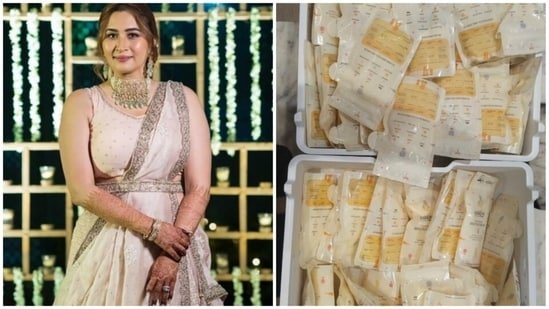
Badminton champion and Olympian Jwala Gutta has taken to X to share a deeply personal and impactful journey from her first year of motherhood. On May 14, Jwala revealed that she had donated approximately 60 litres of breast milk to government hospitals in Hyderabad and Chennai, highlighting a critical need in neonatal care. Also read | Neonatal intensive care unit: Here’s when babies need it, how it helps premature babies
A vital bridge for survival
Jwala Gutta and her husband, actor Vishnu Vishal, welcomed their daughter in April 2025. After a year of postpartum life, the athlete has spoken about donating breast milk to encourage other mothers to consider it. Sharing two photographs on X, Jwala showcased dozens of neatly organised storage bags filled with breast milk. In her detailed post, she explained the profound impact that even a small amount of donor milk can have on a struggling infant.
“I donated around 60 litres of breast milk to the government hospital in Hyderabad and Chennai during my first year of postpartum!!” she wrote. “Why does it matter? Just 100ml of donor milk can feed a tiny 1 kg baby for several days. This donation could potentially support dozens of infants in the NICU (Neonatal Intensive Care Unit)” Jwala added.
The images shared by Jwala provide a glimpse into the scale of her effort. One photo showed several rows of breast milk storage bags lined up on a desk, each meticulously labelled with dates and times. A second photo displayed two large freezer bins packed to the brim with frozen milk pouches, ready for transport to hospital milk banks. Also read | Jwala Gutta on motherhood, keeping her off social media and raising a strong girl
Why donor milk matters
Jwala shared that many babies in the NICU do not have immediate access to their own mother’s milk due to medical complications, stress, or premature birth. “Donor milk acts as a vital bridge, providing immunity and nutrition during those critical first days,” she said, adding, “Donor human milk is proven to significantly reduce the incidence of necrotising enterocolitis (a life-threatening gut condition) in premature infants!!! Check your local govt hospital to see how you can help!”
Jwala’s message aligns with global health standards
Jwala’s advocacy aligns with the World Health Organization (WHO) guidelines. The WHO recommends that low-birth-weight (LBW) infants who cannot be fed their mother’s own milk should be fed donor human milk where safe milk-banking facilities are available.
According to the WHO, over 20 million infants are born weighing less than 2.5kg annually — the vast majority in developing countries. These infants face high risks of infectious diseases and developmental delays. Clinical evidence suggests that donor milk is significantly more effective than formula in preventing severe gut disorders and infections during a newborn’s initial hospital stay.
By sharing her story and the visual reality of her donation, Jwala aimed to destigmatise the process and highlight that donating is ‘safe, screened, and desperately needed’. Her post has garnered widespread praise for highlighting a niche but lifesaving aspect of maternal and infant healthcare.
Note to readers: This article is for informational purposes only and not a substitute for professional medical advice. Always seek the advice of your doctor with any questions about a medical condition.
