

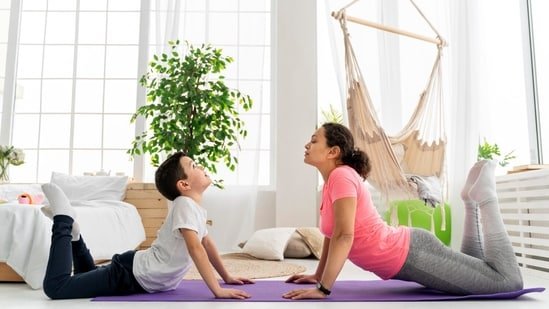
Yoga Day 2026: The International Day of Yoga is observed every year on June 21, and the theme for 2026 is ‘Yoga for Healthy Ageing,’ reminding us that yoga is suitable for people of all ages. It helps keep the body agile, active, and flexible.
Since yoga is suitable for everyone, it suggests that yoga is for children too, and parents can introduce the habit from the formative years of childhood. When introduced early, yoga can help children build focus and flexibility.
Why do children need yoga?
Now you may ask, why yoga for children? In this day and age of AI slop and digital brainrot, where the upcoming generation is dubbed the ‘iPad generation’ and characterised by the troubling dependence on gadgets, the toll on the mind and body is heavy, and too serious to be ignored.
For hours on end, children remain glued to their gadgets, staying seated with little to no movement. As a result, childhood obesity cases are surging worldwide. As per the World Health Organization‘s December 2025 report, to spotlight just how grave the situation is, in 2024, 35 million children under the age of 5 were overweight, and the number is projected to rise if active interventions are not initiated. Since being obese or overweight fundamentally acts as the precursor to many diseases, children are at risk of many lifestyle ailments, from type 2 diabetes and hypertension to a higher vulnerability to heart diseases.
Their mental well-being may deteriorate too, as their attention span shrinks. A 2022 study published in the journal Developmental Neuropsychology revealed that screen time is increasing among children, and this may worsen attention span. On paper, it may not seem much, but in real life, the ramifications are severe, including trouble sitting in class, finishing homework, interacting with friends and family without zoning out. Their thinking capacity is diluted by the high-speed content, making it a major challenge in their developing years.
Yoga emerges as a solution to many of the adversities children may face in the digital, AI age.
Since many of a child’s early habits are shaped by parents and their immediate environment, they need to be encouraged in the right direction from the beginning. So, what does it look like for a parent trying to introduce yoga to their child? In an interview with HT Lifestyle, Abhishek Ghosh, dean, K J Somaiya Institute of Dharma Studies, Somaiya Vidyavihar University, shared practical insights on when children can start practising yoga and which simple asanas parents can begin with.
When should children start doing yoga?
“Children can begin practising yoga as early as 4 to 5 years of age, through playful, story-based movement rather than rigid instruction. Between ages 6 and 12, sessions can gradually include longer holds and simple breath awareness,” Ghosh recommended.
He believed that early childhood is the right time to begin, as childhood is the most ‘impressionable stage’ and children can learn quickly. Yoga also lowers distraction, which children typically struggle with today because of their fragmented attention span.
Further, he delved into the Yoga Sutras to describe what yoga means for children who are constantly distracted in the digital age. For the uninformed, the Yoga Sutras are essential teachings about yoga and the yogic state, a set of 196 sutras, written by Sage Patanjali in 500 BC.
The expert added,“The Yoga Sutras define yoga itself as the stilling of the fluctuations of the mind, citta vritti nirodha. For children who use AI tools, in a time where AI does most thinking and imagining, the ancient yogic insight is more relevant than ever. Yoga is not merely a physical exercise for kids; it is a way of teaching them to return to a quiet, steady centre amid noise.”
Yoga poses that children can do
Ghosh shared these asanas, which children can easily do, the benefits, along with simple, easy-to-follow instructions:
1. Tree Pose (Vrikshasana)
- Curl up gently with your arms stretched forward, resting like a sleepy puppy.
- Benefit: Promotes relaxation, gently stretches the back, and helps children rest, recharge, and focus on their breathing.
Lastly, the expert was of the opinion that a child who practices yoga regularly becomes more physically flexible and also learns what it feels like when the mind is calm rather than a scattered one.
He drew his insights from Yoga Sutras again and spotlighted which areas yoga helps with, “The mind’s fluctuations, what the Sutras call vrittis, are the constant stream of thoughts, comparisons, and reactions that pull attention outward. In children, this shows up as restlessness, difficulty focusing, and emotional reactivity. Yoga works on this directly: through breath, posture, and stillness, the nervous system settles, and the mind’s habitual churn slows down.”
Note to readers: This article is for informational purposes only and not a substitute for professional medical advice. Always seek the advice of your doctor with any questions about a medical condition
