

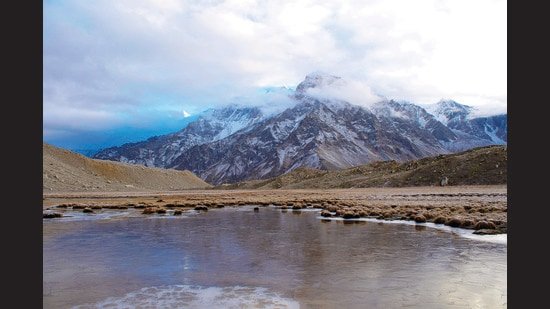
India is like a different planet when it comes to water.
Four unique issues intersect here: 1) the Third Pole melting, putting at risk the largest freshwater sources for about a quarter of the world’s population; 2) a changing monsoon that threatens to shrink rivers further; 3) our use of groundwater; India now draws about 25% of all groundwater extracted worldwide, in an effort to feed crops that, in many cases, shouldn’t be growing in the water-stressed regions they cover); and 4) a uniquely high population and unique levels of population density in poorly governed cities that drain entire regions of water (much of which then goes to waste).
Where do we go from here, given that the clock is running out (groundwater extraction now exceeds the recharge rate by roughly 150%)? Binayak Dasgupta would like to take you on a tour.
***
At the ice face of the Gangotri Glacier, about 4,000 metres above sea level, meltwater emerges at barely above 0 degrees Celsius.
It carries almost no dissolved solids: no nitrates, heavy metals, faecal coliform or chemical memory. Precipitation that fell as snow centuries before the Green Revolution, before the tanneries at Kanpur, before the sewage of a hundred cities, was locked in as ice and has now been released.
For a few metres, it is as close to pure H2O as anything the subcontinent produces.
That doesn’t last. By the time the snowmelt pools at Gaumukh, the glacier’s snout, about 20 km away, the first traces of contamination are already measurable, left by the pilgrims and trekkers who gather here. The river’s transformation begins before it has learned to flow.
Fill a bottle here. Then follow it downhill.
At Haridwar, where the river meets the plains, the first barrage splits it open. The Upper Ganga Canal diverts water into over 6,000 km of distribution channels, with the aim of irrigating close to 1 million hectares of farmland across Uttar Pradesh.
Another 76 km downstream, a second barrage takes more. At Narora, there is a third. Between them, these structures pull away 40% to 60% of the mainstem’s annual flow.
Of the water that enters the canal network, more than half will never reach a crop.
It is lost to seepage through unlined channels, evaporation under a subtropical sun, and irrigation infrastructure that has barely changed in 200 years.
***
Beneath the surface, a second extraction is underway.
India draws a quarter of all groundwater pumped worldwide, and the Gangetic aquifer is among its most heavily used reserves. The pumping has severed a relationship the river depends on: Baseflow, the groundwater that seeps into the riverbed and sustains it between monsoons, has dropped by nearly 60% in some lower reaches.
In a tragic irony, much of the groundwater is used to water the same fields that the above-ground irrigation systems were meant to feed.
By Kanpur, about 800 km downstream from Haridwar, the bottle has changed colour. The tanneries discharge chromium at concentrations that exceed safety thresholds by orders of magnitude. But industry accounts for only a fifth of the pollution. The rest is sewage. More than 100 towns along the river discharge an estimated 3.5 billion litres of wastewater into the Ganga every day (measurements from drains suggest the true figure may be nearly double that).
Some 60% of this wastewater is entirely untreated.
What enters the bottle now is biologically active, chemically complex, carrying the metabolic signature of millions of people.
***
At Prayagraj, the Yamuna merges with the Ganga, doubling the river’s volume.
But the Yamuna has passed through Delhi.
The tributaries from the north, the Gandak, Kosi and Ghaghara, do what they can to help. Swollen with Himalayan snowmelt, they dilute the filth. But each tributary carries its own freight of agricultural runoff, its own nitrogen load.
At Farakka, the last barrage diverts a fraction into the Hooghly to keep Kolkata’s port from silting over. What remains crosses into Bangladesh and fans into the delta.
The crystal-clear waters of Gomukh have long become unrecognisable.
What arrives at the Bay of Bengal is a chemical autobiography of the plains: fertiliser, faecal matter, chromium, pharmaceutical residue, microplastic.
The Ganga captures the pattern of how water is treated as a resource in India. The Yamuna, Sabarmati, Cooum, Mithi… all of India’s rivers are repositories of the same failure applied at different scales.
What makes the Ganga diagnostic is its reach: it passes through the most densely populated floodplain on earth, across the full spectrum of Indian demand — agricultural, industrial, urban, sacred — and what it reveals is not a local problem but a national relationship with water that treats the resource as inexhaustible and the river as a drain.
***
Everything above, meanwhile, is dependent on the monsoon, which delivers about 75% of the country’s annual rainfall, refilling rivers, recharging aquifers and replenishing soil moisture.
As the monsoon becomes more erratic, with rain arriving in large dumps (that cannot percolate and instead run into drains and seas), over fewer days and in less predictable geographies, the recharge window is shrinking, even as the withdrawal rate accelerates.
All the while, the origin of our bottle — the Gangotri Glacier — is disappearing. It has been retreating for over a century, and has shrunk by more than 1,700 metres.
Across the Third Pole, glaciers have lost close to a fifth of their area in three decades.
The water at Gomukh is ancient precipitation, centuries-old snowfall, now being released faster than it is being replaced.
The bottle can still be filled today. It isn’t clear how long that will remain true.
