

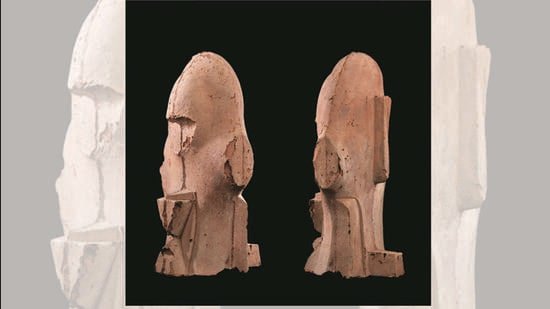
Himmat Shah’s terracotta heads somehow feel ancient and futuristic at the same time. Their surfaces are cracked, weathered, wounded and partially eroded, as though they’re products of an archaeological excavation. One can almost feel the heat, dust, and ash on them. Yet, they seem disconnected from the past we know, devoid of identity markers or any fixed form. They could belong to any time, place or culture, and are in a sense, timeless.
Shah has made a variety of them – heads within heads, kissing heads, disproportionate heads, heads without faces, heads in bronze, stone, wood and terracotta. He also created paper collages specifically to be burnt in a particular location, art assembled from found objects, and abstract expressionist drawings.
Most artists freely take inspiration from their surroundings. Many turn to locally available materials to save money and for their ready availability. Shah has done both, and he’s travelled wide. He was born in 1933 in the Harappan-era site of Lothal in Gujarat. He studied at the Gharshala School in Bhavnagar, which followed Gandhian philosophy and an open education system. He later trained at Bombay’s JJ School of Art, taught fine art at the Maharaja Sayajirao University of Baroda, and won a scholarship to study at the famed printmaking studio Atelier 17 in Paris, winning numerous awards along the way.
In the mid-1980s, Shah was in Jaisalmer in Rajasthan. There, inspired by the stark landscape of the Thar desert, he began creating temporary, site-specific structures using deadwood, stone and other found materials. He didn’t title them. He just left them behind; his photos of them becoming the only record that they ever existed. These were sculptures, but impermanent ones, a radical way of looking at art as separate from the artwork. It echoed the age-old question: What is art if not a search for truth?
I was introduced to his work while casting bronzes in the foundry Shah started in Jaipur where he spent the later years of his life (he passed away in 2025). I understood his works better after talking to him over a decade of visits and becoming friends. The Hindi word Sambhavana, meaning possibility or potential, encapsulated his approach to both art and life. It indicated his desire to let his materials lead him instead of him leading them. The desert was, therefore, a playground of possibility as he experimented with exposure, heat, wind, time and silence.
Artists around the world have used found materials in incredibly powerful ways. Ghanaian sculptor El Anatsui transforms discarded bottle caps into monumental tapestry-like sculptures. Louise Nevelson from the USA has assembled found wooden objects into architectural sculptural pieces. German painter Anselm Kiefer uses ash, straw, lead, and earth-like materials to evoke history and destruction. Giuseppe Penone from Italy works directly with trees and natural materials to reveal hidden growth and time. In India as well, many artists have transformed found materials into deeply conceptual works, but Shah’s approach feels uniquely meditative and elemental. He often spoke about finding the “perfect sound” within silence, and that idea has stayed with me.
Whether it is his terracotta heads, burnt collages or assembled desertscapes, what I truly appreciate about Shah’s art is the idea that an artist can choose to step away from certainty, and allow themselves to be led by their creation.
Artist bio: Siri Devi Khandavilli is a multidisciplinary artist. She focuses on cultural migration, feminism, ecology, and mythology.
From HT Brunch, May 16, 2026
Follow us on www.instagram.com/htbrunch
