

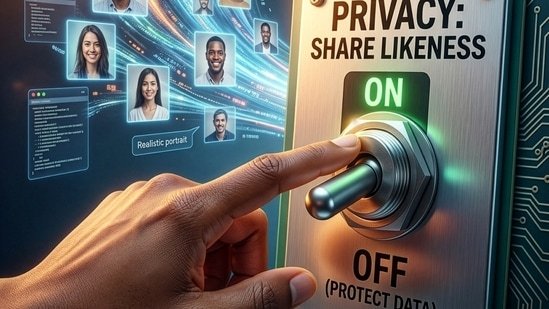
Meta’s newly launched Muse Image generator has sparked a major privacy debate on social media, with some users calling the tool a ‘privacy landmine’. While it offers impressive creative tools, one of its features allows the public content from any Instagram handle to be ‘remixed’ into AI-generated images, without any notification to the account.
A section of Instagram users has also flagged that the feature was on by default. Here’s a lowdown of everything you need to know about it and how to claim control over your digital likeness.
Muse Image is Meta’s first in-house image generator, replacing third-party models with technology from Superintelligence Labs.
It is ‘agentic’, meaning it uses a ‘brain’ called Muse Spark to reason through prompts and plan layouts before the ‘hands’ (Muse Image) draw the result.
The tool is part of apps such as WhatsApp, Instagram Stories, and Meta AI, requiring no new sign-up or credit card information.
Why users are criticising it
Its most controversial feature is the ability to use public Instagram content of users over 18.
Anyone can simply @ your username in a prompt to generate images featuring your face and likeness, with no notification sent to you. Critics have labelled this a “privacy landmine”.
How to check and opt out of the feature
But, the tool is not bad!
Despite privacy concerns, Muse Image is remarkably capable. It is surprisingly adept at handling ’lifestyle’ tasks that would typically require a professional designer.
The tool is uniquely good at rendering readable text for invitations or signs and can even generate functional, scannable QR codes.
It allows for ‘steerable’ editing, where you can circle a specific part of a photo to erase a photobomber or swap the background.
Users can also restore old photos by sharpening faded family pictures.
It can also be used it as a free tool for small business mockups and social media graphics.
