

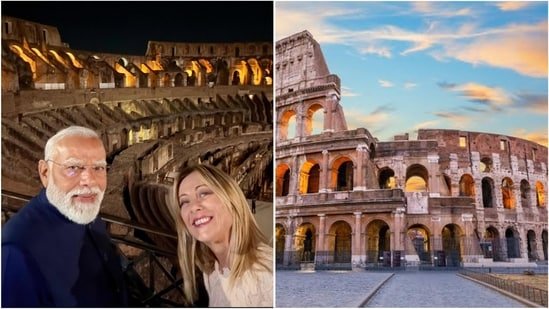
Prime Minister Narendra Modi arrived in Rome on Tuesday and received a warm welcome from Italian PM Giorgia Meloni. The two leaders later attended a dinner meeting before visiting the legendary Colosseum, where they discussed several key issues. Photos from their outing have now surfaced across social media, offering a stunning glimpse of their meeting against the backdrop of ancient Roman history. (Also read: PM Modi praises ‘bhajan clubbing’, calls it ‘no less than global concerts’: Here’s what this Gen Z trend means )
Sharing a picture with PM Modi on Instagram on May 20, Giorgia Meloni wrote, “Welcome to Rome, my friend!” along with the national flags of Italy and India.
The now-viral picture features the Colosseum glowing in the background. Originally known as the Flavian Amphitheatre, the massive stone structure stands at the heart of Rome and remains one of Italy’s most iconic landmarks. Recognised as one of the New 7 Wonders of the World, the historic monument attracts millions of visitors every year and is considered the largest amphitheatre ever built.
From its fascinating gladiator history and grand architecture to ticket prices and travel tips, here’s your complete guide to Rome’s legendary Colosseum.
History of the Colosseum
Located in the heart of Rome, the Colosseum was built between AD 70 and 80 under the rule of Emperor Vespasian and later completed by his son Titus. The amphitheatre once hosted gladiator fights, animal hunts, mock naval battles, theatrical performances and public spectacles attended by thousands of Romans.
The structure could reportedly accommodate between 50,000 and 80,000 spectators at a time. Despite suffering damage from earthquakes and stone theft over the centuries, much of the monument still stands tall today, making it one of the greatest architectural achievements of ancient Rome.
What makes the Colosseum special
The Colosseum is famous for its grand elliptical design, underground chambers and layered seating arrangement. One of the most fascinating parts of the monument is the hypogeum, a network of underground tunnels and rooms where gladiators and animals waited before entering the arena.
Tourists also love the panoramic views from the upper levels, which overlook parts of ancient Rome, including the Roman Forum and Palatine Hill. At night, the monument lights up beautifully, giving visitors a completely different experience from the daytime crowds.
Best time to visit the Colosseum
The ideal time to visit the Colosseum is during spring (April to June) and early autumn (September to October), when the weather remains pleasant and sightseeing becomes more comfortable.
To avoid long queues and heavy crowds, tourists are advised to visit early in the morning or later in the evening. Summers in Rome can get extremely hot and crowded, especially during July and August.
Ticket prices and entry tips
Visitors can choose between standard entry tickets, guided tours and underground access tours, with most tickets including entry to the Roman Forum and Palatine Hill.
According to the official Colosseum website, standard entry tickets start at €18 (around ₹1,700), while Full Experience tickets with access to special areas like the Arena Floor and Underground start at €24 (around ₹2,300). Visitors are advised to book tickets online in advance as slots fill up quickly during peak tourist season.
Nearby attractions you should not miss
A visit to the Colosseum can easily be paired with other iconic Roman landmarks nearby. The Roman Forum, once the centre of political and social life in ancient Rome, is located right next to the amphitheatre.
Tourists can also explore Palatine Hill, the Pantheon, Trevi Fountain, Piazza Venezia and the Spanish Steps, all of which are among Rome’s most loved attractions. Cafes and gelato spots around the area make the experience even more memorable.
Travel tips for first-time visitors
Comfortable walking shoes are a must because the area involves a lot of walking on uneven stone pathways. Carrying water, sunscreen and light clothing is recommended during warmer months.
Photography lovers should carry a wide-angle lens or keep enough phone storage ready because every corner of the Colosseum offers postcard-worthy views. Sunset visits are especially popular for capturing the golden glow over ancient Rome.
