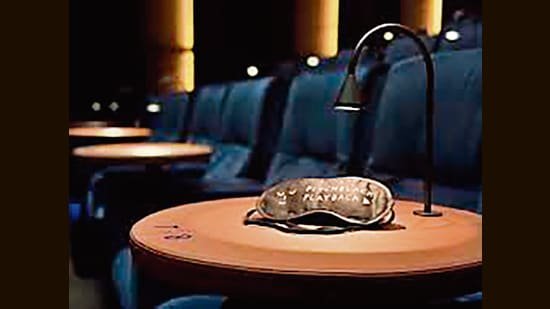
It was a weeknight in Helsinki, cold in the way Finnish spring evenings stubbornly insist on being, and I was filing into a modest cinema. My phone was off. I had no beverage, notebook or recorder. At the door, I was handed a padded black eye mask. A young man reminded us, pleasantly but firmly: no talking, no singing, no noise of any kind.
Narayan listened to the 1975 album Who’s Next by The Who, at Helsinki’s Gilda cinema.
The audience was a study in motley fellowship. The majority were middle-aged to senior people who, like me, had presumably spent decades accumulating opinions about music. A couple arrived in wheelchairs. A gentleman with a white mobility cane was assisted by a volunteer. And then, wonderfully incongruously, a young person dressed in full goth regalia — dark mascara, black everything — slid into a seat near the front.
When the lights went off moments later, it went completely dark. Even the exit signs, with the faint green glow cinema regulations require, were blocked out by the black of the eye mask. I couldn’t see my own hands. Then the music began.
The opening synthesiser swell of Baba O’Riley filled the room the way rain fills a valley, from all directions at once, finding every corner. The sound system in the cinema wasn’t merely good; it was a kind of reckoning. Within the first 30 seconds I understood that I was not listening to a record I already knew. I was listening to a record I had only thought I knew.
I first heard Who’s Next by The Who in 1975, four years after its release, when I was old enough to be astonished by it. I have returned to it on every format and device since: vinyl, tape, CD, lossless digital, planar magnetic headphones that cost an arm and a leg.
I thought I knew this album intimately. But sitting masked and mute in the Helsinki cinema, I heard things I had simply never heard before. Textures in Roger Daltrey’s mid-section phrasing. The exact moment Keith Moon decides a fill is insufficient and does something outrageous instead. The way John Entwistle’s bass lines move not beneath the melody but through it, like an embrace.
Who’s Next runs to 44 minutes. It began as something grander and stranger: Pete Townshend’s abandoned Lifehouse project, a dystopian science-fiction concept that positioned music as a spiritual force in a world consumed by technology. The project collapsed under its own ambition, and what survived became this album, a record about youthful anger, disillusionment, the wreckage of revolutions — and the unlikely persistence of transcendence.
It gains from being heard in the dark, in silence, in community with strangers.
When the final notes of Won’t Get Fooled Again — that synthesiser drone, that unholy scream — faded into the air, the lights slowly came up. Nobody spoke. We filed out: the goth kid, the gentleman with the cane, the people in the wheelchairs and the grey-templed habitués, all of us blinking a little, carrying what the darkness had given us.
The event was organised as part of Pitchblack Playback, a series of deep-listening sessions started in London in 2016 by DJ and producer Ben Gomori and now being held in New York, Paris, Berlin, Tokyo and Helsinki too. The premise is simple: a great album, played in full, in the dark, on a serious sound system, in collective silence. No algorithm decides the sequence. One listen from beginning to end, the way the makers intended.
I am not opposed to algorithms. Spotify has introduced me to music I would not otherwise have found, and Apple Music’s editorial playlists are sometimes inspired. But algorithms are optimised for retention, not revelation. They learn what you like and serve up adjacent versions of it, which is comfortable, and occasionally deadening. The great discoveries — the ones that rearrange something in one’s interior geography — tend to come from elsewhere.
From events like this, of course. But from a range of other non-automated sources too. Join me next fortnight for more on those.
Meanwhile, I’m getting ready to file into Helsinki’s Gilda cinema again later this month. This time to listen to Marvin Gaye’s classic What’s Going On (also from 1971), an album I’ve heard a million times. But never as it’s played back in pitch black.
(Email sanjoy.narayan@gmail.com.The views expressed are personal)
सिद्धभूमि के लेखक एक प्रमुख समाचार लेखक हैं, जिन्होंने समाज और राजनीति के महत्वपूर्ण मुद्दों पर गहरी जानकारी और विश्लेषण प्रदान किया है। उनकी लेखनी न केवल तथ्यात्मक होती है, बल्कि समाज की जटिलताओं को समझने और उजागर करने की क्षमता रखती है। उनके लेखों में तात्कालिक घटनाओं के विस्तृत विश्लेषण और विचारशील दृष्टिकोण की झलक मिलती है, जो पाठकों को समाज के विभिन्न पहलुओं पर सोचने के लिए प्रेरित करते हैं।
एक ऐसे समय में जब प्रिंट एवं मुद्रण अपनी प्रारंभिक अवस्था में था ,समाचार पत्र अपने संसाधनो के बूते निकाल पाना बेहद दुष्कर कार्य था ,लेकिन इसे चुनौती के रूप में स्वीकार करते हुए स्वर्गीय श्री शयाम सुन्दर मिश्र “प्रान ” ने 12 मार्च 1978 को पडरौना (कुशीनगर ) उत्तर प्रदेश से सिद्ध भूमि हिंदी साप्ताहिक का प्रकाशन आरम्भ किया | स्वर्गीय श्री शयाम सुन्दर मिश्र “प्रान ” सीमित साधनों व अभावों के बीच पत्रकारिता को मिशन के रूप में लेकर चलने वाले पत्रकार थे । उनका मानना था कि पत्रकारिता राष्ट्रीय लोक चेतना को उद्वीप्त करने का सबसे सशक्त माध्यम है । इसके द्वारा ही जनपक्षीय सरोकारो को जिन्दा रखा जा सकता है । किसी भी संस्था के लिए चार दशक से अधिक का सफ़र कम नही है ,सिद्ध भूमि ने इस लम्बी यात्रा में जनपक्षीय सरोकारो को जिन्दा रखते हुए कर्मपथ पर अपने कदम बढ़ाएं हैं और भविष्य के लिए भी नयी आशाएं और उम्मीदें जगाई हैं । ऑनलाइन माध्यम की उपयोगिता को समझते हुए सिद्ध भूमि न्यूज़ पोर्टल की शुरुवात जुलाई 2013 में किया गया |
हमसे संपर्क करने और जुड़ने के लिए मेल करें -
siddhbhoomi@gmail.com
Subscribe to Updates
Get the latest creative news from FooBar about art, design and business.