

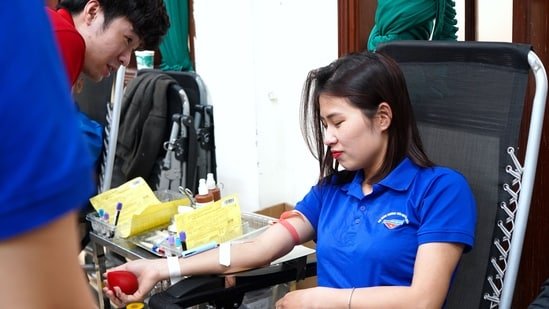
From donating blood will make you weak to the fear of syringes, there are several myths surrounding the process that refrain people from donating blood. In an interview with HT Lifestyle, Dr Anand Deshpande, consultant, transfusion medicine, PD Hinduja hospital and medical research centre, Mahim, busts the most common myths.
Also read | Planning to donate blood? Here’s what first-time donors should know before heading to the donation centre
1. ‘One donation will not make a significant difference’
Many people think that a single blood donation won’t have much impact. However, according to Dr Anand, that’s not true because, in our country, we need around 12 to 13 million units of blood per year, and there is still a shortfall of at least 1 to 1.5 lakh units annually. So, one should not say that their one unit will not make any difference. It will make a difference.
Secondly, whenever you donate blood, it is divided into components such as red cells, plasma, and platelets. These go to three different patients. So, your one unit of blood is utilised for three different patients. Therefore, never say that your one unit will not make any difference.
2. ‘Only people with rare blood types are really needed to donate blood’
Another misconception that troubles people is about rare blood groups. Dr Anand said, “If you look at it, common blood groups such as B positive and O positive are very common. If you have more donors of that type, naturally, you are also going to have more patients of the same type.” So, if there are many B-positive patients, you are bound to require many B-positive donors. Therefore, please don’t go under the myth that people with common blood groups are not required to donate blood.
3. ‘Vegetarians or thin people cannot donate blood’
According to Dr Anand, it doesn’t depend on whether you are vegetarian or non-vegetarian. You have to fulfil the criteria for blood donation. That means your haemoglobin should be good, you should have adequate weight, your weight should be more than 45 kg, and you should not suffer from any major clinical disease. If you fulfil those criteria, anyone can donate blood.
4. ‘Women should not donate blood’
That is another myth. Women should come forward and donate blood. There is nothing stopping them from donating blood. “However, the haemoglobin level of the majority of women is often not up to the mark,” highlighted Dr Anand. It should be a minimum of 12.5 grams per cent, but it is often low due to dietary issues or menstrual problems. Taking this into consideration, the overall number of women donors is quite low. However, if they fit the criteria for blood donation, they should come forward and donate.
5. ‘The donor catches an infection during blood donation’
Dr Anand highlighted that when we collect blood from donors, we take all the necessary precautions, and it is collected under sterile conditions. The blood bags that we use are single use blood bags. The needles are also single-use. After the blood is collected, the needle is cut off and discarded, and the blood is processed into components. Therefore, there is no chance of getting an infection during the blood donation process.
However, he advises, if you are donating blood, please ensure that you go to a licensed blood centre because these licensed blood centres are regulated by the Food and Drug Administration and the State Blood Transfusion Council. They follow all the rules and regulations and make sure that the entire blood donation process is very safe for the donor.
6. ‘Blood donation will make me weak’
“Blood donation can make you temporarily weak, or you may feel lightheaded, but it cannot make you permanently weak,” said Dr Anand. During blood donation, you lose some fluid. We collect around 10 to 15% of your total blood volume, which is not going to cause you any problem. You also lose red blood cells and iron. These fluids can be replenished with good fluid intake within 48 hours. Red blood cells return to normal within 4 to 6 weeks, and iron levels also return to normal within about 3 months, or 8 to 12 weeks. That is why there is a gap of 3 to 4 months between two donations.
The only things you should do after a donation are to hydrate yourself well, not with aerated drinks, but with fruit juices or similar healthy fluids. You should avoid strenuous or very heavy exercise, eat a good meal, and get adequate rest. That is all that is needed. You do not even need to take leave from work when you donate blood.
Note to readers: This article is for informational purposes only and not a substitute for professional medical advice. Always seek the advice of your doctor with any questions about a medical condition.
