

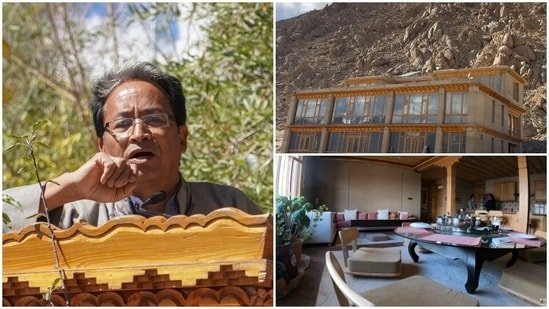
Climate activist Sonam Wangchuk once gave a peek inside his home in Ladakh. Three years ago, a YouTuber, Amita Chhorgia Negi, who goes by Tribal Girl on social media, shared a home tour video of Wangchuk’s home on her channel.
Sonam Wangchuk is an Indian engineer, innovator, and education reformer who is also the founding director of the Students’ Educational and Cultural Movement of Ladakh. In the video, he revealed what a traditional Ladakhi tribal home – that perfectly blends thousands of years of traditional architectural wisdom with modern science and comfort – can look like.
A Ladakhi tribal house
In the video, Sonam Wangchuk demonstrates how rammed earth walls and passive solar heating create high-efficiency living spaces without the need for artificial fuel. During the discussion, he also highlights the importance of eco-friendly sanitation, featuring waterless composting toilets that transform waste into agricultural fertiliser.
The construction and philosophy of the house blend traditional materials with modern interiors and a hybrid approach. The house is constructed using mud, a method used for centuries in regions such as Ladakh, Kinnaur, and Tibet. There are wooden beams in the ceiling and large windows that let in ample natural light.
Innovative and ecological decor
The mud walls stay cool in the summer. However, to keep warm, instead of lighting a bukhari indoors, Wangchuk’s home uses a solar heating system. The exterior is entirely made of large wood-framed windows, covering a completely black wall that makes up the interior of the house. It is made of water bottles that absorb the winter sun’s heat to keep the house warm at night, with a temperature of 18 to 20 degrees Celsius.
While the exterior and walls follow ancient methods, the interior is designed for modern living, featuring modern sofas, vintage furniture, a modular kitchen, traditional low seating for dining, and bedrooms with attached bathrooms.
The modern bathrooms waste five to ten litres of water every day when we flush. Therefore, keeping the decor element of a modern toilet, the washrooms in Wangchuk’s home use an ecological ‘urine separated toilet’. Instead of water, users flush with sawdust or mud, which prevents odours. The waste is collected in buckets and stored to decompose into organic manure.
Meanwhile, the kitchen layout is designed to maintain the traditional spirit of communal living, allowing everyone to sit, cook, and eat together in the same space. Lastly, the property also includes an apple orchard (high-density plantation) and a greenhouse.
Note to readers: This report is based on user-generated content from social media. HT.com has not independently verified the claims and does not endorse them.
