

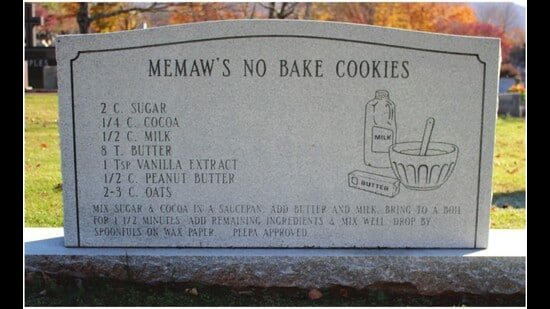
This is not a typical cookbook.
It doesn’t contain marked sections for appetizers, entrees, main courses and desserts. Offer notes on a cuisine, or handy hacks.
What it does hold out are simple, no-frills recipes left by the dead for the living.
To Die For is a collection of 40 recipes gathered by archivist Rosie Grant, from etchings on gravestones spread across the US, from Washington DC through Iowa to Utah towards the east and Nome, Alaska, way in the north. A digital archive of the 60 collated for far, over five years, is available online at ghostlyarchive.com.
Most of the instructions are for desserts: cookies, cakes, cobbler, pie, ice-cream, fudge. There is the occasional savoury note too, for the perfect roast, chicken casserole, or loaf of bread. Some are brief lines engraved on the stone itself. Others are laminated and attached to the memorial.
It has been an unusual sort of pursuit, admits Grant, 36, but then she has always loved to walk through cemeteries. Her parents were ghost-tour guides in her hometown of Alexandria, Virginia. She is now head of outreach and communications at the University of California, Los Angeles (UCLA) Centre for the Study of Women.
This ongoing quest began, for her, in 2021. A year into the pandemic, while studying for a Master’s degree in library and information science at University of Maryland, Grant began a digital archives internship at the Congressional Cemetery in Washington DC, which turned out to hold an array of unusual markers. One featured a tiger, immortalising the animal that had killed this grave’s occupant; another featured the Library of Congress call number for a book written by the deceased.
That summer, she created @ghostlyarchive on Tiktok (now also on Instagram), to document these finds. A year later she came upon a story about a gravestone recipe, in Atlas Obscura, and was intrigued. She eventually travelled to New York’s Green-Wood Cemetery, to see the note on spritz cookies that had been carved into the gravestone of the former postal clerk Naomi Odessa Miller-Dawson.
She ended up meeting Miller-Dawson’s son, Richard Dawson, who had coaxed his mother into letting him share her formula with the world. She died in 2009, aged 87, he said, happy at the thought that her cookies might bring joy to strangers, and perhaps help a struggling parent make a treat for the family.
The biscuits can be made with butter or margarine, sugar, vanilla essence, one egg, flour, baking powder and salt. (Click here to give them a try yourself.)
BATCH MADE IN HEAVEN
As Grant asked around, she learnt that recipes were not that uncommon, as gravestone memorials. “I expected there to be two or three more, then there were five and now I am up to 60,” she says, laughing.
As she began to document her first 10 on social media, families started to reach out, pointing her to headstones they had helped craft. The oldest one she has uncovered so far dates to 1996.
In the Cascade cemetery in Iowa, homemaker Maxine Menster’s famous Christmas cookies are immortalised. Wrapping these up and hanging them on the tree late on Christmas Eve, so the family could wake to the sight and aroma of freshly baked treats, was Menster’s personal twist on the festivities. When she died in 1996, aged 68, her family decided to share her formula with the world, simply titled Mom’s Christmas Cookies. (Click here to see the recipe.)
Each dish she uncovers has a similarly moving tale associated with it, Grant says.
Take Annabelle Gunderson. She and her husband Adolph Gunderson ran a local car dealership, and served as volunteers in wildfire season, fighting back the flames that loomed over their small town of Willits in Northern California. Amid the chaos, Gunderson somehow always found the time to make sandwiches and snickerdoodles for the firefighters, to help keep them going.
When she died in 2007, aged 87, her recipe for snickerdoodles went on her headstone. It comes with her famous tip: “Secret is: Keep dough fluffy!” (Click here for the full note.)
Further northwest, in Nome, Grant found Bonnie June Rainey Johnson, who ran the local Department of Motor Vehicles (DMV) office, which meant everyone had a Bonnie story to share. She ran a tight ship, people still say, with a respectful nod.
“Nome is so remote that every ingredient has to be shipped in. So Bonnie’s recipe for no-bake chocolate oatmeal cookies is precious, because the ingredients are shelf-stable,” Grant says. It calls for sugar, whole milk, cocoa “or 1 Swiss Miss packet”, margarine, creamy peanut butter, vanilla extract and quick oats.
“Affordable enough for a single mom of four kids, which she was,” Grant notes. Bonnie was diagnosed with Alzheimer’s disease in 2004 and died in 2007, aged 71.
FOLLOW THE CRUMBS
Encouraged by the response to this effort, Grant now plans to expand the scope of her project and archive obituaries that contain recipes too.
With each such formula that she uncovers, “I can’t help but think about my own family food memories: a glass of magnolias in my grandmother’s kitchen, char-grilled burgers on an August night, climbing trees with a snickerdoodle cookie in hand,” Grant says. “These aren’t just instructions for food. They are stories, legacies and connections between the living and the dead. They remind us that even in death, we leave behind pieces of who we are.”
What would she pick, if she had to share such a recipe with the world?
At this point, it would be clam linguine, she says, laughing. “My joy comes from the ritual of making it with others. From the steam that rises when the clam pops open. The clink of glasses when we sit down to eat. Food is just an excuse to gather. I think that’s how I would like to be remembered.”
