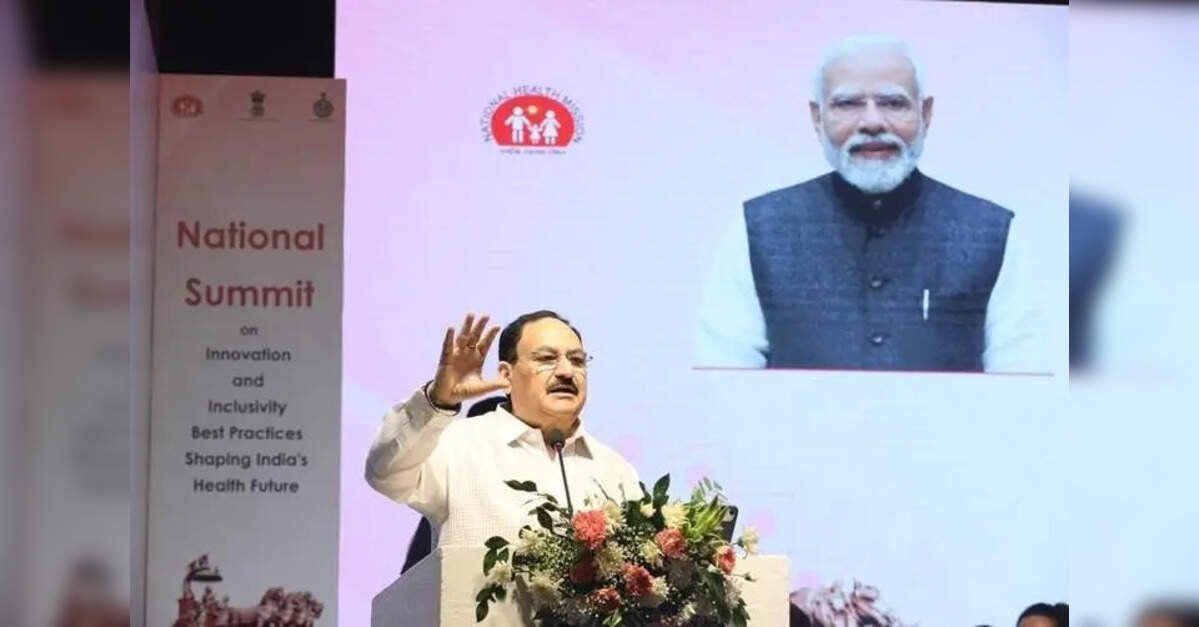
New Delhi: Emphasizing India’s transition towards preventive, integrated, and technology-driven healthcare, Union Minister of Health and Family Welfare Jagat Prakash Nadda inaugurated the 10th National Summit on Innovation and Inclusivity: Best Practices Shaping India’s Health Future.
The summit was attended by Nayab Singh Saini and Arti Singh Rao and brought together states and Union Territories to showcase innovative public health practices aimed at strengthening inclusive and affordable healthcare delivery.
Addressing the gathering, Nadda praised the Government of Haryana for hosting the summit and stressed the importance of field-driven innovations in building a responsive public health ecosystem. He noted that the initiatives launched during the event are designed to ease the workload of frontline health workers while improving healthcare delivery and outcomes.
Reflecting on policy evolution, Nadda said India’s healthcare strategy has moved beyond a predominantly curative model under the National Health Policy (NHP) 2002 to a more comprehensive approach under the National Health Policy 2017 that integrates preventive, promotive, curative, and palliative care.
Highlighting the role of Ayushman Arogya Mandir, the minister said over 1.85 lakh centres now serve as the first point of contact for nearly 1.5 billion people. These facilities have strengthened preventive healthcare through large-scale screening for non-communicable diseases such as hypertension, diabetes, and cancers among individuals aged above 30 years.
Nadda also called for greater focus on quality improvement across public healthcare facilities. While more than 50,000 Ayushman Arogya Mandirs have received certification under the National Quality Assurance Standards (NQAS) , he said expanding quality audits and certification remains a priority.
Highlighting progress over the past decade, the minister pointed to improvements in maternal and child health indicators. Institutional deliveries have increased from 79 per cent to 89 per cent, while under-five mortality and infant mortality have seen significant declines. He also noted that tuberculosis incidence in India has fallen faster than the global average, with treatment coverage reaching 92 per cent.
India has also achieved several major public health milestones, including being declared polio-free in 2014, eliminating neonatal tetanus in 2015, and ensuring that trachoma is no longer a public health concern. The country is also approaching elimination of kala-azar, Nadda added.
However, the minister cautioned that the rising burden of non-communicable diseases requires stronger screening programmes, follow-up care, and referral mechanisms. He also emphasised the need for improved planning and awareness among field-level health officials regarding provisions under the National Health Mission (NHM).
During the summit, the government launched several digital health initiatives, including the Swasth Bharat Portal, a unified platform designed to integrate multiple national health programmes and reduce administrative burden on healthcare providers. The portal will enable seamless integration with the Ayushman Bharat Digital Mission and support the exchange of patient records through the ABHA health account system.
Another major initiative unveiled was the JANANI (Journey of Antenatal, Natal and Neonatal Integrated Care) platform, which will provide real-time tracking of maternal and child health data across the country. The platform aims to support early identification of high-risk pregnancies and ensure continuity of care from pre-pregnancy to childhood.
The government also released updated guidelines under Rashtriya Bal Swasthya Karyakram, known as RBSK 2.0. The revised framework expands screening to include emerging conditions and childhood non-communicable diseases while strengthening referral systems and digital monitoring.
Speaking at the event, Haryana Chief Minister Nayab Singh Saini highlighted the state’s healthcare reforms, including the CARE campaign that trains family members of patients to support home-based care across 188 centres. He also pointed to the growing use of telemedicine services through eSanjeevani, which facilitates nearly 2,000 teleconsultations daily at Ayushman Arogya Mandirs in the state.
Saini said Haryana has increased its health budget by 32.89 per cent to nearly ₹14,000 crore and expanded its medical education infrastructure. The number of medical colleges in the state has increased from six in 2014 to 17, while MBBS seats have risen from 700 to 2,710.
The summit also saw the release of the 17th Common Review Mission report evaluating the implementation of the National Health Mission across states, along with a compendium of best practices and an integrated training module for primary healthcare teams.
Nadda stressed that while financial resources are available, effective utilisation and stronger governance mechanisms will be critical to achieving India’s vision of a resilient and inclusive healthcare system aligned with the broader goal of Viksit Bharat.