

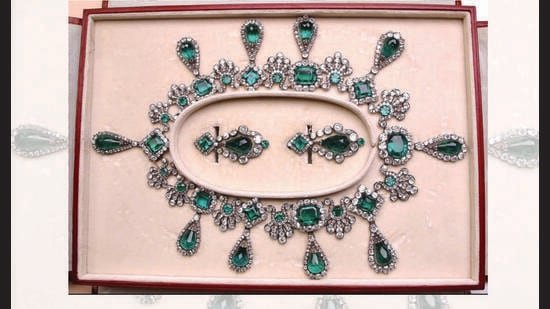
Louvre jewels. Four minutes. Four thieves. Eight pieces of 19th-century jewellery worth $102 million, gone. The October 2025 heist was the Paris museum’s first theft in 27 years. Masked bandits made off with an emerald and diamond necklace-earrings set gifted by Napoleon I to Empress Marie-Louise and other objets d’art from the French royal family. The museum’s video surveillance system had the password “Louvre”. Les amateurs!

Asiatic Society maps. Mumbai’s Asiatic Society vaults keep bugs and insects out. But somehow, about 345 hand-drawn maps dating to the 19th century have gone missing from the 200-year institution. Some of them catalogued city plans of Bombay when its first revenue survey was carried out; others were nautical charts made by the Portuguese. Maybe a tech bro has them displayed in his man cave, and acts all sus when guests ask them where he got it from.

Kolkata Museum’s books and artefacts. The Comptroller and Auditor General of India’s 2006-07 report revealed that the museum’s staff were up to no good. More than 5,000 valuable books – bearing the Indian Museum imprint – had disappeared. Priceless objects were being smuggled out after dusk. Senior officers would just casually pick up relics and display them in their chambers. Where did the books go? We’re sure no serious book lover would steal them.

Paliam Palace Museum’s palm leaf manuscripts. They were found to be missing in 2022. They were at least 350 years old and were part of a 30-bundle bunch (featuring ayurvedic texts, the Ramayana and the Mahabharata) sent to be conserved by Keralam’s Muziris Heritage Project. But only 29 bundles came back. The thief also took the document cataloguing the bundles, so authorities couldn’t figure what was stolen. Wdym no one took a picture of it? Wdym no one made a copy of the manuscript or the doc?

Cairo Museum’s gold bracelet. Imagine surviving 3,000 years only to be filched and melted in 2025. Pharaoh Amenemope’s gold-and-lapis bracelet symbolised divinity and power; ancient Egyptians believed that their gods’ flesh was like gold, and that their hair was like lapis lazuli. The thief, an employee of the Egyptian Museum in Cairo, took it from the restoration lab (which has no cameras BTW) and gave it to a silver trader, who in turn sold it to a jewellery shop owner. He passed it on to a gold smelter who paid $4,000 for it and melted it. This physically hurts.

Russia’s Amber Room. Some called it the eighth wonder of the world. The Amber room has “moved” unlike any other room – from the first king of Prussia’s palace, to Peter the Great’s Winter House in St Petersburg, to the Catherine Palace in Pushkin, and then to a castle in Königsberg in Germany when the Nazis invaded the Soviet Union. The room was outfitted with six tons of amber, backed with gold leaf, studded with semi-precious stones. In 1943, it was dismantled and packed in crates, before bombs fell on the castle. But where did all that amber go?

Japan’s Honjo Masamune sword. It’s the ultimate samurai sword. The glittering, tapered-edge blade was made by a royal Japanese swordsmith in the 13th or 14th century. In 1939, it was named a national treasure. After World War II, the US demanded that all Japanese citizens hand over their weapons. So, the Tokugawa family, who were in possession of it, handed it over to the US army. No one knows what happened to it after. Some dude is probably pretend-fighting with it and feeling all macho.

China’s Peking Man fossils. Paleontologists still get PTSD from this. During the 1920s and 1930s, about 200 Homo Erectus fossils were excavated from the Zhoukoudian cave in China: skulls, teeth. During World War II, fearing that the Japanese would carry away the fossils when they invaded China, American archaeologists smuggled them away in military lockers. But when US bases were bombed, the fossils were lost, probably buried again.

Bermuda’s Tucker’s Cross. In 1955, shipwreck hunter Teddy Tucker stumbled upon a heavy golden cross with “seven large green emeralds the size of a musket ball”. The Bermuda government bought it from him and displayed it at an aquarium. But when Queen Elizabeth II was scheduled to visit in 1975, and it was laid out with other treasures at the Maritime Museum, someone swapped it with a fake, with the paint still drying on it. We’re still shook.

Brazil’s Jules Rimet trophy. The FIFA trophy (depicting Nike, Greek goddess of victory) has been stolen twice. Once in 1966 from a London exhibition, and then from the Rio de Janeiro headquarters of the Brazilian Football Confederation in 1983. So, FIFA now no longer allows countries to keep the current trophy with them permanently. Winners are handed the gilt-and-brass version, while the OG sits in the Zurich FIFA World Football Museum.
From HT Brunch, April 18, 2026
Follow us on www.instagram.com/htbrunch
