

For about 200 years, between 1630 and 1854, the Japanese Shogunate under the Tokugawa rulers closed the archipelago ‘s borders.
Residents were banned from leaving and, more significantly, missionaries from the West were banned from entering the country. Trade was managed through a sliver of an opening: four gateways identified for trade with different regions.
As the Edo period gave way to the Meiji, Japan’s sakoku or isolationist policy was no longer sustainable in the face of the industrial and military advancements of colonial powers.
When the country reopened, art was one of the first things immediately affected.
In fact, such was the influence of Western painting techniques and Western schools of art that the Japanese coined a term to distinguish traditional techniques from these new ones fast gaining popularity. The more traditional techniques employed mineral pigments on washi paper or silk, and animal glue or nikawa as a binder. Unlike oil or acrylic painting, this method — which came to be called nihonga — did not overly coat pigments and, instead, allowed the raw qualities and luminosity of the minerals to stay visible.
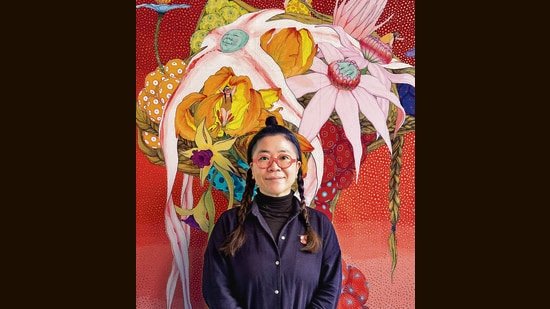
“It is this direct material presence (of nihonga) that I find most compelling. For me, it is less about adhering to a specific style and more about a deep attraction to the beauty and physicality of these materials,” says Mari Ito, whose first solo show in India opened in New Delhi’s Bikaner House on Thursday.
Titled Origin of Desire, the exhibition offers a selection of paintings created between 2024 and now, alongside an installation titled Flowers Blooming in Defiance of the Bombs, which the artist first presented in Barcelona last year. “For this occasion, I have reconfigured the installation as a new, site-responsive work,” Ito says.
This is her first visit to the country, she adds, but her works have been shown at Art Mumbai in 2024. Since 2006, Ito has lived in Barcelona, and the influence of the Mediterranean region is visible in her work, says Wribhu Borphukon, newly appointed director of Galerie Geek Art, which represents her.
“Ito is trained in the traditional nihonga techniques, working with sumi ink and nikawa on Oguni washi, and possesses the discipline of a Japanese craftsperson. However, her move to Barcelona, with its brightness and the multidimensionality inherent in the Mediterranean — the waves, ocean, air, people — brought about a shift in her art,” Borphukon says.
The post-war Japanese nation- and society-building project became tethered to social discipline, gendered responsibility and normative domesticity. Women were positioned as agents of the home, bearers of the future demanded by the State.
Ito’s canvases offer a diametric oppositionality to that ethos.
“Mari Ito’s world is a biopolitical fabulism. Swelling seeds and pods bloom into whimsical compositions, while cellular rhythms pulse through the sturdy stems and flourishing petals, sometimes threaded with human-like faces and punctuated with self-portraits. Ito has been painting a quietly radical aesthetic proposition,” Borphukon explains.
The botanical world she creates is not just surrealistic, it also stages desire in its depiction of the overgrowth. “Her forms proliferate sideways, unfixed and defiant. Her compositions propose desire as a hybrid, multi-directional vitality that mutates, sprouts and leaks. In these organisms, one understands the body as a site of insurgency,” he adds.
The tension between an age-old technique and her feminist approach is palpable in Ito’s works. “I believe this technique is fundamentally open and accessible to anyone. At the same time, it is labour-intensive and sensitive to environmental conditions, especially when compared to digital media. In an age increasingly shaped by AI, I feel it is important to preserve and value the act of making things by hand,” she says.
Ito, who is in her mid-40s, is part of a cohort of Japanese artists practising this technique amid a highly experimental contemporary art scene, marked by the likes of Yayoi Kusama and Yasumasa Morimura. “I initially focused on nihonga, but over time I became interested in transforming my paintings into three-dimensional forms; objects that could be physically experienced. This led me to explore sculptural practices. I have also experimented with a range of media, including photographic works in collaboration with Barcelona-based photographer Toni Mateu, murals, and soft sculpture installations such as the one I (am showing) in India. I am always open to working with different materials, as long as they align with the concept I wish to express,” Ito says.
Galerie Geek Art, which facilitated leading contemporary artist Takashi Murakami’s visit to India in 2020, is an arm of Geek Pictures, which was formed in Tokyo in 2007 as a creative production studio. Geek Pictures India was formed in 2019 with an exclusive South Asian vision. The gallery has a presence in New Delhi and Tokyo.
Borphukon, who has been associated with the Young Collectors’ programme of the India Art Fair for three years, says Ito’s exhibition forms the first of many such showcases that will bring South Asian contemporary artists to India to foster an understanding of the art practices of the region.
“I am looking to build a language, or at least an imagination, of what Asia could be through a contemporary art lens. Going forward, we’re hoping to bring artists from across South Asia, including Korea, Indonesia, Thailand, Singapore and Malaysia, as well as diaspora narratives,” Borphukon says, “because the kind of (art) practices emerging from here offer an interesting dichotomous view to the usual Euro-American contemporary art system.”
(Origin of Desire is on display at Bikaner House, New Delhi, from April 23 to May 1)
