

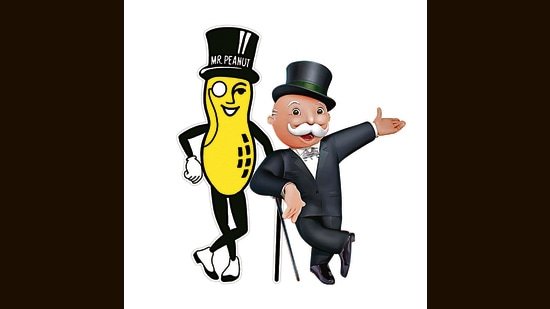
* The evil stepmother never said, “Mirror, mirror on the wall…”. (The line from Disney’s Snow White and the Seven Dwarfs is “Magic Mirror on the wall”)
* Darth Vader didn’t say, “Luke, I am your father.” He said: “No, I am your father.” (Significantly less dramatic, but it makes more sense in context.)
* Shazaam, a 1990s genie movie starring the comedian Sinbad, doesn’t exist. (It was basketball star Shaquille O’Neill who starred as a genie, in Kazaam; but that title barely even rings a bell.)
For decades, entire groups of people have misremembered the same specific things.
This unsettling glitch-in-the-matrix-style phenomenon is called the Mandela Effect, from the fact that many people, in the Aughts, had the inexplicable “memory” of South Africa’s anti-apartheid hero Nelson Mandela dying. Some recalled a funeral; others “remembered” reading about riots that followed. (Mandela died in 2013.)
Along similar lines, Mr Monopoly doesn’t have a monocle. (The Planters food company mascot, Mr Peanut does.)
Pikachu’s tail doesn’t have a black tip. (His ears do.)
Researchers studying the Mandela Effect have been unable to conclusively explain what makes some misremembered details so widespread.
Explanations among seekers of the supernatural include the theory that we do live in a matrix, that occasionally glitches; that we come from parallel histories; and even that the Large Hadron Collider at CERN has unlocked a new dimension.
The scientific explanation is a lot more prosaic. It has to do with the schemas or mental frameworks that help us efficiently make sense of the world, says Neil Dagnall, a cognitive and parapsychological researcher at Manchester Metropolitan University. These frameworks help us organise, process and interpret information based on past experience.
“Although we often envisage memory as a permanent, archival record, recollections are subject to editing and change over time,” Dagnall adds. “Recall is therefore a process of rebuilding details from stored information, leaving it vulnerable to errors, biases and social influences.”
Thus, because Pikachu’s ears have black tips, we “remember” his tail as having one too. Because Mr Monopoly is rich, and has the top hat, we apply the monocle from Mr Peanut to him as well.
MIND THE GAP
What does this mean for shared memory, in the age of AI?
Researchers agree the ramifications are dramatic.
Could a generation grow up believing that US President Donald Trump did indeed dress as Jesus one Easter (rather than merely releasing a doctored image of himself in Christ-like garb)? Could new versions of the present moment recast the uproar that followed — as celebration, perhaps even awe — based on the political leanings of the storyteller?
What happens, in other words, when the Mandela Effect occurs not by accident but by design?
“In a world where different versions of history can exist in visual form,” Dagnall says, “there is a clear risk of fragmentation.” This could result in a breakdown in shared reality, as manufactured “records”, widely circulated, begin to distort existing memory traces.
“Consensus reality would become more difficult to maintain,” Dagnall adds, “as memory is increasingly shaped not only by human thinking but by algorithms used to design and decide what we see.”
As AI introduces the potential for this kind of top-down, engineered misinformation campaign, studying the Mandela Effect could help researchers learn more about how this kind of distortion takes root, and how to combat it, Dagnall adds.
Failing which we really could end up living in parallel realities, in a splintered, fractured version of George Orwell’s 1984: where the past is reshaped not as one authority would like it to be, but to suit the whims of just about anyone with the right apps.
