

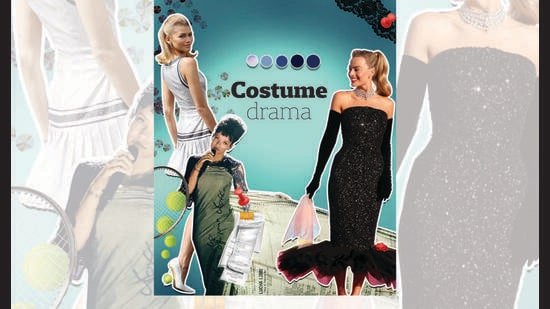
In March, English singer-songwriter Lily Allen opened the tour for her album, West End Girl, in an unusual gown created by designer Anna Fleischle. Printed on her flowy green fabric were texts and handwritten notes that her ex-husband, David Harbour, had sent to other women while he was married to her, and receipts from Chanel, Nobu and NYC’s The Plaza Hotel, where he had spent money on them. It seemed more apt than something off the runway – many songs on West End Girl reference Harbour’s infidelity. Allen literally zipped herself in and took control of her story.
All spring, she’s been a viral example of how power dressing has levelled up in showbiz today. The “Who Are You Wearing?” question no longer cuts it on the red carpet. To stand out, an outfit should now have a backstory, take a stand, show solidarity and throw in a history lesson.

It could be because we’re just tired of those post-Oscar, post-Grammy, post-Met-Gala best-dressed slideshows. Or that we already know how some of the magic works: The skin-toned mesh under the naked dress, the corset sewn into the gown, the update on a classic style. Or that celebrities don’t want to feel like clotheshorses on the GRWM Reels. Or that luxury design houses are struggling to stay relevant. But something has shifted. “Storytelling is now important to convey that you’re being thoughtful, respectful,” says stylist Akshay Tyagi, who has dressed celebrities for the Cannes Film Festival and the International Emmys.
So, what new tales are red-carpet dresses telling? Let’s break it down.

Character is destiny
Until recently, no one expected an actress to promote a movie dressed in outfits especially designed to echo the film’s theme. But zoom in on Carrie-Anne Moss’s Oscar de la Renta black dress at the 2021 premiere of The Matrix Resurrections. Those green sequins at the bottom mimic the cascading digital rain from the franchise. Subtle, clever, viral. Recall Margot Robbie in and as Barbie on the promo tour in 2023 (she did it again, dressing the part when promoting Wuthering Heights this year). Or Zendaya, showing up in tennis-inspired fits, down to shoes with tennis balls plugged into the heels, on the 2024 press tour for Challengers.
It doesn’t take much to notice that Ariana Grande spent 2024 and 2025 in frothy pink tulle, echoing her character, Glinda, as she promoted the Wicked movies. But here’s the Easter Egg: On the final day of her appearances, she wore a gown from Hubert de Givenchy’s Fall 1995 couture collection. Pink, yes. Tulle, yes. But it was also the final look in the designer’s last couture show before leaving the house. It was a farewell wrapped inside another farewell. Tyagi says that celebrity outfits are now deliberately chosen for the “behind-the-scenes tale of the look coming together for someone who’s not in the room”. It rewards the invested. It creates more content. It keeps the chatter going.

In India, method dressing has appeared in bursts and spurts. In Mr And Mrs Mahi (2024), Janhvi Kapoor plays a doctor whose cricketing skills blossom only after marriage. Her promo-tour outfits included saris customised with cricket ball imagery on the drape and her player number, rendered jersey-style, on her sari blouse, in red sequins.
Hearts on their sleeves
It used to be that if a celebrity supported a cause – Aids, perhaps, or LGBTQ+ rights — they’d simply add a ribbon or pin to their otherwise unrelated outfit. But in these trying times, activism is inseparable from the look.
In 2024, when Cate Blanchett walked into the Cannes Film Festival, photographers dutifully began to take pictures of her black-and-white Jean Paul Gaultier gown. It’s only when she raised the back hem, revealing bright green lining, that headlines were made. The colours, plus the red of the Cannes carpet, referenced the Palestinian flag. Blanchett didn’t need a pin; her whole outfit was the statement.

American politician Alexandria Ocasio-Cortez, knew, when she was invited to the Met Gala in 2021, that the elite event was at odds with her socialist politics. So, she let her dress do the protesting: The white gown made by the Black-owned label Brother Vellies had TAX THE RICH painted in bold, bright red across the back.
Indians in the spotlight have long used red-carpet events to showcase the country’s rich handlooms and crafts. Rina Singh, who has dressed everyone, from actors to court advocates, in her luxury artisanal brand Eka, has long collaborated with Arundhati Roy. Singh dressed the firebrand author and activist in soft silhouettes and a mix of earthy and bright colours last year to promote her memoir Mother Mary Comes To Me. “She wanted to make a statement with her clothes, given the situation the world is in today,” Singh says. Wearing unsung crafts from India as she toured the world was one more way that Roy could put her politics on display.

Celebrities are taking increasingly strong stances on what they wish to convey through their clothes, says designer Ikshit Pande. His high-end streetwear label Quod has been seen on Shruti Haasan, Dhee and Kavya Trehan, all of whom swing between artistic disciplines and are open to “using fashion for more than just a great visual”. In August 2021, Dhee posed in a Quod shirt for the cover of Rolling Stone India magazine. It was off-white, with a pointed collar and voluminous Victorian sleeves, and featured an abstract portrait of a woman whose face was composed of overlapping, jagged lines. “She has a very clear idea of who she is and the kind of stuff she wants,” Pande says. The shirt mirrored Dhee’s whimsy but within a defined silhouette, showing that there was a method to her madness.
Haasan, on the other hand, prefers a bit of goth-rock: Lace, leather, corsetry, deep hues. They help the actor-musician stand out in fields that are dominated by men.

The history lesson
“I remember putting Hrithik Roshan in a tomato-red tux for the IIFA awards in 2015,” says Tyagi. “It was the first time an Indian celebrity was wearing Tom Ford, and that was a big deal.” Indian stylists sought validation from the West then. They no longer do. Even Indian designers are no longer seen as simply providers of clothes. Fashion houses are building and investing in archives. Fashion schools teach modern design histories alongside older fabric-making traditions.
Nayanika Chatterjee, mentor and former model, says much has changed in the three decades she’s worked in fashion. But some challenges are inherently Indian. “We cannot wear the tricolour as costume; we can’t depict gods and goddesses on our clothes. It restricts how power dressing comes across,” she says.

And yet, new statements are possible. Consider what Isha Ambani wore to the Met Gala this year. The sari: Custom Gaurav Gupta, in woven gold tissue with handpainted pichwai-style motifs. The blouse: Studded with 1,800 carats of heirloom jewels from the family’s collection. The handbag: A 20-year-old steel mango-shaped potli by Indian artist Subodh Gupta. “She could afford to dress like that,” acknowledges stylist Jahnavi Sharma, who works in India, London and Paris. “But the fact that she chose to wear Indian craftsmanship on such a platform, instead of a Dior gown, is the statement.”

The boldest move for many might just be breaking out of the boss-lady/bimbo binary expected of Indian women. Designer Suket Dhir understood the politics of power dressing from the day he started his label in 2011. He’d seen his wife and co-founder, Svetlana, pull off his baggy clothes better than he did, and introduced menswear in women’s sizes in 2018. His cashmere sherwanis, printed khadi blazers, jumpsuits, and reversible ikat bomber jackets have been worn by Nobel laureate Abhijit Banerjee, actors Ranveer Singh, Kareena Kapoor Khan, Alia Bhatt and Sonam Kapoor.

The unlikely ambassador for the style: “Mira Nair”. The film director (and mother of NYC mayor Zohran Mamdani) has reworn Dhir’s jewel-toned brocade pantsuits over and over, across the years. “She will wear one pantsuit six different times in six different ways. She’ll sometimes pair the blazer with something else, or the pants with something else. Isn’t that fantastic?” Dhir asks. It’s method dressing – only this time, she’s following her own script.
From HT Brunch, June 20, 2026
Follow us on www.instagram.com/htbrunch
