

We have long used thread to register protest.
In Greek mythology, after Philomela’s brother-in-law Tereus raped her and cut out her tongue, she wove the story of what he had done into embroidery that she then sent to her sister.
During her long imprisonment in England, Mary, Queen of Scots, used symbols such as crowned cats, hunted mice and defiant phoenixes in her needlework, to write into history her fury and undying resistance against her cousin, Elizabeth I.
Earlier this year, red-tasselled beanies began appearing on the streets of Minnesota, inspired by Norwegian anti-Nazi hats. Known as Melt the ICE hats, proceeds go towards immigrant-aid agencies.
In such ways, craft has served as the language of those denied speech and visibility, during suffragette movements, ecological campaigns, even the Indian freedom struggle. (More on these in a bit.)
This legacy led knitting activist Betsy Greer to coin the term “craftivism” in 2003, to describe slow, intentional campaigns that use such art forms to spark dialogue and eventually help drive change.

“Craftivism is a bit like punk. Under that term, you have many different musicians with different styles and values,” says Sarah Corbett, 42, a craftivist and London-based activist. Inspired by Greer and all those who came before her, Corbett set up a social enterprise called the Craftivist Collective, in 2009. It offers tools, books and DIY craftivism kits for individuals, groups and campaign organisations around the world looking to use text-based hand-embroidery and papercraft for critical thinking and as a catalyst for action.
Eventually, people have, for instance, made stuffed clouds that say “I Dream of Clean Air” and luggage tags with the message “Albert Einstein was a refugee…”.
“Craftivism’s smallness can draw people in,” she says. “It can open doors to difficult conversations, creating a space where we can sit with people we disagree with, and grapple with the complexities of such topics.”
SEW IT GOES

The aim of such protest, adds Lynn Sanders-Bustle, associate professor of art education at the University of Georgia, is not necessarily to drive direct impact, but rather to chip away at injustice over time. “In essence, you are creating something with your hands that counters the production of hate, racism, and violence.”
What makes this particularly powerful, she adds, is that it engages people who don’t typically participate in more demonstrative forms of activism, urging them to stop, think and reconsider.
Over the long term, the power of such campaigns becomes visible.
As part of the abolitionist movement of the 1800s, for instance, Whites supported the anti-slavery cause through craftivism that spread the anti-slavery message. Woven into products such as quilts were messages that sought to evoke the appropriate horror at this deeply entrenched system.
A quilt made by activist Lydia Maria Child in 1836, for instance, featured lines from a poem by her contemporary, Elizabeth Margaret Chandler, that described the trauma of a slave separated from her child.
“Think of the negro mother, when / Her child is torn away, /
Sold for a little slave-oh then / For that poor mother pray!”

In a similar vein, the Suffragette Handkerchief, now preserved at the Priest House museum in England, bears in hand-embroidery the names of 68 women arrested in London in 1912, for demanding the right to vote.
India’s move towards khadi during the struggle for independence was, in a sense, a form of craftivism too, although it was also so much more, hitting out as it did at the heart of the British empire in India: its textile profits.
In Chile, meanwhile, women used brightly coloured tapestries to tell the stories of men in their families who went missing during the totalitarian regime of Augusto Pinochet in the 1970s and ’80s. Many of these tapestries were smuggled out and used by Amnesty International to help build public and political pressure to force Pinochet out of office. (He eventually lost a democratic vote and stepped down, in 1990.)
WOOL YOU RESIST?
Perhaps the world’s largest and best-known piece of craftivism, of course, is the AIDS Memorial Quilt.
Work on it began in 1987 and remains ongoing. The 54-tonne memorial to grief and loss is currently made up of 50,000 panels bearing the names of 110,000 people who died from a disease that was ignored by governments and the medical community for years. (It was last displayed in full at the National Mall in Washington DC in 1996, and is preserved at the National AIDS Memorial in San Francisco.)

Dramatic recent examples of craftivism, meanwhile, include the iconic Red Dress by artist Kirstie Mcleod, made up of 87 pieces of burgundy fabric embroidered by 380 individuals, including refugees from Palestine, Syria, Ukraine, Iran, Iraq, China, Nigeria, Namibia, Kosovo, Bosnia and Herzegovina, Rwanda, the Congo, South Africa, Mexico, Egypt and marginalised artisans from India.
As the artwork, which was completed between 2009 and 2023, moves across galleries and exhibitions, even a single-line descriptor like the one above offers a sense of the scale of still-ongoing conflicts and the extended toll they exact.

It feels counterintuitive, but slow craftivism can engage people more deeply and intimately, since it can be harder to dismiss than more divisive forms of activism, Corbett says.
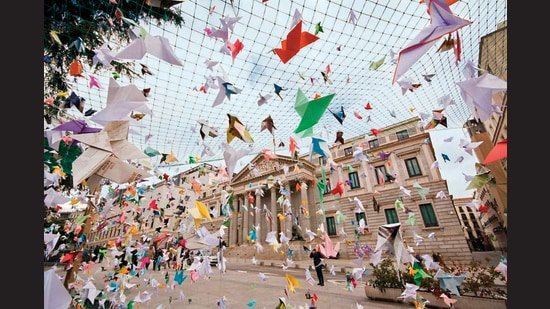
This was certainly true of World Wide Fund for Nature’s (WWF’s) 2016 origami migration campaign, in which thousands of colourful origami birds of varying sizes were hung outside Spain’s parliament, in an appeal against plans to dredge up a river and build a shipping canal through the Donana national park (which hosts thousands of migratory birds each year).
Over 1,800 people contributed by sending handmade birds by post to WWF. The campaign made global news. It added to the weight of sustained marches and protests, and Spain’s government eventually announced there would be no dredging in the Guadalquivir river.
Is there a cause close to your heart that you would like to subtly draw attention to?
Corbett’s Craftivist Collective Handbook (2024) offers ideas for thought-provoking projects, tips on sourcing ethical supplies, advice on picking fonts and colours, and even soothing playlists to help keep you going. You’d be surprised how effective it can be, she promises.
