

When India’s ultra-wealthy tie the knot or celebrate milestones, the scale of extravagance routinely makes global headlines. Yet, behind the multi-million-dollar floral installations and sprawling glass pavilions lies an invisible, hyper-precise engine: VVIP catering. Also read | Step inside fancy venues for Anant Ambani’s pre-wedding festivities with larger-than-life florals all around
This is a world where menus read like fine-art manifestos, timelines change by the minute, and billionaires stand shoulder to shoulder waiting for street food. At the peak of this elite circuit is Cherish Hospitality and its signature culinary concept, A-La-Chaat.
Having curated dining experiences for India’s most powerful families — including the Ambanis and Adanis — as well as royalty, heads of state like former President of India Pranab Mukherjee, and Bollywood A-listers, such as Akshay Kumar, they have turned the simple act of feeding guests into high-stakes theatre.
From grandeur to emotion
The definition of luxury at Indian weddings has undergone a profound shift. The modern billionaire guest is no longer swayed by gold leaf and sheer volume. “Today’s discerning clients are no longer impressed by grandeur alone; they seek meaningful, personalised, and immersive experiences,” Naveen Sachdeva, founder and managing director of Cherish Hospitality, told HT Lifestyle in an interview. “VVIP guests rarely remember how extravagant an event looked; they remember how smoothly it was managed, how welcomed they felt, and the thoughtful details,” he added.
This philosophy translates into spaces where local heritage seamlessly meets international luxury standards. For global destinations, traditional Indian recipes retain their culinary essence, while the presentation and service flow are meticulously elevated to compete on the world stage. Also read | Inside Ambani family’s Venice party with opulent decor, traditional Indian thali menu of poori, bhindi, dahi bada
A look inside the culinary setup
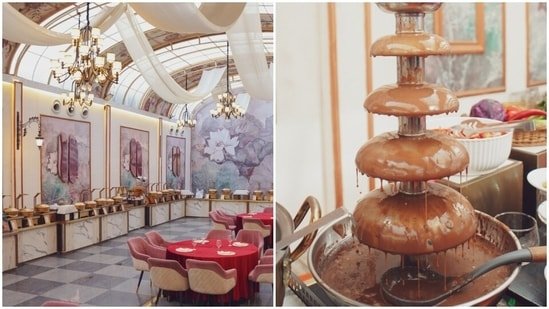
The visual presentation is treated with the same reverence as fine architecture. Step in and you’re met with sprawling banquet halls where dramatic, floor-to-ceiling drapes cascade beneath arched, glass-paned ceilings. Majestic, tiered chandeliers throw a warm glow across polished marble floors and carved wood paneling.
But the drama doesn’t stop at the dining room. The live counters are staged like culinary theatres. Think luxury materials — brass, stone, and velvet — paired with handcrafted displays. Warm, geometric-patterned lattice risers hold mounds of seasonal produce, flanked by halved citrus, terracotta pots, and apothecary jars filled with raw spices and herbs. You can smell the cardamom before you even see it.
For contrast, there are sleek, multi-tiered chocolate fountains catching the light, and custom-lit neon bar lounges that pulse with a modern, high-energy vibe. It’s where old-world opulence meets contemporary design. The result: a dining space that feels more like a curated experience — traditional at its core, but with moments of drama and indulgence built into every corner.
Serving the perfect pani puri to India’s elite
Perhaps the most fascinating phenomenon at these ultra-luxury gatherings is the unexpected centrepiece: street food. Through A-La-Chaat, humble staples like pani puri, papdi chaat, and aloo tikki are elevated into artisanal crafts without losing their authentic souls.
“Pani puri is perhaps India’s most democratic food. Every generation has a memory associated with it. At luxury weddings, it instantly breaks barriers,” Kratika Gupta, co-founder of Cherish Exclusive and A-La-Chaat, told HT Lifestyle, adding, “Billionaires, celebrities, diplomats, and international guests all stand together waiting for the next puri. That shared experience creates energy unlike any other food station.”
Executing this at a massive scale requires treating street food with laboratory-like precision. “We don’t believe luxury means changing the identity of a dish. Every pani puri shell is perfectly crisp. Every chutney is prepared in-house. Scale should never compromise authenticity,” Kratika said.
Operating under extreme pressure
Catering for individuals who can command any luxury on earth comes with intense logistical pressure. The real test of a luxury caterer lies not during the smooth tasting sessions, but in how they handle chaos behind the velvet curtains.
During one of the country’s most high-profile wedding celebrations, guest movements and service windows shifted completely at the final hour, recalled Kratika. The team had to reorganise entire live kitchens and service flows on the fly. “The guests experienced the event exactly as planned — without ever realising the complexity behind the scenes,” she said
An even greater testament to their operational agility occurred during a massive destination wedding originally slated for the Emirates Palace in Abu Dhabi. Kratika shared that due to sudden, unexpected geopolitical airspace closures, the entire wedding had to be completely uprooted and relocated to Rishikesh, India, with just a few days’ notice. The team instantly pivoted — re-routing supply chains, flying in manpower, and redesigning kitchen layouts on a mountainous terrain under a ticking clock.
The event went off flawlessly.
Ultimately, the true marker of VVIP catering isn’t the price per plate; it is the absolute peace of mind given to hosts who own the world, ensuring that their guests leave with a memory that cannot be bought — only experienced.
