

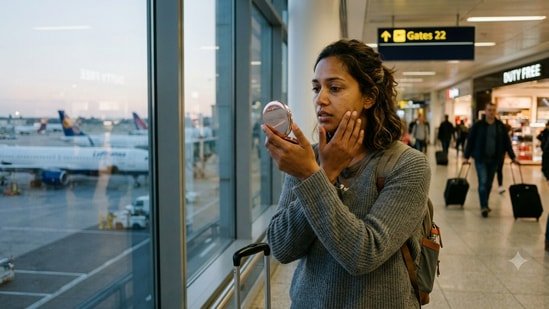
When you are at the airport, your skin goes through a lot as you navigate long security checks, cabin dryness, crowded terminals, layovers, delayed flights, long hours of indoor air-conditioning and poor sleep. The culmination of all these results in your skin looking dull, dehydrated and just very tired as you step out of the airport looking dishevelled. The post-travel skin fatigue is referred to as ‘airport skin.’
As much as it gets in the way of your well-planned airport OOTD, airport skin can also feel uneasy to bear. It may leave the skin feeling uncomfortable, rough, tight, dry and even scratchy at times.
Dermatologist, Dr Rupika Singh, founder of Akiya Aesthetics, told us that airport skin is a very ‘real’ response of the skin to long hours of air travel.
Major reasons why airport skin happens
The first reason, according to the dermatologist, is the extremely dry cabin air. The conditions inside an aircraft are not always skin-friendly, and this can result in telltale signs of skin dehydration, like flakiness or a sensation of tightness. “Low humidity levels of aeroplane cabins, such as somewhere between 10-20 percent is way too low for the skin,” Dr Singh cautioned.
The second reason is related to stress, as there are several challenges including delayed flights, poor sleep and jet lag. Dr Singh believed stress can increase cortisol levels in the body, which may then, as a chain effect, worsen inflammation, trigger acne, and increase sebum production, which causes the skin to look dull and dry.
Many people tend to drink a lot of coffee at the airport while waiting for their flights, but Dr Singh strongly urged travellers to avoid overdoing it, as coffee is diuretic in nature, which means it may worsen dehydration, and as you know, dehydration is the precursor to dull and dry skin. So, it means fewer coffee pitstops between security checks and boarding gates!
Now, why is dehydration so damaging to your skin, making it look visibly tired? This happens because of a process called transpidermal water loss (TEWL.) At the airport, dehydration can disrupt the skin barrier, causing the skin to lose more water. This is why the dermatologist observed that the skin appears more tired and much less plump.
Did you know your plane seat matters too?
If you love the crowd-favourite window seat for the cosiness, amazing views, and the dreamy blue sky shots from above the clouds, there is a grim catch to it.
“The seat next to airplane windows exposes the skin to even higher levels of UV radiation than the ground because the altitude is high. This leads to pigmentation, tanning and even oxidative damage,” Dr Singh warned, describing how your skin may be directly exposed to UV damage if you pick the window seat.
How to prevent airport skin?
You can prevent ‘airport skin’! It is doable and quite simple as well. There are a few guidelines you need to adhere to so that your skin is well-protected as you jet off. Steps such as drinking water, using barrier-repairing moisturiser, and in general following a routine, significantly reduce dryness, dullness and irritation when you are travelling and in between terminals.
Dr Singh outlined these steps to prevent airport skin:
1. Hydration both before and after travelling:
- Before travelling days, begin sipping water to be well hydrated.
- Just be mindful of not gulping water.
2. Moisturise with moisturiser containing barrier-repairing ingredients:
- Use moisturisers that contain ingredients that support skin barrier strengthening.
- Use ingredients like hyaluronic acid, ceramides, glycerin or squalane.
3. Sunscreen is non-negotiable:
- Sunscreen is non-negotiable and is on flights, especially if during the morning hours.
- A broad-spectrum SPF helps protect against UV damage and pigmentation.
4. Keep skincare simple:
- Over-exfoliation and using harsh actives before flying is not recommended.
- A simple regime of cleansing, moisturising, and applying sunscreen works the best.
5. Lip balm and hydrating mist help:
- Lips and undereyes are two sensitive areas of the face that dry out quickly during flights.
- Using a hydrating lip balm and facial mist free from fragrance helps.
Note to readers: This article is for informational purposes only and not a substitute for professional medical advice. Always seek the advice of your doctor with any questions about a medical condition.
