

In 79 CE, the Mount Vesuvius eruption froze street-food counters mid-service.
When archaeologists uncovered these thermopolia (literally, “hot shops”), they found them covered with paintings advertising the fare: chicken and upside-down mallard ducks (alongside a naked nereid riding a seahorse, presumably to liven things up). There was even community feedback: Cinaede Cacator (Shameless Shitter), says one scrawl.
Through the ages, we have sought to satisfy our cravings with minimal effort. Today’s food delivery apps are merely the latest phase in a project as old as life itself: removing friction from eating.
Convenient food often began as a way to cater to travelling traders, yes, but also to anyone who did not have the means or inclination to run their own kitchen: the lonely, lazy, or merely those out for a lark. Think of the kebabs of Central Asia, noodle shops of China, and descriptions in Chanakya’s Arthashastra of spies who disguised themselves as food vendors. Even the Thiruvilaiyadal or stories of the divine games of Shiva in Madurai, see him subbing, and subsequently slacking off, for a poor woman who sells puttu or rice cakes on the street.
There is one key difference today. Ancient street food celebrated seasonality and locality, and minimised waste (the puttu seller, for instance, offered leftover cakes to Shiva as wages). These are qualities that modern fast food does not prioritise… yet.
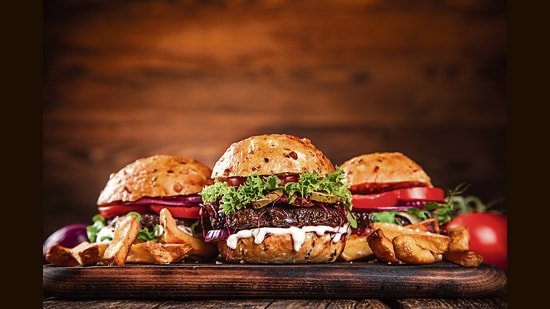
Modern capitalism instead spotted the potential of the craving, a biochemical tug that can seem too strong to resist. Its impact is clear in the way the hamburger was transformed.
The proto-hamburger was anything but fast food. Food writer Josh Ozersky describes a recipe from 1763 in his book, The Hamburger: A History (2008): “Take a pound of Beef, mince it very small, with half a Pound of the best Suet; then mix three Quarters of a Pound of Suet cut in large Pieces; then season it with Pepper, Cloves, Nutmeg, a great Quantity of Garlic cut small, some Wine Vinegar, some Bay Salt, a Glass of red Wine, and one of Rum; mix all these very well together, then take the largest Gut you can find, stuff it very tight; then hang it up a Chimney, and smoke it with Saw-dust for a Week or ten Days; hang them in the Air, till they are dry, and they will keep a Year.”
By the 20th century, hamburgers had an image problem too. They were “widely considered the final resting place of every kind of scrap and offal,” Ozersky writes.
American capitalism kept hamburgers cheap while giving them an image makeover and whittling prep time down to seconds. The story begins with the White Castle chain, which in the 1920s sold burgers in pristine white buildings, on spotless counters with kitchens in plain sight that reassured hungry patrons the product was trustworthy while encouraging them to load up on cheap burgers. They even quoted studies that claimed students could remain healthy eating nothing but (their) burgers.
McDonald’s took this to the next level. The brothers Richard and Maurice McDonald ran a successful barbecue joint off Route 66 in California in the 1940s, serving slow-cooked food. Then came World War 2, and the massive boom that followed. Amid growing competition, the brothers decided to reinvent. In 1948, they rebuilt their restaurant around the principles of Henry Ford’s assembly line.
The new avatar emphasised quick service, disposable packaging and a small menu of fast-moving items: burgers, soft drinks, milk, coffee, potato chips and pie. The format set the tone for fast-food going forward: cheap, quick, with bold flavours — loaded with salt, sugar and fat — sold in large quantities, usually wrapped up in single-use packaging (no dishwasher needed) for people on the go.
In India, early fast-food icons predate McDonald’s. They catered to the newly emerging urban migrant, short on time and cash, wanting something filling, cheap and quick. In 1942, for instance, Rama Nayak opened what is considered Mumbai’s first Udupi restaurant, Udupi Shri Krishna Boarding in Matunga, to cater to the growing South Indian community. He settled on specific quantities of coconut and spices for his chutneys and sambhars that allowed standardisation in high volumes. While this food suited the client’s palate and pocketbook, it still required the customer to come to the restaurant.
By the 1960s, thousands of textile workers began passing through Dadar’s railway station on their way to work at the mills. Ashok Vaidya set up a small stall there to sell them a cheap, quick breakfast. It was among the first places to offer the city’s iconic vada pav.
Convenience became about serving tasty cheap food when and where the customer was, such as Dadar station at breakfast. Alongside, food choices were changing: poha, pithla and zunka were increasingly losing ground to fried items. Bread often featured in the new options, as wheat gained prominence across the country thanks in part to cheap American imports and then the Green Revolution.
As India slowly grew wealthier, a small middle class began to hanker after “foreign foods”. To meet this demand, the brothers Lakshmi Chand and Madan Gopal Nirula, longtime restaurateurs, opened an early American-style fast-food restaurant at Connaught Place in Delhi, serving pizzas, burgers, ice-cream and milkshakes. Long before the multinational invasion, Nirula’s was where joint families went after movies, to celebrate birthdays, and for other treats. Convenience became a way to make novelty accessible.
***
Then India opened up to the world. Multinational brands entered. America’s poor man’s fare became aspirational here, evidenced by the snaking lines waiting to enter McDonald’s.
Meanwhile, our own poor man’s fare, the hardy millet, receded further into the background. Gut- and climate-friendly though it was, how could it compete with the zing of fried, sugared and salted maida?
Over the next few decades, refrigerators became widespread, more women entered the workforce, and young professionals saw their disposable incomes boom. India’s middle class became wealthier and time poor. As roads grew more congested, convenience translated to home delivery. (Cue even more disposable packaging.)
Fast-forward to today and over 85% of households own at least one smartphone. Indians are moving to new cities to study and work, with no one to cook for them, and little time or inclination to cook for themselves. Thus, a new market was born.
In July 2008, Deepinder Goyal and Pankaj Chaddah launched FoodieBay, which let users access restaurant menus from their computers. It grew, was renamed Zomato, and pivoted into food delivery in 2015. Today, Zomato controls about 55% of India’s online food delivery marketplace, with Swiggy controlling most of the other 45%. With this, and the recent addition of quick commerce, convenience now means whatever food, whenever and wherever you want it.
***
With AI, “convenience” can even strip away the veneer of conscious thought, as algorithms reach directly into the primal emotional brain nestled within us.
Before the merest glimmerings of a desire for, say, biryani, manifests, the phone pings with a notification trained on intimate knowledge of past orders and when your hunger tends to strike. A screen shows goodies one loves accompanied by “special” offers. A click or two and the deal is done. Each stage of the delivery process is logged in real time, the gamification only serving to reinforce the biochemical manacle that tethers one to the app.
The food arrives predictably tasty, having been reviewed by thousands, safely wrapped in layers of packaging. (Even better, the price tag doesn’t reflect the full cost of the order.)
One eats with disposable cutlery; tosses disposable accompaniments. No clean-up. No compromise either; as each adult in the house operates their own account. We virtuously store leftovers in the fridge, but really, how many of us return to them?
Convenience has evolved from minimising effort to eliminating decision-making itself. We have spiralled up, moving from conscious action to habit.
Only, in this long march, we have lost a fair bit. There is the environmental cost, of course, paid in packaging and grain and food choices, in carbon and wasted food. There is also a hidden biochemical cost within our bodies, which have been rendered less resilient.
Today, certain companies have enormous power to shape what India eats. They can help unleash innovation to lessen some of these societal costs.
That is the power and promise of capitalism — if the customer demands it, and makes it worth the company’s while to do so. Tune in to unpack some of the losses, and what can be done about them, next time.
(Mridula Ramesh is a climate-tech investor and author. She can be reached on tradeoffs@climaction.net. The views expressed are personal)
