

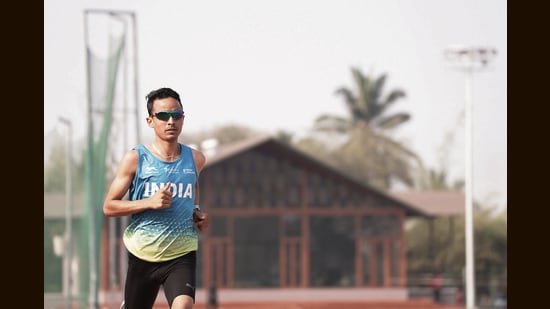
There’s a reason the 10,000m race isn’t called the 10km run.
It isn’t run across a 10-km stretch. It is run on a standard 400m track, in what can grow to a steady rhythm.
Take the runner out of the stadium, and so much changes. The unevenness of terrain and changing conditions are part of what makes a marathon so challenging. Added to this is the vast distance: 42.135 km.
One is no longer merely racing against one’s opponents, in such a race.
One is accommodating the “x” factor, challenging the body and battling the mind.
So it isn’t surprising that, when Sawan Barwal finished the Rotterdam marathon in the Netherlands, and didn’t meet his target, he was disappointed.
“I had gone there looking to do better than 2:10:00 hours,” he says.
The winning time in Rotterdam last month was 2:03:54, clocked by Ethiopia’s Guye Adola. (The new world record, meanwhile, set by Kenya’s Sabastian Sawe at the London Marathon on April 26, is 1:59:30.)
Barwal had not been looking to win at Rotterdam. Still, when he crossed the finish line in 2:11:58, he was not pleased.
Then his coaches and members of the organising team began to congratulate him. It turned out he had broken India’s longest-standing athletics record.
He had beaten a legend, across nearly half a century.
The late Shivnath Singh’s time of 2:12:00 had stood for 48 years. Since before the CD was invented, or the IBM PC. Seasoned runners had struggled and failed to beat it.
Now Barwal had reset the clock, in his first marathon ever.
“I still couldn’t shake that feeling of being disappointed,” says the soft-spoken 28-year-old havildar with the Indian Army. “I spoke to my family and they too said that now that I had broken a record that had stood for so long, I should enjoy the moment. Eventually, I did.”
Celebrations included dinner at a Japanese restaurant, he adds, and a river cruise with his coach the following day.
***
Barwal has been a runner for over a decade, but he’s still a bit surprised to be pursuing a career as an elite athlete.
“I had an interest in the banking sector,” he says.
He only started running after a chance visit to a track near his hometown in Himachal Pradesh’s Mandi district. His elder brother was on the school’s track team. Watching from the sidelines, he was roped in to train in the 1500m athletics event, at the age of 14.
He had until then played mainly badminton. “I finished fourth in the athletics event, despite competing against seniors. That was quite a good result, so I got interested in running,” he says.
His parents — Kuldeep Singh, 55, a driver in New Delhi, and Subhadra Devi, 50, a homemaker — were enthusiastic about his new passion.
“It helped that I kept winning medals,” Barwal says.
He won at inter-district meets. Then, in 2013, went home with bronze in the 3000m race at his first Sub-Junior Nationals. That’s when he realised he was really good at this, he says.
In 2019, he joined his elder brother in the Army, under the sports quota, determined to train and make the most of his talent.
“My whole life changed – the way I dress, speak, train, the way I eat… Back home I didn’t know much, but here I see the discipline of the senior athletes and learn from it,” he says.
Based at the Army Sports Institute in Pune, he started training under coach Ajith Markose in the Reliance Foundation’s Endurance Program in 2022. The faith his coaches show in him gives him the confidence he needs, Barwal says.
In 2023, the idea of moving from his usual 10,000m event to the marathon was first floated by Athletics Federation of India coach Scott Simmons.
“The coaches were clear that I should try it. They told me, if it doesn’t work out, it’s not a big deal, but I should try,” Barwal says. “That made me feel good, but for me, there was a lot riding on this too.”
To train for his new challenge, he raised his weekly mileage from 180 km to 220 km , including a longer run on Sundays. That longer run went from 28 km to 36 km.
He really wanted to make an impact in his first marathon, he says.
“I knew I needed to do well, because if I didn’t, I would be disappointed for the whole year and that would affect my other performances,” he says.
With his new record, he has now qualified for the Asian Games in Japan, in September-October. The record there is 2:08:21. Could another new record for India be on the cards?
***
Even as he was raising the bar for India, in Rotterdam, Barwal was learning what not to do when running on this mammoth scale.
The last 7 km of a marathon is the most difficult stretch, he says. “After the 35km mark, it becomes a mental race more than a physical one.”
The body is craving rest, and there is a temptation to speed up.
Speed can be an insidious enemy.
“Going too fast for a few consecutive km breaks your rhythm. You cannot be too fast,” Barwal says. “In the 10,000m, one doesn’t have to worry about this. But with the marathon, you aren’t just running, you’re measuring. I had aimed to cover each km in 3:02 to 3:04 minutes. That calibration is a big challenge.”
Another key hurdle can be weather. The Rotterdam race was run on a cold and windy morning, in temperatures of about 5 degrees Celsius.
At the 35-km mark, exhausted and desperate for relief, Barwal splashed cold water on his face, which turned out to be a mistake, given the conditions. “Because of the wind, the water on my face started to freeze. The mind stopped working and once that happens, you can’t do much. I blacked out and lost time.”
Barwal stumbled on the track, faltered and fell, 100m short of the finish line. A volunteer helped him back up and he finished the race, but it had cost him about 90 seconds.
Already, all this is behind him. He and his coaches have their sights set on Japan.
The target is 2:08:00.
He’s raised the bar once, he says. He wants to raise it again.
