

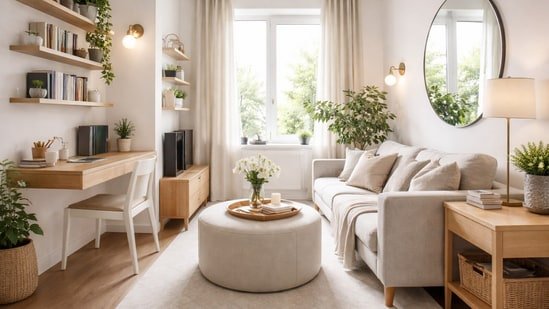
Furniture effectively jazzes up your home, and for good reason. It is considered an integral part of any interior, because without it, a space would feel like a bland shell.
ALSO READ: Want your home to feel like a warm hug? 6 decor tips to make it cosy
Beyond utilitarian purposes like storage or seating, furniture also determines the aesthetic and the sense of space within a room.
But here’s a common oversight when curating furniture: there’s a fine line between furnishing a space to fill it tactfully and tacky overcrowding.
In such situations, every item needs to be chosen with due diligence and, most importantly, with intention. Overfilling a room can make it feel cramped or chaotic, while a more nuanced take makes it visually more open.
HT Lifestyle connected with Lokendra Ranawat, CEO & Co-Founder of Wooden Street, to get practical tips on how to make small spaces appear bigger when adding furniture.
Sharing his observation on how most people are living in smaller homes, especially in cities due to urbanisation and space limitation, there is a need for space-efficient solutions.
“Compact living is a rapidly growing trend, particularly in urban areas in India,” Lokendra noted.
He further went on to suggest that with better design strategies and furniture innovation, compact homes can be stylish as well. “Small living spaces do not have to mean sacrificing design or comfort,” Lokendra added. But he also reminded us that to pull off this balancing act, choose furniture that has a seamless combination of functionality and visual lightness.
Here are some of his hacks:
1. Choose multi-purpose furniture
- The right kind of furniture can make a world of difference in small and compact living spaces.
- For example, bedding that has hidden storage, a foldable dining table or a storage ottoman that can be used as an additional seat.
- Such furniture helps to keep the space free of clutter and maximises the functionality of the space.
2. Stick to light and neutral colour tones
- Beige, white, and pastels are colours that are more light reflective, and will make a room look bigger than it is.
- Neutral-toned furniture will also be less of a visual distraction, blending in with the rest of the room and producing a more cohesive look.
3. Neutral is better
- For walls and larger furniture pieces, go for light and neutral.
- Furniture with this design trait provides an illusion of space because the light can pass through, and the less light that is blocked, the less the visual overwhelm of the room.
4. Invest in foldable or expandable pieces
- Fusion design gives you multiple options when creating a space.
- Wall desks, foldable chairs, and extendable tables adapt to specific design and space needs at any given time.
5. Employ mirrors and glass surfaces
- Using glass surfaces, such as glass-top tables and mirrors, is a great way to make a room feel larger.
- These surfaces reflect light and give the illusion of a larger room.
6. Do not overfill the space
- The biggest mistake people make when designing a small space is overcrowding it with furniture.
- For small spaces, it is best to choose a few basic pieces of furniture that are the most useful and leave out the ones that will make the space feel busier.
In the end, he urged to prioritise functionality, lightness, simplicity, and practicality, stating the ‘less is more’ principle holds true for furniture placement in spaces.
