

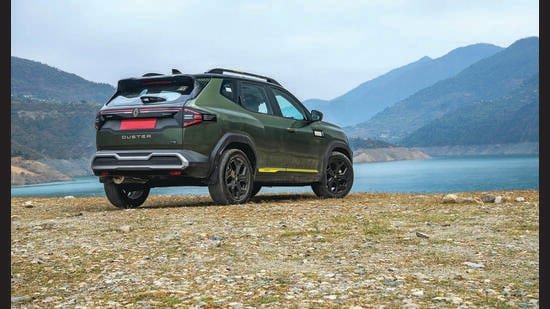
A decade ago, the first Duster pretty much invented the midsize SUV space in India, winning fans with its tough stance, brilliant ride and torquey diesel engine. As rivals mushroomed, Renault quietly got out of the race, letting the legend grow in owners’ WhatsApp groups and used-car forums. Now it’s back. You’ll recognise the square-shouldered stance, but the details are all-new. This time there’s no diesel, no all-wheel drive and no bargain-basement image.
Instead, you get high-tech turbo-petrol engines, a new platform, and a cabin that looks 2026-ready. The front wears bold LED headlights with eyebrow-style daytime lights that double up as indicators, a chunky skid plate and, interestingly, a big Duster badge instead of the Renault logo – an admission that the Duster brand is a bigger name than the company that makes it. Along the sides, black cladding, proper roof rails and 18-inch alloys give it that “road trip to the hills” vibe, backed by 212mm of ground clearance, and serious approach and departure angles for rough roads.
This is still a very practical SUV: The boot can swallow 518 litres with ease, expanding to 700 litres if you stack luggage to the roof. Step inside and you won’t mistake this for the old Duster. The dash has two screens, textured plastics and splashes of silver, faux-carbon-fibre and contrast green stitching that make it feel more upmarket. Crucially, Renault has not gone touchscreen-crazy: The AC has proper buttons and knobs, so you’re not stabbing at the screen on a bumpy road.
The front seats are generously padded, electrically adjustable and get powerful ventilation. The rear bench has good headroom and enough knee room. But shoulder space is tighter than in some rival SUVs and a third passenger won’t thank you on longer drives. There are rear AC vents, charging ports and a centre armrest, but no sunblinds, and the higher window line means you don’t get the same airy feel that the original Duster offered.
Under the bonnet, the old diesel workhorse has been replaced by a pair of turbo-petrols. The range starts with a 1.0-litre 3-cylinder unit with 100hp and a manual gearbox, but it’s the 1.3-litre four-cylinder turbo-petrol that’s the star. On paper it makes a strong 163hp and 280Nm, and in the real world it feels smooth, quiet and properly punchy once the turbo wakes up. You can have it with a six-speed manual or a six-speed dual-clutch automatic; the automatic suits the Duster’s relaxed, family-crossover vibe better.
Where the Duster still stands out is its ride comfort. On our route from Dehradun to New Tehri, it soaked up broken patches, rocks and potholes with a calm, almost unbothered attitude, the suspension feeling slightly firm at low speeds but wonderfully composed as speeds rise.
Prices for the new Duster start at ₹10.29 lakh and go up to ₹18.49 lakh (ex-showroom), putting it right in the heart of the midsize SUV crowd. A warranty of up to seven years or 1.5 lakh kilometres further boosts peace of mind.
So, does it live up to its legacy? Absolutely. The new Duster is still tough, still comfortable on bad roads and now much more modern, safe and feature-rich.
From HT Brunch, March 28, 2026
Follow us on www.instagram.com/htbrunch
