

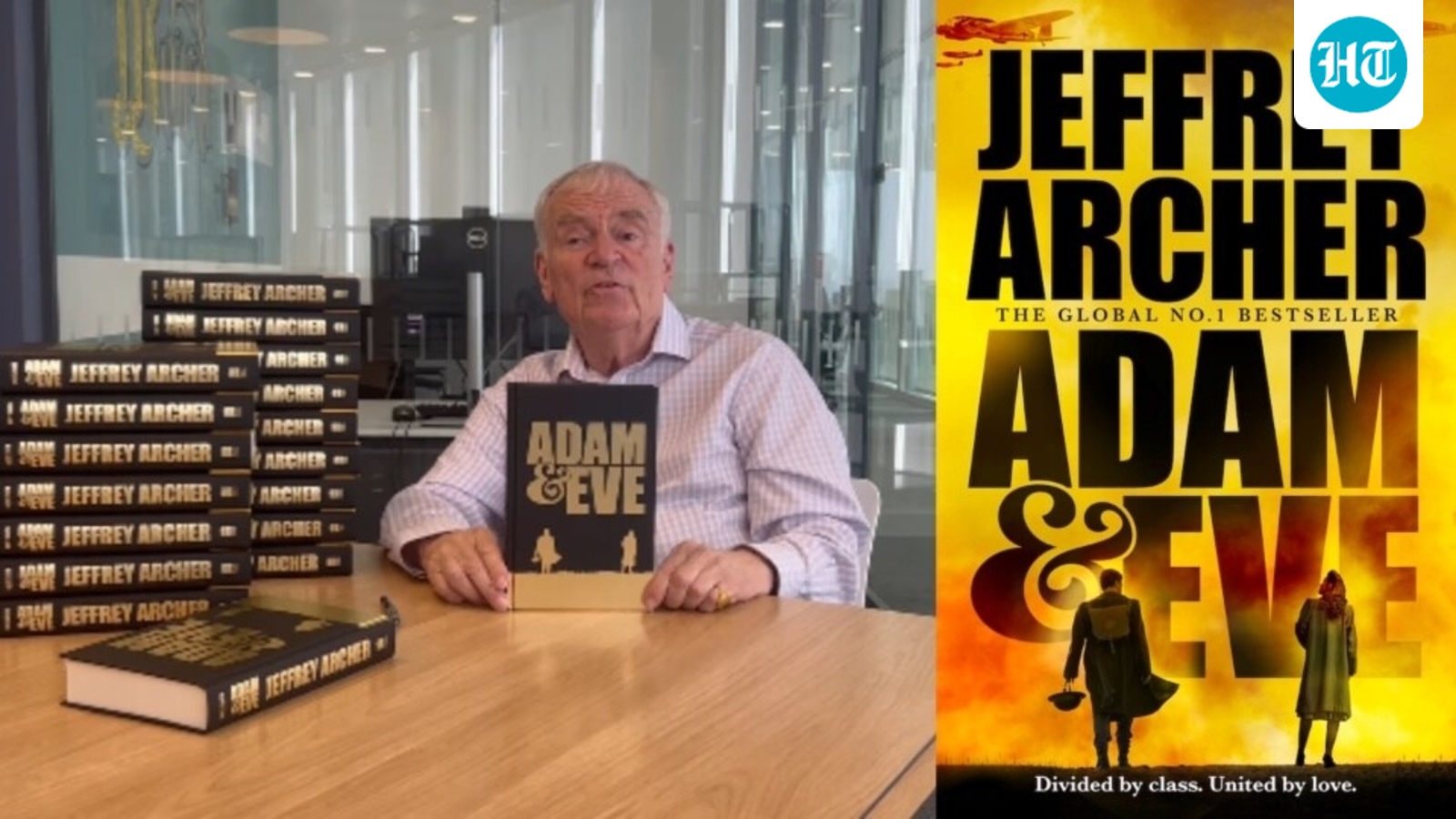
Bestselling British novelist Jeffrey Archer has died at 86, just one day before his last novel was set to hit shelves worldwide. He died ‘peacefully’ at his home on October 5, publisher HarperCollins confirmed. His last book, Adam and Eve, was released globally on October 6. Also read | Jeffrey Archer, British author and politician, dies at 86 ‘between writing sessions’
What is Adam and Eve about?
If you grew up with a copy of Kane and Abel, you already know Jeffrey’s formula. And his final novel brings him full circle. Like Kane and Abel, it follows two biblically-named characters born on the same day — but into very different worlds.
Per details shared on Jeffreyarcher.com, the official synopsis is this: “Two children are born on the same day, the eleventh of November, 1918, the day the First World War ended. One is the daughter of an Earl, whose father wanted a son so that the title and the estate could pass on. One is the son of a shepherd on that same estate, whose father wanted a daughter, because he was certain a boy would end up going to war. You follow them from that first day, through childhood and school and university, to the fifteenth of September, 1940, when they cause Adolf Hitler to change his mind.”
It’s a love story, a class commentary, and a war epic all at once. At its heart is Eve, the daughter of an earl who is disappointed he didn’t get a male heir to inherit his title and estate, and Adam, the son of a shepherd on that very estate, whose father quietly prayed for a girl because he knew a son would eventually be sent off to fight. Jeffrey tracks them from that first breath on Armistice Day, through their totally opposite childhoods, to school, to university, and finally to one day in the Second World War — September 15, 1940 — the date the book ultimately pivots on, when their actions cause Adolf Hitler to change his mind.
Is it based on a true story?
This is the question everyone is asking, and Jeffrey himself answered it on Jeffreyarcher.com. The historical scaffolding is true; the central link to Hitler is purely a Jeffrey Archer invention. He explained: “The history is real. The war is real. The date the whole book turns on is real, and rather more important than most people realise. The two of them are mine. So is the idea that links them to Hitler, and I have had a reader write to ask whether I found that somewhere. I did not. It is my invention, entirely.”
‘The most satisfying thing I have ever written’
He was open about the fact that Adam and Eve would be his swan song. In a Q and A posted on Jeffreyarcher.com, he was asked whether this was really his final novel. His answer was honest: “Yes. After fifty years of storytelling, I decided the time had come to write my final novel, and this is it. I am often asked whether I might change my mind. I am eighty-six. A novel of a hundred and fifty thousand words takes more than twenty drafts, and it takes a great deal out of you. That is the honest answer. Adam and Eve has proved the most satisfying thing I have ever written, and there is a great deal to be said for finishing on the book you are proudest of.”
End of an era
For those who don’t know the full Jeffrey Archer story, it was never just about books. He was both a global literary phenomenon and a political figure. His debut novel, Not a Penny More, Not a Penny Less, was published in 1976 and was inspired by his near-bankruptcy after bad investments. He went on to sell more than 300 million books worldwide and spent over five years on The New York Times bestseller list, according to HarperCollins.
In politics, he rose through the Conservative Party under Margaret Thatcher and was appointed to the House of Lords in 1992 by John Major. His political career was derailed by a perjury conviction that led to a brief prison sentence, which he then wrote his way through, coming back again. Some of his fiction, including his final book, continued to explore themes of gender bias and inherited inequality. He is survived by his wife of 60 years, Dame Mary Archer, their two sons, and their families.
With agency inputs
