

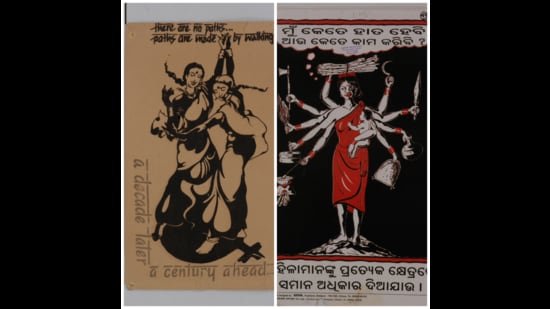
* “Kokh ke andhere se kabra ke andhere tak (From the darkness of the womb to the darkness of the grave),” says a poster that serves as a comment on female infanticide, violence against women, and biases that serve to keep women in the dark.
* “Yes we can,” says a note held up by a chic, smiling, wheelchair-bound woman in another such art work.
* A third poster bears no words, just a heartfelt wish. It shows a woman reclining in a sari, her feet up on a stool, a book in her hands and a cathode-ray TV on its stand in front of her. A cup of tea sits at her side, and she wears a carefree smile.
It’s been 20 years since the feminist imprint Zubaan began collecting posters from across India’s women’s-rights movements.
The imprint was only three years old at the time, having been set up in 2003, but its founder, Urvashi Butalia (a writer and activist who also co-founded the feminist publishing house Kali for Women), decided there was no time to waste.
The protest-art works, she knew, would serve as a vital record of how a still-ongoing battle had played out across the country. They would represent the range of emotions and ideas held within this complex, layered effort.
As a first step, letters went out to groups across the country, inviting submissions for such an archive. Soon, about 160 organisations were helping collect and document the artefacts. “This was a project on which the feminist movement came together in India in deeply participative and feminist ways,” Butalia says.
Not long after, handmade and DIY-printed artefacts full of joy, anger and grief and rebellion began to arrive by courier and mail.
“Most posters in the archive deal with violence against women. This was the biggest category, and included dowry deaths, rape, domestic violence, conflict and its impact on women,” Butalia says. “Other themes involved health, literacy, political participation, the environment, legal rights, housing rights, communalism and religion.”
The archive, called Poster Women, now contains 1,500 art works.
“Trust, peace, tolerance, coexistence, friendship, hope… the other casualties of hate,” says one, created by the women’s enterprise Saheli in Rajasthan, in the aftermath of the Gujarat riots of 2002.
Over the years, pieces have trickled in from Gujarat, Maharashtra, West Bengal, Assam, Odisha, Kerala, Karnataka, Delhi.
It wasn’t easy. Or quick.
Posters are generally seen as ephemera. People often throw them away at the end of a campaign, so the first challenge was to find them, Butalia says.
Most of the volunteers and activists working on the project had favourites they remembered from marches they had attended. “But matching memory to material was difficult,” Butalia says, smiling. “We had many posters in our memories that could not be found on the ground.”
Even those that were sent in often arrived with little to no detail about what NGO or artist had created them, where the words were from, or the imagery. “Groups were often pretty liberal about where they sourced images from,” Butalia says, “so a poster could carry the name of one group but the idea or imagery may have been taken from another group’s posters.”
DRAWN TO DISSENT
Within three years, however, the effort had made considerable headway.
In 2009, Poster Women held an exhibition at Lalit Kala Akademi in Delhi, showcasing 200 pieces.
A number of feminist icons were present at the opening, including scholar and activist Vina Mazumdar, and activist and poet Kamla Bhasin. “We sang songs, unfurled scrolls of the posters, snaked our way through Lalit Kala and together celebrated our histories,” Butalia says.
All the artefacts in the archive have since been digitised and uploaded to the website posterwomen.org.
Where possible, details of its origins and creators have been added. All slogans not in English have been translated. In certain cases, people involved in a specific movement or protest have contributed short essays and personal anecdotes as context.
FREQUENT FLYERS
“It was the early ’80s and news of brides being burnt for dowry extortion had become commonplace,” writes social activist Malika Virdi. “We took to the streets… with political theatre on the issue of dowry and that of custodial rape, in residential colonies and outside government offices during lunch-breaks. While we performed, we’d sometimes see women in the audience begin to cry and we’d know that we had touched a raw nerve.”
Bidisha Mahanta, an executive director at Zubaan, says what struck her most when she first viewed the collection as a whole was that, amid the anger and pain, there was so much hope too.
In one poster, for instance, a homemaker weighed down by implements of labour moves briskly with a handbag over one arm. Perhaps, after all the work is done, she will go to the movies, Butalia says.
In another sepia-toned poster, two women dance like no one’s watching. The slogan reads: “There are no paths… paths are made by walking.”
The oldest posters in the collection date to the 1970s. A majority are drawn from the early Aughts. Some things have changed, across these years; others have stayed the same.
“The words ‘rights’ and ‘human rights’ occur frequently across languages,” says Butalia. The word “lesbian” has been broadened, as the movement broadened, to “queer”.
Zubaan recently held an open call for feminist posters, and found that the most dominant themes overlapped with their older collection: gender-based violence, uneven distribution of household labour, disability, queerness, Brahmanical patriarchy.
Now, Poster Women is celebrating 20 years with an exhibition (on until May 17) organised in collaboration with the gallery Arthshila Art Spaces, which opened at Santiniketan in March.
In addition to the works on display, listening stations offer audio versions of interviews and essays drawn from the archive. The show will travel to Arthshila spaces in Goa and Ahmedabad later in the year.
Step back and the novelty of it all hits you: Women’s stories, told only in women’s voices, across a span of 50 years.
“History tends to be written by powerful men and is a reflection of a blinkered perspective. It leaves out women and everyone else who is not part of that network of power,” Butalia says. This archive offers a version of the story that is “closer to the history we hear passed down by our mothers and grandmothers, of memories that were not deemed ‘research material’ or ‘scientifically valuable’,” Butalia adds. “They hold the threads that make the story whole.”
Click here to see more of the posters.
