

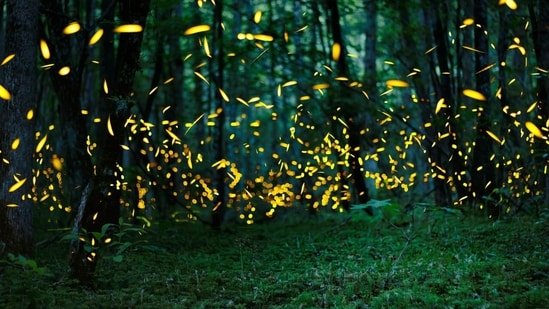
The Photinus carolinus species of firefly has just a few weeks every summer to flash their bioluminescent lights and mate.
The beetles may have gotten too good at their job. These days, their rare display is also attracting tourists by the thousands, who queue up for limited tours and compete for ideal photo spots to capture nature at its most magical.
A little rain wasn’t going to stand in the way of Kealey Linton and her 4-year-old daughter. The pair set off on a trip to Great Smoky Mountains National Park from their home in North Carolina over Memorial Day weekend.
Despite the wet forecast, their expectations for illumination were high. America’s most-visited national park is home to 19 different firefly species. Chief among them is Photinus carolinus, also known as the Smokies synchronous firefly, which produces dazzlingly coordinated displays that rival even the most extravagant Christmas light installation.
Linton and her daughter arrived just as the sun was setting. After an hour’s wait in the rain, they got their reward: Fireflies pulsing in sync, almost like a heartbeat. It brought Linton to tears.
“Even my sleep-deprived, delirious 4-year-old was completely entranced,” she said.
Nature-loving travelers from around the globe are bugging out over the fireflies, descending en masse on isolated stretches of the U.S.
Their annual emergence in the Great Smoky Mountains has become so popular that campsites sell out months in advance. This year’s lottery to get parking spots for the park’s eight-night official viewing period, when activity was expected to peak, attracted more than 45,000 applicants. Only 960 slots were distributed.
A four-night viewing event in June—priced at $325 a person per night—organized by a local biodiversity nonprofit also sold out. For those who miss out, nearby adventure park Anakeesta is building an attraction replicating the experience.
“Firefly season is one of our busiest times,” said Vesna Plakanis, co-owner of A Walk in the Woods.
The Gatlinburg, Tenn., company offers special viewing tours and backpacking trips in Great Smoky Mountains National Park. “We’re constantly having to add more dates,” she said.
Those lucky enough to score a coveted slot or campsite don’t take the opportunity lightly.
Nighttime photography enthusiast Tim Reaves scouts out potential vantage points before the sun goes down to ensure he can get the best shot possible. Come nightfall, capturing the lightning bugs during the few hours they appear each evening takes stamina and perseverance.
“Bug spray repels them like it repels any other insect, so you just have to kind of hope that you don’t get eaten alive,” Reaves said.
In South Carolina, where the bugs appear around Congaree National Park, business leaders and regional planners are looking into ways to optimize the season beyond its viewing lottery.
But plans based on a natural phenomenon that changes year to year based on temperature, rainfall and other environmental factors can, unsurprisingly, go awry.
Peggy and Ken Butler were forewarned. In 2012, a team of researchers investigating reports of synchronous fireflies stayed at their bed-and-breakfast in Kellettville, Pa., a small community surrounded by Allegheny National Forest. When the team found the bugs, they gave the Butlers two options.
“You can ignore it and go on with your lives, and we will keep the sites secret,” Peggy Butler recalled the researchers warning. “But if you decide to do something like a festival or tours, you need to educate yourselves and be prepared because the world will come to your door.”
The pair organized the Pennsylvania Firefly Festival. Within three years, they had around 1,000 people show up for a tour in a single night.
“It was just an absolute disaster,” Peggy Butler said. “We couldn’t control the crowds anymore.”
A ticket policy followed. So did visitors from every continent except Antarctica.
This year, they’ve added entertainment and moved the main event to nearby Tionesta. Over the years, Ken Butler said, it’s generated an economic impact for the region exceeding $1.5 million.
For the bugs themselves, the stakes are even higher. Fireflies spend most of their lives as larvae below the soil surface. Generally once they become adults, the bugs only have a few weeks to shine—and mate—before dying. Scientists warn that increased foot traffic could jeopardize it all.
Some female fireflies, including those of the Smokies synchronous variety, stay on the ground while the males fly around. That makes them prone to trampling, said Candace Fallon, a senior endangered species conservation biologist at science nonprofit Xerces Society.
The gleam of a cellphone or a car’s headlights also can throw off the courtship ritual by distracting the bugs. Official viewing events typically hand out covers to turn lights a less disruptive red.
“They’re not flashing for us,” Fallon said. “They’re flashing to find a mate for the night and to hopefully produce the next generation of fireflies.”
Still, scientists and conservationists recognize viewing events can inspire people to care more about the environment and the fates of creatures big and small.
Melissa Krider thought she’d won the golden ticket when she discovered she’d been selected in the Great Smoky Mountains lottery. Before her slot, she noticed there hadn’t been as many fireflies in her own backyard in Asheville, N.C., but she chalked that up to the dry weather and a neighbor’s landscaping work.
Things weren’t much different at the viewing. Krider and her husband hardly saw anything.
She suspects the steady flow of visitors may have spooked the bugs. Weather was also likely a factor: An unseasonably warm early spring was followed by colder air, making the season more unpredictable.
“It was hard not to be a little bit sour,” Krider said.
She’s still holding out hope this year’s lottery wasn’t a flash in the pan and she’ll have another chance. “I don’t know how likely it is because thousands and thousands of people apply.”
Write to Jacob Passy at jacob.passy@wsj.com
