

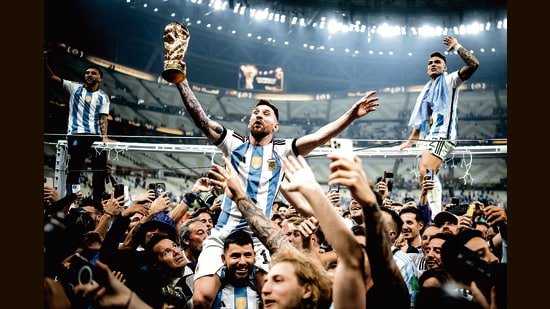
Four years ago, on a warm Qatari evening, Lionel Messi, chasing his elusive World Cup dream, decided it was time for one of his magic tricks. He didn’t specifically choose Jasko Gvardiol as his mark. The Croatian centre-back, the star defender of the tournament, wearing a protective face mask that was more Bane than Batman, just happened to be there.
So, when the time was right, Messi, 35, exploded past the 20-year-old Gvardiol down the right wing, waited to be caught, pirouetted at the edge of the box like a ballerina in an allegro, dropped one shoulder to send his pursuer scampering the other way, darted down the touchline, and knocked the ball to striker Julian Alvaraz for a tap-in goal that took Argentina to the World Cup final.
As he pumped his fists, the world went into rapture. It did not matter which team you supported, which country you belonged to, or whether you had any skin in the game. From New Zealand to Canada, from Bengal to Kerala, from the political bureau to the sports desk, the gasp was unanimous. The cheer, universal.
There are times when sport becomes a celebration of human endeavour stripped of all its biases. At that moment, there is no team jersey, no national pride; just a man with a ball at his feet and a target in his eyes. The frenzy of European club football often makes us forget this, but the World Cup, ironically a battle between nations that could easily evoke patriotism and prejudice, comes around every four years to free the world’s most popular sport of the filter of favouritism. The conductor of the global orchestra may change — Pele for Brazil in 1970, Maradona for Argentina in 1986, Zidane for France in 1998, Xavi and Iniesta for Spain in 2010, and Messi in 2022 — but its spirit endures.
A BLURRED LENS
The 2026 edition of the World Cup will start two weeks after a defining season in European club football that illustrated how football fandom has plummeted to a point where echo-chamber narratives have replaced reality. The quality of play is still of the highest level — perhaps far above what we will see at the World Cup since league players understand the nuances of cohering as a unit much better than national team players who assemble intermittently for friendlies or qualifiers. But the lens through which club football is watched has become so blurred that a brilliant goal or a sensational save brings joy only to one rabid band of followers. The others are either too busy dismissing it as a fluke or blaming the referee for corruption to care.
In the hysteria of club loyalty, we have traded the thrill of football for provocative television commentary, merchandise sales, and social media punditry that thrives on fuelling anger.
A walk-on part in a war for the lead role in a cage.
Arsenal’s victory in the English Premier League after 22 years brought North London to a halt last month. As legions of fans thronged at the stadium to celebrate a cathartic triumph that resonated from Nairobi to Sydney, the parallel narrative of discontent was no less emphatic.
From the team’s set-piece excellence to video reviews that went in their favour to their insurmountable defence, Arsenal were targeted instead of being lauded. Just as a highly creative Manchester City were attacked in the past for heavy spending, or a dominant Chelsea for a rigid back-line, or a free-flowing Liverpool for benefiting from underperforming rivals. Then, when Arsenal lost the Champions League final on penalties to PSG — the best team in Europe and deserving back-to-back winners — the delirious trolling in England nearly overshadowed the pandemonium of the victory celebrations in France.
RECLAIM THE JOY
This trolling goes beyond the traditional banter that it pretends to be. It’s taken us far away from a time when large parts of the world, even its most forgotten corners, first fell hopelessly in love with football.
The 1986 World Cup was brought to our homes in India, conjured up by Doordarshan through a fortunate bilateral deal, as it was by state broadcasters in many other countries in what was still the first generation of live sport. We perhaps started watching because it was a different era, and frankly, we had nothing else to do. It didn’t even matter how much footballing history we were familiar with — everyone was starting from scratch. Over the course of that month, a frizzy-haired magician with feet of gold and the hand of God became the physical manifestation of the beautiful game, and of the World Cup itself. Instead of someone who was shining on the biggest stage, Diego Maradona appeared to give the platform its relevance and its sheen. As he took Argentina through the group stages, past the quarterfinal against England, and the semifinal against Belgium, towards a dramatic victory in the dying seconds in the final against West Germany, Maradona single-handedly manifested the globalisation of football.
What would we care about Argentina or Germany without him? By compelling us to root for him, even if for a month, Maradona elevated football to a level where it broke the shackles of nationality.
The impact was such that, even today, in an era where football is fenced by the cult of clubs, the World Cup manages to shatter this invisible barrier and awaken a new legion of watchers in countries that have no horse in the race. To be sure, there are still biases and flared passions — tears are shed in defeat, raucous parades are organised in celebration, and things sometimes get out of hand — but the size of the global audience is too large for any one group to queer the pitch. For whenever people in the rest of the world feel ecstatic or anguished about the fate of their temporary adopted nations, it’s a true triumph of the sporting spirit.
So let’s get ready to watch some World Cup football. Will it be Messi’s Argentina again or Ronaldo’s Portugal? Mbappe’s France or Neymar’s Brazil? England’s golden generation or Germany’s comeback kids? Let’s savour the frenzy of a last-minute winner and the sweet pain of a missed penalty. Most of all, let’s keep our eyes open for the mesmerising magic tricks that got us here.
(The views expressed are personal)
