

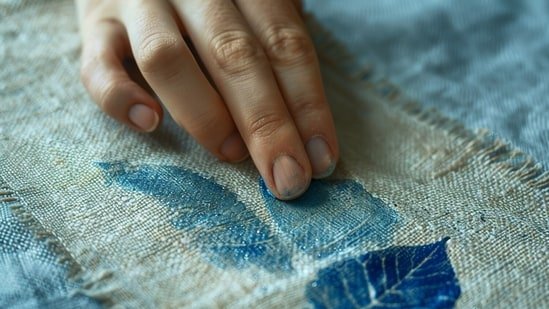
Hand embroidery work, like Lucknowi Chikankari, Kashmiri handiwork, to Zardozi and Aari, is recognised for the rich detailing, fine craftsmanship and the beautiful textures. All such handiwork really is reflective of India’s extensive artistic history. Each piece has a story of how the artisan brought it to life with incredible patience and dedication.
ALSO READ: Don’t have a blouse? Check out these 4 easy and stylish tops to wear with your saree
But lately, with machine-made clothes being able to replicate and produce them in larger quantities, it has become harder to tell hand embroidery apart from machine-made ones.
As a buyer, it may be confusing as the differences might not be apparent right away. To understand what sets real hand embroidery apart, Kailash Poojary, founder and CEO of V V. Exports Universal Pvt. Ltd., shared with HT Lifestyle a few practical ways to identify genuine craftsmanship, like stitch variation and texture on the reverse side of the fabric. He believed that the essence of genuine hand embroidery can never truly be replicated through machine work. To truly wear an embroidered garment, it is best to look for the genuine, hand-embroidered ones by skilled artisans.
Here are some of the identifiers that can help you differentiate easily!
1. All stitches are never the same
If the hand embroidery work, whatever it is, Phulkari, Kantha or Zardozi, the easiest way you can tell if it is authentic or not is by looking closely at the stitch pattern.
Kailash explained the reason behind it by giving a simple analogy, “The stitches are never the same, and are much like letters. The stitches may appear the same from afar, but a close observation will reveal differences, which is what makes the piece unique. These differences are proof of handcraft.”
Just like handwriting, two letters may look similar, but are never exactly the same. In the same way, the hand-embroidered stitches will carry subtle irregularities like spacing, shape or diminishing. These imperfections give the piece its individuality and genuine quality, unlike factory-made embroidery, where every stitch is identical. So, the next time you buy an embroidered garment, make sure you look closely at the stitch work. Check whether it appears too clean, too neat, or too uniform, as then they may signal machine-made.
2. Turn the fabric over
The reverse side of the fabric can tell you a lot and help you identify the embroidery process. Most buyers focus on how the garment looks from the front, but the reverse side reveals how the work was actually done. Kailash shared that when several visible flaws, loose threads or uneven details are spotted at the back, it usually means hand embroidery. This is in sharp contrast to machine embroidery, where even the reverse side tends to look quite even. Handiwork may create small irregularities, but that is the beauty of it.
3. Depth of work
You need to amp up your observation game because the third indicator requires you to observe the depth and texture of teh work. The expert noted that, unlike flat, machine-made embroidery, hand-embroidery is much richer and has a more ‘dimensional look.’ He gave examples of handmade styles like Aari, Zardozi, Chikankari, artisans use threads, beads, sequins, fabrics and layering to create texture. This results in a raised, three-dimensional effect, rather than a plain-surface finish, which you will see in machine-made.
4. Time
Time is another factor you should consider, especially if you are placing an order and expecting a timeline. While it may not be immediately visible like stitch work or texture, the time taken to create a piece can say a lot about the embroidery process. “Sometimes the most complex and detailed designs take days, weeks, and even months of dedicated hard work. Such a degree of detailing is not possible to achieve through mass production by machinery,” Kailash said. This means that if you are being promised a detailed and heavily ornate custom embroidered garment within just a few days, it may likely involve machine-made work. Authentic hand embroidery takes time, patience and careful craftsmanship.
As a final tip, Kailash also suggested comparing embroidery samples closely. Gold-coloured samples show fine-quality hand embroidery throughout, while the red-coloured samples may be mixed.
