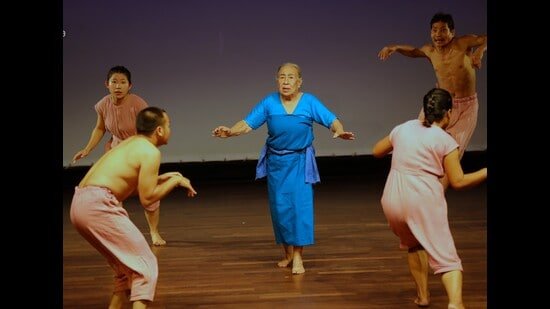
No one who watched Pebet at Bangalore International Centre on the last day of the BLR Hubba in January 2026 had to be told that they were witnessing something special. The 51-year-old play with an 80-year-old protagonist co-opted the audience into a journey of transformation even as it portrayed a Manipuri children’s myth creatively moulded into a sharp political commentary.
Ima Sabitri (centre) in Pebet at the BLR Hubba (BLR Hubba)
Mother Pebet’s voice seemed to awaken a deeper consciousness in the audience when Ima Sabitri, the actor playing the role, entered the stage. A myth disappeared as did the actor’s habitual body. Written and directed by Heisnam Kanhailal (1941-2016), who founded Kalakshetra Manipur in 1969 , Pebet has seen many changes in cast. But never has Mother Pebet been played by anyone other than Ima Sabitri.
Excerpts from a conversation after her performance at BLR Hubba:
You have played Mother Pebet in the play for 51 years. How much harder has it become to be a mother in Manipur over those 51 years?
The role of a mother is dynamic and has immense responsibilities. This is not only for mothers of Manipur. It applies to all mothers worldwide, regardless of their geographical location. Within the theatre and beyond, a mother must nurture her child. Again, we take equal responsibility and play different societal roles. Remember how the Pebet mother takes care of her children in the play? Also, for instance, observe how a mother hen works hard to feed her chicks. A mother has to feed her child even if she goes hungry.
A woman’s body goes through many changes at different stages in life. How did you balance your life as an actor with all of that?
Yes, a woman’s body goes through different stages of change: from a small girl to a teen and then to a fully grown woman. The mind as well goes through a lot of changes. We have to try to understand this process and internalise it. We, as theatre workers, intermingle with different genders. We, as co-workers, have to focus on our work with devotion. Here, body and mind harmony are of utmost importance.
When I was young, I was taught certain dos and don’ts by my aunt, who was my first guru. The world is changing. So is today’s generation. And, I have changed too, from a girl to a mother to a grandmother. And now I am a great-grandmother. But one thing is certain. We have to face struggles in each and every phase along with the responsibilities.
I think God has given us the ability to fight in our own different ways. As a young actor, I was not tasked with so many household chores. I got ample time to devote to my art. But as soon as I got married and started having children, my responsibilities too grew in leaps and bounds. I managed to balance my commitments. I used to practice my acts while performing the household chores. Returning home from the theatre, I skipped meals. Sometimes, I used to leave the kids at my parents’ house to be able to take part in rehearsals. I rehearsed and rehearsed by even compromising my sleep hours.
Since I had embarked on a life’s journey from which I cannot take a U-turn, I had to move on, come what may. I also managed to contribute my time to social commitments by taking part in the women’s Meira Paibi (Women’s voluntary group) as a call of duty against the backdrop of a society in turmoil. I try to internalise the turmoil and try to express it in my acts. Here, the role of a theatre director is also important. The director has to understand my female instincts and sensibilities in expressing myself. A deep understanding between the artist and the director is very important in this regard.
Please talk about the approach to theatre making that sets you apart at Kalakshetra. Among all the plays you have done, which is closest to your heart?
The play Tamnalai (1972) is very close to my heart. Draupadi (2000) is another play I love, and at the same time, a difficult role to play. The play shows atrocities meted out to women. It highlights the female gaze on the man in uniform and on men in power. I internalised the pain of Ahanjaobi (a rape victim) and disrobed myself on the stage. It was a difficult act, and my act garnered both praise and backlashes.
When violence and conflict are part of the daily landscape, it is bound to affect the psyche of the young people in the region. What are the challenges you and Kanhailalji have faced as theatre educators? How did you cope with those challenges?
We cannot cease our work as theatre practitioners, despite the chaos in our region. It is a challenging period for all of us. Furthermore, it is a pivotal moment for younger generations, who possess much energy yet are entangled in dilemmas. College or university students cannot escape this upheaval; they must continue seeking workable solutions to understand the root causes. Kalakshetra Manipur, for instance, does not offer answers or explanations for the current social turmoil. However, at Kalakshetra, we train the mind and body to balance energy through breathing exercises, bodily movements, singing and meditation. To observe the world or any unfolding event, one needs a calm mind to gain a rational perspective.
Charumathi Supraja is a writer, poet and journalist based in Bengaluru.
सिद्धभूमि के लेखक एक प्रमुख समाचार लेखक हैं, जिन्होंने समाज और राजनीति के महत्वपूर्ण मुद्दों पर गहरी जानकारी और विश्लेषण प्रदान किया है। उनकी लेखनी न केवल तथ्यात्मक होती है, बल्कि समाज की जटिलताओं को समझने और उजागर करने की क्षमता रखती है। उनके लेखों में तात्कालिक घटनाओं के विस्तृत विश्लेषण और विचारशील दृष्टिकोण की झलक मिलती है, जो पाठकों को समाज के विभिन्न पहलुओं पर सोचने के लिए प्रेरित करते हैं।
एक ऐसे समय में जब प्रिंट एवं मुद्रण अपनी प्रारंभिक अवस्था में था ,समाचार पत्र अपने संसाधनो के बूते निकाल पाना बेहद दुष्कर कार्य था ,लेकिन इसे चुनौती के रूप में स्वीकार करते हुए स्वर्गीय श्री शयाम सुन्दर मिश्र “प्रान ” ने 12 मार्च 1978 को पडरौना (कुशीनगर ) उत्तर प्रदेश से सिद्ध भूमि हिंदी साप्ताहिक का प्रकाशन आरम्भ किया | स्वर्गीय श्री शयाम सुन्दर मिश्र “प्रान ” सीमित साधनों व अभावों के बीच पत्रकारिता को मिशन के रूप में लेकर चलने वाले पत्रकार थे । उनका मानना था कि पत्रकारिता राष्ट्रीय लोक चेतना को उद्वीप्त करने का सबसे सशक्त माध्यम है । इसके द्वारा ही जनपक्षीय सरोकारो को जिन्दा रखा जा सकता है । किसी भी संस्था के लिए चार दशक से अधिक का सफ़र कम नही है ,सिद्ध भूमि ने इस लम्बी यात्रा में जनपक्षीय सरोकारो को जिन्दा रखते हुए कर्मपथ पर अपने कदम बढ़ाएं हैं और भविष्य के लिए भी नयी आशाएं और उम्मीदें जगाई हैं । ऑनलाइन माध्यम की उपयोगिता को समझते हुए सिद्ध भूमि न्यूज़ पोर्टल की शुरुवात जुलाई 2013 में किया गया |
हमसे संपर्क करने और जुड़ने के लिए मेल करें -
siddhbhoomi@gmail.com
Subscribe to Updates
Get the latest creative news from FooBar about art, design and business.