

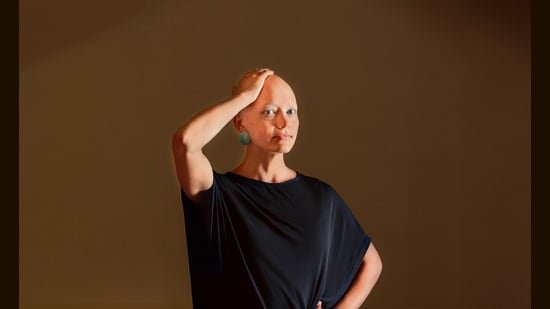
When Helen Phillips began to write Hum in 2019, it felt like speculative fiction.
In her future world, people found it hard to breathe as the worst effects of the climate crisis kicked in; their jobs were threatened by evolving technology, forcing them into strange new professions; and they remained locked to their screens in a spell they couldn’t seem to break.
The book, released in 2024, has now won the 2026 Climate Fiction Prize.
In it, hums or supremely intelligent humanoids live alongside humans, in a city battling with climate change. Her protagonist May is a young woman who loses her job to AI.
Desperate, with children to raise and debts to pay, May signs up as a test subject in an experiment where injections aim to alter her face so it cannot be recognised by surveillance software.
When she gets paid, May treats her family (herself, husband and two children) to passes to the Botanical Garden, the city’s last remaining green patch. Here, things take a turn for the worse. The children go missing; she is accused of negligence. She must now fight for her family’s future.
Hum is a world cracked open by the possibility of dystopia, says Phillips.
It isn’t prophetic so much as an extrapolation; a reading of what could be.
“I was doing a lot of reading about climate change and AI while writing the book, and it seemed essential to be clear about where some of these ideas stemmed from, so there are copious endnotes pointing to external research work,” she says. “This may seem like an alternate world, but I wanted to also say: Look how it’s seeded from our reality.”
***
Phillips, 44, was born and raised in Colorado, a state of wide-open plains, high deserts, grasslands and soaring mountain peaks. She switched worlds, in a sense, when she moved to New York, where she teaches creative writing at Brooklyn College.
She switched worlds again, when she became a mother (she and her husband, artist Adam Douglas Thompson, have a 14-year-old daughter and 11-year-old son).
Parenthood caused her anxieties about climate, nature and the general state of the world to bubble up to the surface, she says. “Climate events feel so much more dramatic and in-your-face now than they did when I was a child,” she adds. “My children and I recently drove past huge wildfires on a visit to Colorado, and it was hard to comfort my son because I’d never seen a wildfire like that myself.”
Before the children, these fears were abstract, Phillips says. “Now, the future is embodied in specific people: these two people. So, I guess I’m just trying to imagine what it might be like. I’m trying to imagine a future family figuring out how to live a meaningful life in the world.”
***
In the imagined world of Hum, May will likely never work again. She and her colleagues have been replaced by robots that work faster, cost less, take no sick days and make no demands.
This represents one of Phillips’s deepest worries about the future: the way AI could fundamentally reshape work and, in doing so, reshape self-worth. “Our work is our way of supporting ourselves and our families. It’s a form of dignity,” she says. What happens when one is stripped of that dignity almost entirely; how far might one go?
Scarcity is a prominent theme as well.
Growing up in Colorado, there was exquisite beauty but also an inherent aridity to the landscape that meant a constant threat of drought. One of the after-effects of this is that Phillips still cannot luxuriate in a long bath. “I usually shower in three to four minutes. I am well known in my family for this,” she says.
Her fears of coming face-to-face with such scarcity again, fears that never really left, have lately come roaring back. They have worked their way into most of her five previous books.
In her first novel, And Yet They Were Happy (2011), for instance, a young couple tries to build a meaningful life in a world of droughts, floods and swarms of misfortune that include mice who seem to be “doing a much better job at living than they are”.
And yet her humans find ways forward. Hope persists, if you know where to look for it, Phillips says.
She finds it in books such as The Artist in the Machine: The World of AI-Powered Creativity (2019), a work of non-fiction by the scientist Arthur I Miller that takes a highly positive view of human and AI collaboration.
“In email correspondence I had with him after reading the book, he made a very compelling case for such coexistence,” Phillips says. “And while I may not agree with all he says, he is proposing a realistic alternative to the idea that no enduring good can come of this invention.”
