

LOS ANGELES—“I already know what she’s going to buy,” Dedy Shwartzberg whispered as a shopper stepped into his aggressively pink clothing store.
He nodded toward a bright aqua tank. A day earlier, a dashboard powered by his company’s proprietary software had shown that tank tops were “going crazy” with shoppers, as was the blue-green hue. Like a moth to a flame, the shopper headed right to the shirt, adding it to her haul.
Shwartzberg is the co-founder and CEO of Edikted, a fast-fashion company known for hyper-trendy clothes that teenagers and 20-somethings find irresistible. He says it’s his shoppers who run his brand. “We’re more like a data company than a fashion company,” Shwartzberg, 50, said.
The Edikted customer—or “babe,” as the company calls her—shapes the store’s merchandise based on her internet searches, her social-media activity and whatever Hailey Bieber wears, among other data points.
“If she likes something, we make more of it, which is why you see all these polka dots,” said Shwartzberg, motioning at the dotted halter tops around him. “If she doesn’t like something, it goes away. Last year’s barrel jeans? Bye bye.”
Edikted’s stores have become gathering places for girls, who line up outside its locations in New York, Houston, London and beyond. A 2025 survey from investment bank Piper Sandler placed it in the top five websites for upper-income teenage girls. They often drag their uncomfortable mothers for help procuring skimpy dresses for school dances and pop concerts. The company’s newest store, on Fifth Avenue in New York City, just opened this month; a matcha cafe and weekend DJ will soon grace the space.
Tons of brands follow Edikted’s strategy of low prices, trending styles and aggressive social-media marketing. What sets Edikted apart, Shwartzberg said, is its trend-capturing software and on-demand manufacturing. Edikted’s gross sales hit $460 million in 2025, Shwartzberg said. The company has raised $9 million in funding and is profitable, he said. Shwartzberg declined to share its valuation.

Edikted, he said, drops 300 new styles a month and produces new designs in two to three weeks.
“You cannot sit and rest for even one month,” Shwartzberg said, “because you will lose them all.”
An Israeli entrepreneur and former hedge fund analyst, Shwartzberg co-founded Edikted in 2021. By then he’d spent nearly a decade running Adika, an Israeli fast-fashion brand.

Edikted, whose name Shwartzberg said is a pun on “e-commerce addiction,” has over 1,000 employees and is headquartered in L.A.
Shwartzberg launched during the pandemic and deployed a strategy of sending free clothes to nano-influencers. “The bigger influencers seem like billboards,” he said. “The micro-influencers, they’re more like a sister. The girls trust them.”
His brand’s first hits were low-rise denim, flaunted by teen mega-influencers like Demetra Dias, and faux leather bell bottoms. Last summer, TikTok users documented an abundance of the brand’s leopard sequin shorts at pop star Tate McRae’s concert tour.
The clothes are made in China, where third-party factories produce first-run orders in small batches of about 500 items, he said. The company watches analytics closely and determines which items to reorder.
“The product is changing all the time,” he said. “During the pandemic, corsets were huge, today no one wants them. Crop tops were crazy four years ago. Now, crop tops are dead.”
Sweatshirts, meanwhile, aren’t going anywhere.
“Everyone and their mother has the Bonney Bow hoodie,” said Kyle Patterson, Edikted’s head of trends, referencing the brand’s sweatshirt that’s beloved by Gen Alpha. Patterson said all Edikted hits have one thing in common. “It’s just cute.”

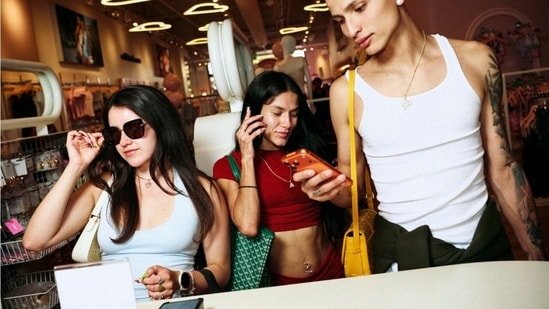
Shoppers were flooding the Grove, hunting for mini graduation dresses and breezy summer pants. Nearly every girl at the mall wore a uniform of strappy tank tops, baggy denim and Trader Joe’s tote bags slung over their shoulders. Heart-shaped lights twinkled overhead as they navigated Edikted’s pink store—college students and younger Gen Alpha girls shopping with their moms.
“The branding grabs the girls right in,” said Katrina Tolentino, who lives in San Diego and was shopping with her daughter. “I grew up with Charlotte Russe. I worked at Wet Seal. This is that store for them now.”
“The clothes make me feel special,” said Vivienne, Tolentino’s 11-year-old. “All of our friends go here. It’s just, like, fun.”
Consumer trends analyst Jessica Ramirez said the brand has “the gift of gabbing like Gen Z.” Tweens and teens “talk a certain way and know how to look on camera,” Ramirez said. “Edikted knows how to sound just as young and just as cute.”

Edikted stores are layered with girlie touches: a giant heart installation at the entrance, a photo booth off to the side, Pepto-pink, bulbous furniture, plenty of decorated mirrors for selfies.
“We are like a party,” Shwartzberg said. “We are giving them a good time.”
Shwartzberg balks at the comparison to startups like Quince and Shein, which also use data to drive styles. The in-store experience sets the brand apart. “We are pushing people to be happy,” he said.
Edikted has 15 stores and plans to open 10 more in the U.S. within the next year. It recently inked a franchise agreement to bring its stores internationally, said Shwartzberg.
“The website is your body, but the stores are the legs,” he said. “The girls want a destination.”
Shwartzberg said college students buy Edikted’s more revealing going-out clothes, while sweatsuits and T-shirts bring in the tweens and teens. What would he say to parents peeved that their tweens covet his micro-mini dresses?
“Take away the TikTok,” he said. “Believe me, the clothes are better than the things they’re seeing.”
Shwartzberg, who has a 5-year-old daughter, paused in front of a rack of black leather shorts with an 1.8-inch inseam. “My girl will not wear these until she’s 21. I hope.”
Write to Chavie Lieber at Chavie.Lieber@WSJ.com
