

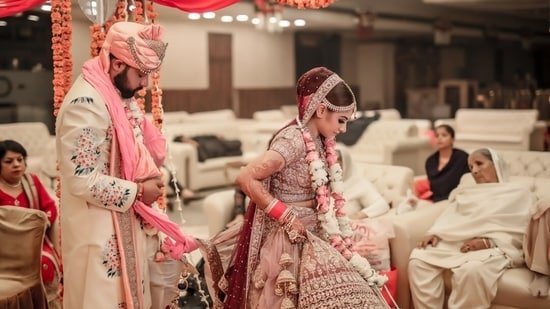
A woman has sparked conversation around Indian wedding traditions by pointing out how certain marriage vows recited by pandits continue to carry patriarchal undertones. She highlights that many of these age-old promises place unequal expectations on women, pushing them to follow norms that feel outdated and out of place in today’s context.
Also read | ‘You are not marrying a maid’: What the Supreme Court said, and why it matters for modern marriages
What did the woman point out about traditional wedding vows?
Anita Rani, a digital content creator, shared that she recently saw a wedding video in which a pandit asked the bride to take a vow not to visit her parents’ home without her husband’s permission. The bride questioned, “Do I now have to seek permission just to go to my own home?” before breaking down in tears. Anita mentioned that this video brought tears to her eyes and reminded her of her own daughter’s wedding.
Anita’s personal experience
Anita also shared her personal experience from her daughter’s wedding, where she was refused the chance to perform kanyadaan because she is a widow. The pandit asked her not to carry out the ritual and instead requested another married couple to do it. Rather than simply obeying, she questioned the decision and went on to perform the ritual. However, the incident left her in tears.
How did the internet react?
One of the users wrote, “This is so true, aunty! I recently got married, and I faced the same. I really wanted my dad to do kanyadan, and as a single father, I knew pandit ji wouldn’t let him do it! I even requested him prior to my wedding, but he clearly denied, and this wrecked my heart into pieces, so I couldn’t do anything! Also, a very informative video.”
Another viewer commented, “I’m single, and it was my cousin’s wedding; his mother didn’t allow me to participate in any rituals just because I don’t have a husband. It was utterly humiliating. Not just men, women are also a part of this rotten core, so-called culture.”
Utsav Kamboj wrote, “Pandit ji’s these days themselves don’t have 100% clarity on things. A lot of their opinions (especially towards women) are very much influenced by their own upbringing of looking down on women. They talk and preach what they have heard & seen in their homes, rather than what the Vedas & puranas teach. It’s Androcentrism & male supremacy. It’s not just in pandit ji’s, it’s in astrologers, and many other such professions. The whole concept of kanyadaan is so misused. I am not something to daan, I decide who I’m gonna be with, when I wanna go, and why. Nobody has the right over my life except me, definitely not my husband, absolutely not his parents, who have invested nothing literally in me.”
Note to readers: This report is based on user-generated content from social media. HT.com has not independently verified the claims and does not endorse them. This article is for informational purposes only.
