

Bookbinding. For anyone with a serious book collection, this is the most satisfying upgrade. Tear the cover off a tired paperback, sew on your own cover. Or create a notebook from scratch with handmade paper, fabric, or botanical-pressed covers. The thick thread rhythmically pulling through a wad of pages feels almost meditative. Crack the spine. That sound? You made it happen. A starter set (bone folder to make creases, awl, bookbinding needles, waxed linen thread, PVA glue) costs ₹1,500 to ₹3,000. Give yourself 20-30 hours before your spines stop looking tragic.
Brush & dip pen calligraphy. The hobby that elevates grocery lists, Zoom-call doodles and notes in the margins. Calligraphy retrains your hand. Every pressure shift and angled stroke builds fine motor skills, strengthens muscle memory, and forces you to engage your arm and wrist; undoing the stiff, repetitive movements of typing. Start with a dip pen, ink, and guide sheets ( ₹800 to ₹2,000). For inspiration and tutorials, follow @SeblesterSigns and @LoveLeighLoops on Instagram. Prepare to ruin 40 sheets before a decent letterform appears. That’s not failure, that’s the process.

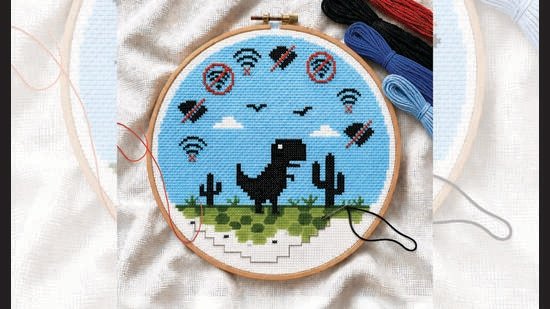
Cross stitch. Granny’s favourite embroidery has had a subversive glow-up and is essentially a full-system reboot for those who lose focus every 30 seconds. Beginner kits ( ₹300 to ₹700) come with stiff, open-weave cloth, a printed pattern chart, threads sorted by number, and a thick needle. Recreate the chart’s grid pattern on the cloth. Text and simple geometric patterns take 10 to 15 hours to complete; figurative work takes longer. Then, go boss-level by cross-stitching freehand on linen, cotton, even denim. You’ll be dreaming in pixels by then.
Cyanotype. Old photographic printing process; new fans among Gen Z. Coat paper or fabric with a light-sensitive solution, lay botanicals, leaves, or negatives on top, expose to sunlight for a few minutes, rinse, and watch a deep blue print emerge. No camera, no kiln needed. A beginner kit costs ₹1,500 to ₹2,500 and yields 20 to 30 prints. Cyanotype workshops are now held in most big cities, and you get to take your art work home. Great for those looking to develop an eye for composition.
Diamond painting. No. Not with real gems (though if you have crores to burn, go for it). This involves precisely fixing tiny baubles on to a canvas to make a pattern or slogan appear. Think paint-by-numbers meets cross-stitch – place, press, repeat, over and over until you’re one with the diamonds. Starter kits run ₹500 to ₹2,000, some include specialised tweezers too. If you have anxiety, a tendency to overthink, or simply cannot sit still, this is how to stay anchored.

Basic sewing. You’ll tell yourself that you’re getting a sewing machine only to make alterations on your existing clothes. You’ll end up sewing tote bags (with a zipper, hurrah!), oven mitts, laptop sleeves, toiletry cases. You’ll gift them to every friend. Then, you’ll look at mannequins in the mall, and say “Ah, inverted box pleat, circle skirt, blind hem” and you’ll recreate it over the weekend. Gen Z fans have been dropping ₹5,000 to ₹8,000 on electric-powered sewing machines and filming their adventures, pricks and all. Budget 25-35 hours before your seams lie flat. For India-specific tutorials, Savi’s Fashion Studio on YouTube is excellent.
Bracelet making. Taylor Swift’s Eras Tour turned a childhood craft into a trading economy. Swifties don’t just make bracelets, they spell out song titles, lyrics, and inside jokes in letter beads to trade with strangers at concerts. Start with embroidery floss, beads, a safety pin (collectively ₹200 to ₹500). Look up basic knot tutorials on YouTube. Look for ideas on Pinterest and work in your own twists so they turn out unique. Basic competency comes in under 10 hours. And you’ll branch out of Swift themes soon enough. This is a forever comfort craft.
Fermentation. For the scientifically curious, the sustainability-minded, and anyone who has wondered what’s going on inside a jar of kimchi. Most projects require little more than vegetables, salt, spices, and a starter culture, all available at a grocery store and shouldn’t cost more than ₹2,000. Start easy. A summer mango pickle, made to a family recipe, is the most forgiving entry point. Failed batches are demoralising and common, as are burst glass jars. You’ll figure out technique quickly, but the real lesson is patience.

Film photography. Shooting analogue means no auto alignment, no instant preview, no deleting the bad shots, no filters, just 24 or 36 frames and the discipline to plan ahead and capture the moment. Expect to pay ₹3,000 to ₹8,000 for a decent second-hand film camera. Budget extra for film, and to develop and print each roll. Kodak and other companies have re-launched their specialty film and photo paper types after the pandemic. Expensive is not always better. But patient and precise is.
Hand lettering. Not calligraphy. Here, handwriting is irrelevant, design instinct matters more. Start with brush pens and marker paper ( ₹500 to ₹1,500). For inspiration and tutorials, follow Indian lettering artist Tanisha (@Handlettering.Is.Fun) on Instagram. For the first 30 to 40 hours, you’ll scowl at your shaky flourishes, you’ll produce splotches instead of swishes. But eventually your letterforms will look artistic. You will create quotes to hang on your friend’s walls, you’ll take on ‘Happy Birthday Ahaan’ banner commissions, wedding favours, corporate presents. What started as a hobby might end up as a tidy side business.
Letterpress & Woodcut printmaking. Two crafts, one satisfying process: Press ink onto surface, pull back, reveal. Letterpress uses metal or polymer type pressed onto paper; woodcut is like block printing, but on paper. Both produce results that look nothing like digital design, which is the point! Woodcut is the more accessible starting point. Gouges, lino blocks, and ink will set you back ₹1,000 to ₹3,000 and can be done at home. Letterpress requires studio access. Look up letterpress studios in your city. Set aside 50 to 80 hours of practise, before your prints turn out sharp. The bonus: You’ll print presents that people actually keep.

Nail art. What are press-on nails but a tiny canvas? They require focus, a steady hand, an attention to detail and a sense of fun, which makes it a good activity for restless creatives. Get a basic kit, with a range of nail colours, a base coat, a top coat, buffers, a stamper and a few layering stencils for ₹2,000 to ₹5,000. Start off with shading, building layers of design and getting your non-dominant hand to not wobble so much (this might take a week, don’t cry). On Instagram @BritneyTokyo, @Aaryamenon_Nails and @The.NailArtistry make it look calming and easy. It’s both, if you keep at it.
Perfume making. You’ll need a clean, well-ventilated space, essential oils, carrier oil, high-purity alcohol, glass beakers, pipettes, and dark glass bottles. Then wait. Your blend needs to age for at least two to four weeks before it smells good. Start with ISAK Fragrances’ beginner kit, an India-made lab-in-a-box with 12 ingredients and a workbook, which makes up to 20 perfumes ( ₹7,700). Trove Experiences also runs beginner sessions in Mumbai, Delhi, and Bengaluru. The real learning curve isn’t technique, it’s training your nose to tell scent from stench.
Polymer clay charms. Feel like a giant when the world makes you feel small. You condition the clay, shape it, bake it in a regular home oven and attach a charm loop. Brands such as Sculpey III or FIMO Soft cost from ₹500 to ₹1,500 for clay and toolkit. For India-specific supplies (cutters, texture sheets, findings), TheCraftShop.in ships across India. The community lives on Pinterest. Search #ClayCharms for a rabbit hole of miniature sushi, cottagecore mushrooms, and tiny croissants. Basic competency comes in around 15–20 hours. Profitability comes with corporate orders.

Pottery. Gen Z has figured out that the activity goes beyond pots and cups. They’re making ceramic phone stands, spatula rests, incense holders shaped like hands and wobbly trinket trays. It’s like 3D printing, but with clay. Before investing in a wheel, start at a community studio. The Pottery Lab (Mumbai), The Clay Company (Delhi), A Ware Studio (Bengaluru), or Art Rickshaw (Kolkata) all run beginner-friendly sessions. Once you’re hooked, studio memberships run ₹1,500 to ₹3,000 per month. Expect 40-60 hours before anything usable emerges. Your first ten attempts will look like abstract art. Pretend it’s what you wanted.
Resin art. Messy, complicated but worth it once you level up. Most beginners go with epoxy resin, hardener, silicone moulds, pigments, mixing cups, nitrile gloves, and a heat gun to pop bubbles ( ₹2,000 to ₹5,000; look for 1:1 ratio kits). Mix the ingredients in exact ratios, pour at the right temperature and height, and leave undisturbed for 24 to 72 hours. One wrong move and you have a sticky, cloudy disaster. The abandonment rate is high among people who took it up to sell. Hobbyists however do better, preserving baby booties, Lollapalooza wristbands and more in resin.
Tea blending. Not a coffee person? Tea blending creates just enough complication to make you slow down and pay attention to your brew. You combine loose leaf bases with botanicals, spices, and dried flowers to create personal blends. Loose leaf bases, dried herbs, and spice jars shouldn’t set you back more than ₹2,000. And you get to sip all your mistakes and realise you can’t go very wrong. For structured learning, Indian School of Tea runs blending workshops online and in Bengaluru. Plus, you’ll be able to send out personalised tea blends for frazzled friends.

Tufting. The one gun you can legally own in India? A tufting gun. It punches yarn through stretched backing cloth at speed, letting you build a rug or wall piece in hours rather than the weeks that traditional rug-making takes. Before buying equipment ( ₹8,000 to ₹15,000 for a gun, frame, and monk’s cloth), try a studio session. Go Rug Yourself has sessions in Delhi, Gurgaon, Bengaluru, Pune, and Chennai, starting at ₹799. Mumbai’s The Clumsy Studio (@TheClumsyStudio_) runs three-hour beginner workshops. Confidence matters as much as creativity here.
Ukulele. Four strings, not six. Nylon, not steel, so less finger pain. Small, so it’s cabin-baggage. And simple, no six-month wait before anything sounds good. The ukulele is what the guitar promises to beginners but rarely delivers. It’s genuinely playable within a week. Even a good one shouldn’t cost more than ₹5,000 and most online tutorials deliver the basics. Bernadette Teaches Music on YouTube is a well-structured free resource. The Ukulele Teacher is excellent for song tutorials once you have basic chords down. Basic competency takes around 20-30 hours. Learn one new song a week, no matter how badly, to stay locked in.
Zine-making. If you’ve got a lot of thoughts, and Substack feels impersonal and ugly, the thing to do is collate your ideas into a little printed booklet, with photos, illustrations, footnotes, whatever. Most people start with a handwritten edition, images drawn in or pasted on, and photocopy as many issues as they hope to distribute. Some have printed theirs on the reverse of brown-paper delivery bags, others have published theirs on school-style foolscap. The genius isn’t the making, it’s having something to say and someone to say it to. Start by attending Bombay Zine Fest (@BombayZineFest), which travels to Delhi, Bengaluru, Pune, and Kochi. It’s the surest cure for a blank page.
From HT Brunch, July 11, 2026
Follow us on www.instagram.com/htbrunch
