

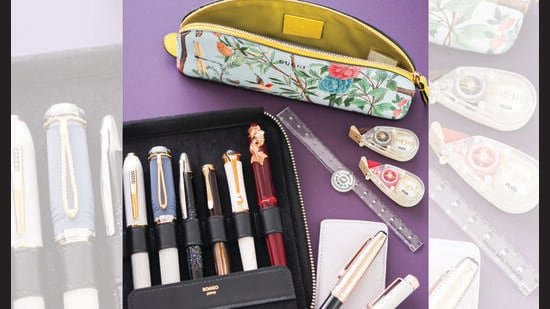
Every literate human on Earth has used stationery. We know what pencils are supposed to do. We instinctively shake a ball-point pen to coax the ink towards the nib. We’ve refilled a fountain pen, made a mess, and hoped nobody noticed. How then, does Japanese stationery stand apart? The tiny nation holds five major stationery awards each year. Thousands compete. Most come back to compete again. What’s going on, kudasai?
The short answer: While the rest of the world views writing tools as functional, forgettable items, the Japanese focus on solving micro-problems we never even knew existed.
Consider some of the winners of this year’s Bungu’s Japanese Stationery Store and ISOT Japanese Stationery awards. The Laconic Solid Write is no mere mechanical pencil. Its centre of gravity sits slightly lower on the barrel, distributing its weight more evenly, preventing hand cramps. Sailor’s Pensiero Verita S Multi Pen is not just two ballpoint pens in one; there’s a mechanical pencil in there too. Sun-star’s Tsumamono Stickyle is both scissor and tweezer. Who knew the world could be so simple?
It’s no surprise that the country with an elaborate writing system is preoccupied with making writing easier, says Minjal Kadakia, a Mumbai-based calligrapher. But the secret sauce goes beyond that. It’s a competitive market. So, stationery companies are constantly making tweaks, and locals pay attention to the details that the rest of the world doesn’t. It means that cutting-edge, impeccably made, functional tools – the best in the world – can cost as little as ¥200 or roughly ₹120.
The Japanese obsess over pens the way interior designers obsess over chairs – a commonplace item revised endlessly to meet the needs of the moment. Click it. Here’s what’s going on inside.
The finer point
In the rest of the world, a good pen is one that merely writes without stopping midway, with ink that doesn’t seep through the page. In Japan, a pen is judged by how it sits in your hand, if it works without noisily scratching at the paper, how smoothly the ink flows and how quickly it dries. Oh, and it absolutely can’t be ugly.
The Holy Grail of out time: The Uni-ball Zento Signature. It was launched in February 2025 and sold out so fast, one YouTube commenter calls it “an urban legend”. It has a magnetic cap, a sleek black body and “the viscosity of the ink has been refined so that the pen just glides across the page,” says Akash Yelchur, the founder of online stationery platform Bumbo Stationeries. It costs ¥3,300 and starts at ₹3,000 – if you can find it.
Japan’s royal family of ballpoint makers – Pilot, Zebra, Pentel, Tombow, Uni Mitsubishi – are where new tech gets a showcase. Tombow’s AirPress works even if you’re writing against a wall or on wet paper, says Abhishek Chordia, co-founder of Aarcaai, which sells stationery online. It was designed for delivery workers, construction workers and people who need to scribble notes quickly. Over at Pentel, designers noticed that young people didn’t want a pen that clicked too loudly. They developed Calme, a pen that they claim clicks “66% softer”. “There’s always some sort of lore,” says Kadakia. “They’re designed to appeal to all your senses.”
In a flow state
In a world going increasingly paperless, pen design seems almost like an anachronism. Still, the demand for fountain pens continues. “It ties into Gen Z’s obsession with analogue culture and being offline,” says Vasundhara Singh Bhati, who founded the stationery site Sozodori with Snigdha Puri. India loves fountain pens from Pilot, Sailor and Platinum (from ₹1,110 to ₹6,800). “People who like the therapeutic feeling of ink flowing on paper don’t mind spending on their collection,” Singh Bhati says.
The women attend the ISOT Japanese Stationery Awards, held in Tokyo in June. At their first visit in 2024, they were surprised at the buzzy energy, and the calm, almost ceremonial-like vibe. “It was like a fan-meet or a festival, but for stationery,” says Singh Bhati. While the Bungu awards are judged by Japan’s industry professionals and stationery-store staff, the ISOT is judged by magazine editors and product designers. “You can even try out the winning products at the awards – it’s stationery heaven.” Winning pens are sold out almost instantly on Sozodori. Indian fans even ask for products they’ve not listed. “It’s like a sneaker or album drop,” says Puri.
It’s a world away from limited-edition sneakers or luxury handbags – here it’s not about the monogram, the collab or the rarity. A pen is sought after primarily because it performs better, even if all you’re doing is writing down the name of your crush, over and over, in your journal. The royal family is already gearing up for the digital world to come. Uni Mitsubishi has been making ballpoint pens that have a stylus on the other end since 2017. Zebra’s upcoming Stylus Two-Way writes on both paper and a screen with the same nib; fans on Instagram are calling it the future of stationery. “The innovations will only keep getting better and better,” says Puri.
From HT Brunch, July 18, 2026
Follow us on www.instagram.com/htbrunch
