

New York
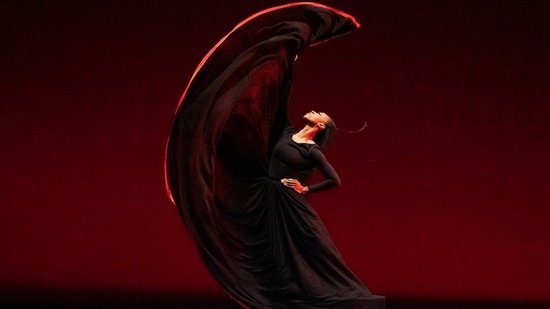
Martha Graham (1894-1991), heralded in her lifetime as “the mother of modern dance,” is being especially celebrated this year in the city where her career began and evolved.
When the Martha Graham Dance Company closed its five-day spring season at City Center on April 12, it was just six days shy of the troupe’s 100th anniversary. Billed, on April 18, 1926, as “Martha Graham in a Dance Recital, with Louis Horst, pianist, assisted by the Martha Graham Concert Group, and Mabel Zoeckler, soprano” at New York’s Forty-Eighth Street Theater, this initial performance launched Graham as a history-making name in American modern dance; her catalog of works numbers 181.
The current 17-member company, since 2005 under the artistic direction of former Graham dancer Janet Eilber, accompanied by the Mannes Orchestra, presented five Graham dances in April that spanned the 1930s and ’40s. Four 21st-century commissions were also included.
The three Graham works I caught brimmed with powerful physicality. For instance, the stirring and stark “Steps in the Street” from 1936’s “Chronicle,” replete with haunting, backward paces that take its 11 barefoot and black-sheathed women through Graham’s taut choreography, revealed female figures as if on an implacable mission.
None of the post-Graham works on offer did much more than make occasional reference to the choreographic effects of the company’s namesake. A cursory look back at the commissions the company has presented of late finds that only Pam Tanowitz’s 2019 “Untitled (Souvenir)” possessed substantive dance theatrics that artfully and playfully co-opted and made new some of Graham’s distinctive steps and compelling, postural accents.
Now on view at the New York Public Library for the Performing Arts at Lincoln Center, through Nov. 7, is “Martha Graham: The Mother of Psychological Dance,” a select display of materials—visual, audio and video—culled from the library’s Martha Graham archive along with some of the company’s set pieces by sculptor Isamu Noguchi and costumes designed by Graham. The selection has been curated by choreographer, writer and educator Jack Ferver, whose exhibition explores such themes as “The Divine Feminine” and “Psychosexual.”
Graham developed her now-familiar modernist principles for working the torso and spine, known as “contraction” and “release,” with her troupe, all female at the time, between 1927 and 1928. Today they remain synonymous with her training and her choreographic images.
A wall text identifies these contrasting expressive efforts, which are connected to the dancer’s breath, as echoing the “psychological rhythms of crying and laughing.” The show’s photos, predominantly in black and white, document these dramatic emphases as revealed by the stances and gestures of Graham and her dedicated group of women.
By 1938, Graham’s company began including male dancers. A posed portrait grouping by Cris Alexander of the leading men and women in the original 1944 production of “Appalachian Spring” telescopes the distinct body language animating the dance’s vision of Americana, which remained vividly alive in a recent, affecting performance of “Spring” at City Center.
The arrangement of Noguchi’s sculptural set pieces—some heavy and solid, others linear and light, alongside Graham’s mostly form-fitting costumes—evokes spare landscapes framing theatrical fashion. An unfortunate presentation of three golden unitards designed by Halston for Graham’s 1981 “Acts of Light” makes them look more lumpy than revealing as they lifelessly cap the display.
On the printed page, “Martha Graham Dance Company: 100 Years” (Black Dog & Leventhal), an oversize volume of text and photographs by Ken Browar and Deborah Ory, presents the Graham company in both historical and contemporary photos, most of the latter in color. Graham’s statement that “the body says what words cannot” opens the spreads that feature 24 of her dances spanning 1930 to 1990.
A palpably animated black-and-white, full-stage photo from 1935—of Graham in her 1931 “Primitive Mysteries” as its ritualistic Virgin figure surrounded by celebrants—resonates with life in comparison to the studio-posed photos in the exhibit. The book’s captioning about the white organdy costume Graham designed for herself, currently displayed in the library, notes that its inspiration was the “night-blooming Cereus” flower.
To feature “Appalachian Spring,” the book includes a 10-page entry with a historic stage shot documenting Noguchi’s skeletal setting and some of its original cast, with Graham prominent as the Bride in her long-skirted dress holding hands with a high-stepping Erick Hawkins as the Husbandman. The photo is especially historic because it shows the dance in its premiere, on the intimate stage of Washington’s Library of Congress.
What follows in both these instances are energetic photos of today’s Graham dancers. “Mysteries” includes six photos, some as spreads, of the dance’s current staging, vibrantly revealing what today’s bodies artfully say that words cannot quite express; “Spring” shows a recent production’s leading couple radiant in a rural landscape—a sunlit, fenced field.
Company dancer Lloyd Knight, costumed as the Preacher in “Spring” and captured in a determined stance on a boulder, faces the book’s last page, which quotes Graham: “Dancers are the messengers of the gods.”
Mr. Greskovic writes about dance for the Journal.
