

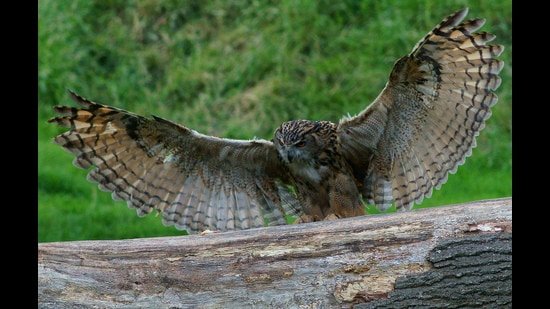
It took us millions of years to figure out how to fly, and we still can’t do it quite like they do.
A hop, a flap, and they’re airborne… so it’s no surprise that this ability, in the minds of ancient humans, gave birds the air of something magical or divine.
Among the Hopi people of North America, it was said they could carry messages between humans and the gods. The mighty eagle was considered particularly powerful in this respect, able to carry prayers far into the heavens. (Which is why eagle feathers are still used in a range of ceremonies.)
Among the Yakut of Siberia, birds of prey were associated with shamans, the soul, and travel between worlds. For this reason, small wooden bird effigies were placed in funerary settings as symbolic aids or representations of that journey.
As people attempted to make sense of all the unexpected and unexplained that these creatures represented, the same bird, interestingly, could end up signifying very different things, in different parts of the world.
Owls are one of the clearest examples of this duality. In parts of India, they are considered a bad omen. If one screeches on or near a home at night, it is said to mean that death, illness or financial troubles may soon follow. It is thought that the owl’s blank stare, its habit of hunting surreptitiously at night and its eerie screeches earned it this superstition.
In Ancient Greece, meanwhile, the owl served as sacred companion to Athena, goddess of wisdom and strategy. The influence of this early belief persists in modern Western culture, where fairy tales cast the owl as a wise elder of the forest.
The simple rooster, because it so often crows at dawn, acquired powerful symbolism. Among the Pueblo peoples of North America, it is seen as a symbol of renewal. In China, it is considered quite an honourable bird, with a comb that resembles the headgear of a mandarin, and a propensity to protect weaker hens. Paint a rooster on the door and the sun will soon shine on it, it is said.
Not so among Tibetan Buddhists. This tradition regards the rooster as highly inauspicious. With its incessant cawing and pecking at the ground, it has come to represent insatiable desire. It even appears at the centre of the Wheel of Life, alongside the pig and snake, as one of the Three Poisons: attachment, ignorance (sadly, the pig) and hatred / aversion (represented, rather unfairly, by the beautiful snake).
Swallows carry layered meanings across cultures. In parts of Africa, they symbolise purity, because they appear to never soil their feet by walking on the ground. In China, the symmetry of two swallows flying together represents marital harmony.
Some beliefs surrounding birds take on a darker tone. The Buryat of Siberia believed that eagle-owls hunted the souls of women who had died in childbirth, and brought them back, to harm the living.
Europe is full of lore about magpies. Because they tend to mate for life, seeing a single one, or an odd number, was viewed as a sign that bad luck was on its way. A well-known rhyme reflects this: “One for sorrow, two for mirth, three for a funeral, four for a birth,” it goes, ending with “Thirteen beware it’s the devil himself!”
Perhaps my favourite avian muddle, though, has less to do with a superstition and more to do with language, and geography.
The bird known in English as the turkey got this name because European traders confused it with the rather-similar-looking African guinea fowl, which was imported in large numbers via Turkiye (Land of the Turks). The guinea fowl was nicknamed “turkey fowl” and then “turkey”. (And today, many wonder why the country is “named after the bird”!)
Meanwhile, in Turkey, the bird is called Hindi, meaning “from India”, for reasons that have roots in what remains the world’s biggest geographical mess.
The turkey, you see, is native to North America. When Columbus made his big mistake in 1492-93, and announced to the world that he had arrived in India, it would be years before anyone realised his error. Meanwhile, traders began to use his route and export this delicious species (among other things) to major markets, advertising them as products from India.
And so this creature, found nowhere but America, came to be named “Hindi” or other versions of “From India”, in certain importing countries, such as Turkey.
The really haunting detail: Columbus never admitted he was wrong. He died in 1506, still adamant that he had reached Asia. Compelling evidence of a “new continent” would come via a revolutionary map that forced Europe to update its view of the world. But that would happen only in 1507.
(Adam Jacot de Boinod is author of The Meaning of Tingo. The views expressed are personal)
