

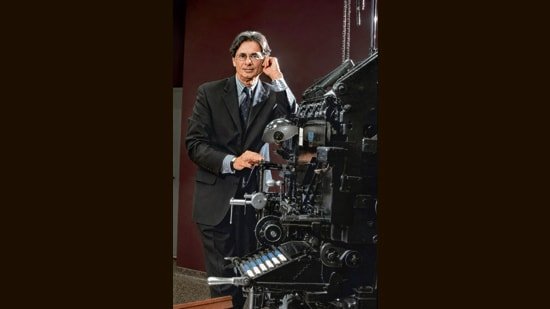
It took quite a few failed dreams, says Haroon Siddiqui, before he hit upon the right one.
He failed at medical and engineering entrance tests; attempted to build a career in cricket. He knew he could write, so he turned to journalism at the age of 23, joining the news agency Press Trust of India in 1963.
Then he lost his father, took on the family’s construction business and realised it wasn’t for him. Restless and eager to be part of the wider world, Siddiqui moved to Canada in 1967. He was 25. He secured a job at the Brandon Sun in picturesque Manitoba, and reported on local elections in small towns where children stared because they had never seen a non-White person.
In this world, Siddiqui, with all that the name implied, began to write of the need for multiculturalism. He shared then-prime minister Pierre Trudeau’s idealism: Canada could only benefit from opening up to the world.
Not everyone agreed. A new Manitoba premier, Sterling Lyon, was among those who refused to say Siddiqui’s name. “One day I told him, ‘Premier, my name is not Harry. I don’t want to be Harry. I am Haroon — that’s my name’.”
In six years, Siddiqui was managing editor of the Brandon Sun. In 1975, he travelled to India to report on Indira Gandhi and Emergency. Three years later, he moved to the Toronto Star, where he served as national editor, columnist and editorial page editor.
He travelled to Iran in 1979, as 52 American diplomats were held hostage at the US embassy in Tehran. As the Soviet Union invaded Afghanistan later that year, he flew to Kabul, pressed on to the Khyber Pass, and met tribal chieftans who talked about how they would resist, at all costs. Amid the Iraq-Iran war in the 1980s, Siddiqui travelled 700 km along the border, reporting as bombs flew overhead.
Siddiqui’s five-decade career earned him the Order of Canada in 2001, and the Canadian Journalism Foundation’s Lifetime Achievement Award in 2023. At 84, he remains Editorial page editor emeritus at the Toronto Star. His memoir, My Name is Not Harry, now out in India as Unapologetic, traces how he has navigated identity, truth and change. Excerpts from an interview.
* This isn’t your first book…
No. I wrote an anthology of modern Urdu poetry in 1988, and then a book titled Being Muslim in 2006, which was about Islamophobia and growing racism after 9/11. This memoir is about growing up in India and about how Canada has changed since I came here. My India, My Canada, if you will.
* What was it like, when you first moved?
Manitoba, which is in the Canadian prairies, had -35-degree-Celsius winters. It lacked diversity. Kids kept staring at me because they’d never seen a non-White person in real life. I would think: Stare at me as much as you want. I laughed it off.
* Soon enough, you began to cover wars in foreign countries. What was that like?
In 1979, I was covering the American diplomats hostage crisis in Iran, alongside hundreds of American journalists. Large crowds of Iranians, who were angry, would shout slogans like “Death to the Shah, Death to America” in front of the US embassy. When the cameras stopped recording, people would get off the stage and offer cigarettes and pistachios to reporters. They were performing for the cameras, and many journalists didn’t press to go beyond that.
A veteran Indian journalist from England, Dilip Hiro, said to me, “This is all bullshit. This is not real. This is not Iran.” He told me to get out of there and write about the Iranians.
This proved to be great advice. As soon as I got out of there, I saw different stories, by talking to people and people talking to me because I was not American. I think they trusted me because I was a Muslim from India who saw things from a perspective they felt other Western journalists lacked.
In Iran and elsewhere in the world, and, most importantly in Canada, I saw things with Indian eyes, Third World eyes, Muslim eyes and immigrant eyes, which were now Canadian eyes. That is what helped my journalism.
Whose side was I on? Nobody’s. Which of those were “my people?” None. I was a reporter-columnist-editor with a point of view based on what I saw, which others either didn’t see or chose not to.
* You write about how your Canadian identity made you friends in unlikely places too…
Oh yes. In 1979, as Soviets invaded Afghanistan, I was on a bus from Kandahar to Herat and it was pulled over by a Soviet battalion. A young Afghan soldier with a Kalashnikov was telling everyone to get out of the bus. I was thinking, “What am I going to tell this guy? How am I going to explain what I’m doing here, when journalists aren’t supposed to travel without a government ‘minder’?” I thought to myself, Should I say I’m Indian? Because India had a strong relationship with the Soviet Union.
Eventually I simply said: “I’m Canadian.” The soldier was happy to hear that. He smiled. I was later told some Canadians ran an eye clinic in Kabul for a long time. Unexpected moments like these have enriched me as a journalist and a human being.
* Has the idea of journalism changed for you, over the decades?
As a journalist, your responsibility is to hew to the facts and be fair. Your responsibility is to lead public opinion and not cater to the lowest common denominator.
With time, the responsibility has been enhanced.
The means of carrying out the journalistic mission through independent platforms, such as major newspapers with enough revenues to resist government or other pressures and offer independent points of view, are fewer and fewer.
Public opinion has now found new means such as YouTube and Facebook. Is that sufficient? One does not quite know yet.
When outrageous things happen, like the war on Gaza, individual creators contribute to the narrative to explain what is happening. Amid the ongoing war on Iran, more and more people are on YouTube finding an alternative point of view. In this age of polarisation, we need to strengthen democratic institutions, and stand up for civilised dialogue among citizens.
When I was writing this book, I asked a friend, “Do you think it’s worth it? Why should anyone care what I write?” And he said something terrific. “If you have a good story to tell and there’s good writing, people will read it. Similarly, if you have something critical to say, something useful, people will hear it, listen to it.”
* In our world of overlapping crises, what else gives you hope? What are the best ideas for our shared future that you have encountered, in your years of talking to experts on such themes?
There are two answers to that. One is the old Indian model of thousands of years of syncretic culture, which is essentially a deep respect for each other. This can come from religion. As Mahatma Gandhi said after reading Rumi, people of deep faith cannot hate people of other religions.
The second is that we cannot live in silos. We need each other, especially as Western societies become less and less White and more multicultural. Elsewhere too, majorities in democratic nations will have no choice but to respect the rights of minorities if they want to live in peace and harmony.
* If you were to distil it all down to a motto, what would that be?
Tell the truth. Let the facts do the talking, and hope that when it intersects with the reader’s mind, the worst they can say is: “I don’t agree with what you say, but I learned something”, or “You made me think.” That’s what you want as a journalist: to foster ideas, spark independent thinking, persuade people and augment civility in society.
