

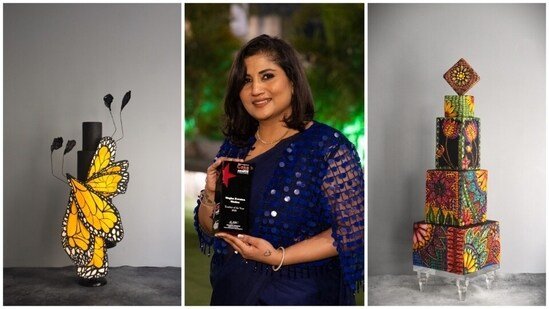
Move over, live jalebi counters and towering pyramids of traditional mithai. There is a new, gravity-defying showstopper commanding its own dedicated lighting and custom time slot at grand Indian weddings: the luxury, multi-tiered bespoke wedding cake. Also read | Altar your plans: Can Indian weddings really be sustainable?
Once a Western tradition quietly relegated to a corner at the reception, the wedding cake has evolved into a massive, seven-foot architectural anchor in modern Indian celebrations. Leading this cultural shift is acclaimed cake artist Megha Kwatra Madan, founder of Studio Cake O’ Luv.
A former dentist who turned to baking as a therapeutic outlet following a life-changing brain cyst and epilepsy diagnosis, Megha recently made history as the first Indian to win Teacher of the Year 2026 at the India and International Cake Magazine Awards.
In an interview with HT Lifestyle, Megha opened up about how Indian couples are redefining luxury, blending structural engineering with heritage, and why a luxury cake is no longer just a dessert — it’s an experience.
Cakes with individuality
According to Megha, the meteoric rise of luxury cakes doesn’t mean India is abandoning its roots. Instead, modern couples are looking for a unique visual canvas.
“Traditional sweets will always remain an integral part of Indian celebrations because they are deeply rooted in our culture and hospitality,” Megha explained, adding, “However, a luxury wedding cake serves a very different purpose. It has evolved into a symbolic centrepiece that reflects the couple’s personality, story, aspirations, and aesthetic.”
For today’s tech-savvy, well-travelled couples, standard designs simply won’t do. They want their shared history baked into the design. Megha shared, “A bespoke wedding cake becomes a visual expression of their journey together—something that is designed exclusively for them rather than being a standard element of the celebration. While mithai represents tradition and abundance, a luxury wedding cake often represents individuality and shared memories.”
Weaving Indian heritage into global aesthetics
Rather than blindly mimicking Western trends, Indian couples are aggressively localized the art form. Megha noted that her most challenging and rewarding projects involve translating heavy fabrics, historic architecture, and regional art into delicate sugar mediums.
⦿ The inspiration: Bridal lehengas, heirloom jewelry, temple architecture, and family traditions.
⦿ The medium: Intricate sugar lace, wafer paper draping, embroidery effects, and hand-painted detailing.
⦿ The motifs: Pichwai art, lotus motifs, and architectural jharokhas (palace windows).
“What excites me most is that Indian couples are no longer treating wedding cakes as imported traditions. They are making them deeply personal and culturally relevant,” she said, adding, “I have created cakes inspired by Indian textiles, hand embroidery, lotus motifs, Pichwai art, and architectural details found in historic palaces.”
Ultimately, Megha said authenticity trumps replication: “The global aesthetic may have introduced the concept, but the storytelling is becoming increasingly Indian. The most memorable cakes are not the ones that look international — they are the ones that feel personal and rooted in the couple’s heritage.”
From dentistry to sugar craft
Constructing a massive, multi-tiered cake that must withstand India’s diverse weather conditions is a logistical and structural nightmare. To survive, Megha leaned heavily on her medical background. After being advised to step away from her dental practice due to her diagnosis, she discovered that the operating room and the kitchen required identical muscle memory.
“The real connection between my two careers became evident much later, when I started creating intricate sugar flowers, hand-carved cakes, and fine decorative details,” Megha reflected. “I realised that the steady wrist movements, precision, patience, and meticulous attention to detail that dentistry had ingrained in me were naturally finding their way into my cake artistry,” she added.
“Looking back, I don’t think I ever truly left dentistry behind. The profession gave me the discipline, craftsmanship, and precision that continue to shape every design I create today,” Megha further shared.
When it comes to keeping a seven-foot cake from toppling over, Madan approaches the task with scientific rigour. “Large-scale wedding cakes require a strong understanding of structure, balance, and load distribution, which is very similar to architectural thinking,” she said.
Megha added, “When constructing a multi-tiered cake, every support system, dowel placement, internal structure, and assembly sequence must be planned meticulously. There is very little room for error. I often say that the artistic side of cake design gets the attention, but it is the engineering behind the scenes that allows those artistic visions to become reality.”
Moving beyond Pinterest
With Indian weddings hosting anywhere from hundreds to thousands of guests, the pressure on-site is immense. Transporting fragile sugar structures through chaotic venues, uneven flooring, and tight setup timelines is what Megha called the ‘most challenging aspect’ of the job: “The only way to manage that pressure is through preparation. Every component is planned, tested, and packed systematically.”
For couples looking to jump on the luxury cake trend, Megha offered one crucial piece of advice: step away from social media copy-pasting. “The first thing I tell couples is that Pinterest is a starting point, not the destination,” Megha asserted. “A truly luxurious cake is not defined by size or decoration. It is defined by originality. My goal is to create something that could belong only to that couple and no one else. When guests look at the cake, I want them to feel that it tells a story rather than simply displaying a trend,” she concluded.
