

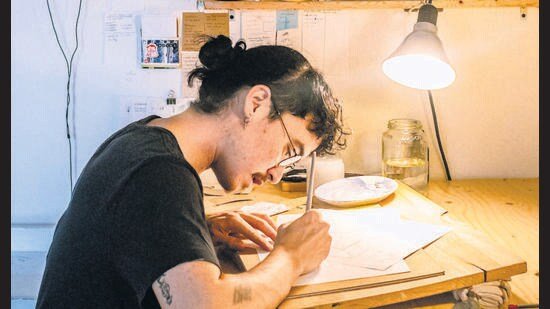
Friends can sometimes see you as no one else does.
That’s how it is for a young woman holding it together as she juggles work as a chef in Montreal, wards off a lecherous boss, cares for an ailing grandfather, copes with a distant mother, listens to mindfulness tapes, and runs, runs, runs, even when she knows she shouldn’t.
The woman is Lucy aka Cannon. The friend is Trish, a writer with a chaotic love life. Lucy is her confidante, advisor, troubleshooter. But now, their relationship is wobbling. Trish, it turns out, has secretly been mining her friend’s life for her fledgling writing career. Learning this, years of exhaustion, obligation and anger start to spill over for Lucy.
The graphic novel that tells this story, Cannon (2025), is drawn largely in black-and-white. Magpies appear as a recurring motif, in silent witnesses to Lucy’s emotions, their feathers dusting the page. Red turns up, from time to time, to signify rage.
The delicate, evocative tale has won its creator, the Australian cartoonist Lee Lai, the prestigious $60,000 Stella Prize, making Cannon the first graphic novel to win in the award’s 14-year history.
“I’ve known the fragility of friendships and what it means to hold onto each other as you enter a new era, whether that’s dealing with capitalism, ageing parents or romantic relationships. It can feel like a little pressure cooker of resentment and obligation,” says Lai, 33, who lives in Montreal.
What is it like to be the first graphic novelist and the first transgender non-binary writer to receive this award? “I feel a lot of responsibility to be protective of my community because the flip side of such a win in a public sphere is that it angers all the people who already don’t like us,” Lai says. “There’s been a backlash. I was expecting that. It is a challenge. But it’s also been beautiful, to feel the love pour in from various quarters.”
Cannon is Lai’s second novel. Her first, Stone Fruit (2021), followed a queer couple, recently broken up, as their lives unravelled and they attempted to reconnect with their families. It won the Lambda Literary Award and was a finalist for the LA Times Book Prize.
Growing up in Melbourne the child of a high-school art teacher, Lai says she was always encouraged to draw. Reading works such as Persepolis (2000; Marjane Satrapi’s semi-autobiographical account of girlhood in Iran) and Skim by Mariko Tamaki (2008; set in a girls’ school in Toronto), opened up a “third language” for her, she says, “created through the alchemy of text and visuals.”
The Stella Award could open up new worlds too. “I hope to stop juggling day jobs and use some of the prize money to buy myself maybe a year or so to work on just books,” Lai says. “I’m hoping publishers will be more willing to take more risks with graphic novels too.”
Excerpts from an interview.
The first graphic novelist to win the Stella. How exhilarating is that?
It is. You get used to the kind of cosiness of this niche subculture, where everyone is supportive of each other. With the award, it feels like I’ve suddenly been thrust into a much bigger pond and I’ve had to swim very fast.
I’m nervous, but also thrilled and very grateful.
It’s heartening to see that readers are ready to challenge themselves a little more when it comes to graphic novels. I’m hoping publishers will be more willing to take more risks with graphic novels too.
Lucy struggles to say what she is feeling. How hard was it to build a graphic novel around such a character?
It was very hard to write a book like this about someone’s internal world when they don’t talk much. That was a challenge I should have anticipated more!
I found myself really relying on all these nonverbal cues – a tightening of the mouth, averting of the gaze, a real stiffening of the shoulders.
Trish is clearly doing it wrong, but is there a good way to draw on someone else’s life for one’s own creative endeavours?
I ask them for permission. That can end up being a beautiful point of connection. I have multiple conversations with the person that also help me understand why I want to draw from a certain experience or individual. To understand this is important to me ethically as well as from the point of view of being a good storyteller.
What do most people miss, or misunderstand, about what it takes to tell a story in this way?
I think most folks don’t realise just how much drawing it is. It’s a ridiculous amount of labour.
It’s why a lot of cartoonists talk about feeling anguish after they spend years working on a project, and then someone reads it in an hour or two. I’m honestly kind of happy when that happens, because it tells me that someone gave it all their attention.
What troubles you most about the world you live in, and what gives you the most hope?
I think all our struggles across the world are interconnected. But what troubles me most is the climate crisis. It affects us all.
What gives me hope is my people. I’m surrounded by folks who are simultaneously not shying away from how terrible everything is, have a desire for things to be better, and do things that can help in that direction.
Who is Lee Lai when not writing or illustrating?
I’m someone who likes to be with my friends, and also be by myself a lot. There’s a constant tension between those two. I really like community organising, dancing with friends, riding my bike. Here in Montreal, I spend a lot of time missing my family, the eucalyptus back home, and that disgusting Australian sense of humour. Australians are willing to make fun of just everything. The Canadians are too polite!
What has the Stella Prize already changed for you?
I think this will be the first time I won’t have to take on day jobs to support myself as I work on a book. I don’t know yet what that’s like, but my hope is that I can use some of that money to buy myself maybe a year or so to work on just books. I’m curious to see what happens to my process if I give myself that space and time.
I’m working on a collection of short stories, which is a break from long-form and gives me a chance to experiment. I’m also working on a funny little web comic. And there’s a longer graphic novel I’m beginning to research that I’m excited about.
