

A lot has been said about the new generation of chefs in India. But what’s not been said enough is how different they are to the generations that went before them. Quality comparisons are always tricky, because the older generations did not have access to top ingredients (either because they could not import them or Indian farmers had not started growing them), were not really familiar with wine, and catered mostly to a smaller audience that was less demanding. So yes, restaurant food today is far superior to anything that has ever been served in India before, but that is partly because of circumstances.
But there’s one thing that is indisputable: This generation has stopped being needlessly competitive. The chefs like and admire each other, exchange ideas and enjoy being part of an inclusive community. This is so different from 20 years ago, when they all bitched about each other and let arrogance take precedence over talent.
I saw this new era of friendship and cooperation for myself a fortnight ago in Mumbai.
It happened like this. My friend ( and co-founder of Culinary Culture) Sameer Sain and his buddy, the noted foodie and wine lover Vikas Oberoi, were hosting a charity wine dinner. There were just ten people, all friends of the hosts, who made hugely generous contributions to Epic, the charity for whom the dinner was planned. (I went as Sameer’s guest.)
Vikas has hosted great winemakers at his fabulous beachfront villa before, and has organised dinners featuring Bordeaux Grand Crus and other great wines before. He hosted this dinner with his usual fair too. But both Sameer and he wanted to do something that had never been done before. Sameer said he would provide the wines from his own collection. And Vikas would let the chefs cook in his magnificent kitchen at home.
This sounds grand enough, but this was not going to be just another wine dinner. They served the best wines in the world: From Burgundy’s Domaine de la Romanée-Conti (or DRC to its fans). DRC produces only about 7,000 cases in total of its nine or ten wines every year. In contrast, a Grand Cru Bordeaux chateau such as Mouton Rothschild can produce around 17,000 to 20,000 cases of its top wine per year.
All this makes DRC wines (sold only on an allocation basis) rare and extremely desirable. The prices at which each bottle is sold for are crazy; I won’t quote them here except to say that they sound like telephone numbers rather than wine prices.
Sameer donated several different DRC wines and threw in a few other bottles (Dom Perignon, Chateau d’Yquem, his favourite Clos du Bourg etc). And Vikas found chefs who could create food that matched the wines.
The three chefs who cooked were Mumbai’s superstars. Hussain Shahzad was number one on the Culinary Culture list of India’s greatest chefs two years ago (once you reach number one, you leave the list and join a hall of fame) and oversees Hunger Inc’s restaurants: The Bombay Canteen, O Pedro, Veronica’s etc. Papa’s, the tiny counter-seating restaurant where he cooks, is India’s hardest reservation. (I haven’t been able to get in since it opened).
Hussain worked at New York’s legendary three-Michelin-starred Eleven Madison Park before coming to cook in Mumbai. So did Alex Sanchez, who transformed casual fine-dining in Mumbai at The Table before opening his own super-hot Americano (I have to call Alex well in advance if I want a table) and the jam-packed Otra. He is that rare chef, equally at home with Italian and Latin American food, both of which he tweaks to his own style. And of course he is classically trained.
The third chef was Varun Totlani of Masque, which has been, for several years, the top Indian restaurant on the list of the World’s 50 Best. Varun has cooked with the world’s greatest chefs and created a cuisine which is global but has distinct Indian flavours.
My guess was that the chefs would do two or three courses each. Instead they opted to collaborate on every dish, exchanging ideas and ingredients so readily that they created a menu where no course was entirely the work of any one chef.
It’s difficult for chefs to do a DRC dinner because, a) like the rest of us and unlike Sameer and Vikas they don’t drink these wines on a regular basis so they have to guess which ingredients will go with each wine. And b) because the wine is the star of the show, the food cannot be allowed to overshadow it. And yet they have to create superlative food, worthy of such great wines.
Did they succeed despite these constraints? You bet! It was the best wine dinner I have ever been to anywhere in the world.
If Aubert de Villaine, the owner of DRC, had been there, he would have conceded that Indian chefs had now reached the level where their food could more than match up to his spectacular wines.
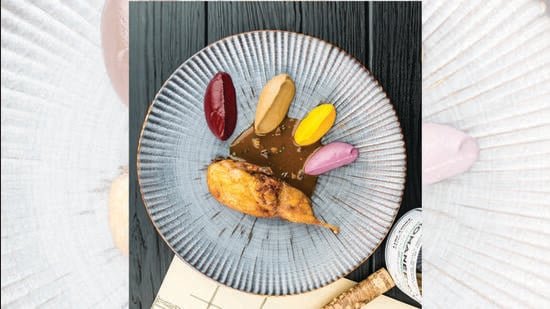
Some dishes were unforgettable: White asparagus and scallop tartare with horseradish, Kashmiri morels with black garlic, warm cheese custard with barbecued pork, shoulder of lamb with mole, celeriac tortellini in a brown butter sauce, and a killer mango dessert to go with a Corton-Charlemagne Grand Cru.
None of the pairings were ‘safe’. Asparagus and horseradish can be tricky with wine, a mole with one of the world’s greatest red wines is a real risk, and I was astonished by the happy marriage of mango with Corton-Charlemagne.
But these were chefs at the top of their game. They had the skills and the confidence not to be intimidated by DRC wines and to create a menu where every dish had the guests reeling in surprise and delight.
It was the wine dinner of a lifetime and demonstrated to me that this generation of chefs has risen above the old rivalries and pettiness to collaborate on food that surpasses global standards of excellence.
Now, let’s see if chefs in other Indian cities can reach the heights that Mumbai’s chefs have! Frankly I am not sure they can.
From HT Brunch, May 30, 2026
Follow us on www.instagram.com/htbrunch
