

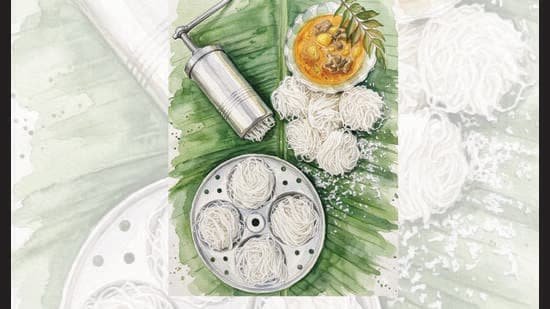
Sevai nazhi (Tamil Nadu). The traditional cylindrical press is known by different names across south India. But the best ones – in brass or steel – all perform the same function: To extrude batter through sieves of different sizes to produce vermicelli, snacky crunchies, idiyappam and smaller dough shapes for cooking. Use them for their intended purpose, or to make Chinese noodles and Italian pasta. Everything comes out softer and lighter.

Chirava (Kerala). Communities along both coasts have worked out ingenious ways to efficiently scrape the white flesh inside coconuts. Electrical appliances try, but they’re too noisy, too fast, and only deliver a soggy mess. Besides, those whirring blades are dangerous. Kerala’s version – in sitting and kneeling variants – puts a serrated blade on a low platform or bench, so users can rotate the coconut directly on the teeth, producing light, fluffy shavings without effort or wobble.

Bonti (West Bengal). Long, curved blade fixed vertically onto a base, sharp side in. Users fold out the knife, so it holds its position, blade side up, leaving users with both hands free as they do the chopping. Great to scale fish, quickly cut meats and chop dense veggies with precision. It’s less mess too – juices all drip down, unlike with a chopping board. It folds back to safety when done.

Madhani (Punjab). Put down the bullet blender. Punjab’s analogue contraption delivers airy, soft lassi and buttermilk, and freshly whisked makkhan. And because hand-churning goes slow, the milk solids never overheat, retaining their texture and flavour. Get a wooden one, preferably in non-reactive sheesham. And put a podcast on as you churn, the quiet repetitive motion is almost meditative.

Khalbatta (Maharashtra). The pestle and mortar are old, old friends. Every community is devoted to their version. The ones from Nashik (small, solid brass) are great to pound just enough masala or herbs for a single meal. Brass doesn’t chip or scrape easily, it doesn’t retain odours, is easy to clean and won’t flatten every spice mix into a boring smooth powder. Even professional chefs use them. Plus, so pretty, they deserve countertop space.

Wooden tools (Andhra Pradesh). In Udayagiri, woodworking communities take pride in their intricately carved spatulas, ladles, bowls and baking tools from locally sourced wood. Their signature handcarved, Persian-inspired floral detailing gives everyday kitchen tools the vibe of an heirloom object. The wood is light but dense, won’t warp under heat like plastic, and a wooden chopping board is kinder to knife blades. And those handles are surprisingly ergonomic too.

Bamboo steamer (North East). Everyone’s got frozen dumplings in the freezer, now. Don’t heat them in the microwave, they’ll just dry out. Go slow and authentic with steamers from Karimganj in Assam and parts of Mizoram. They have typically precise craftsmanship – the lids sit securely, letting no steam escape. And the slow-steam process cooks momos, delicate bao buns, silky tofu, custard or sticky rice desserts without making them limp or soggy. Even vegetables taste better when infused with the subtle bamboo fragrance.

Goshpar (Kashmir). This is technically a mallet for meats. Pounding meat on a stone slab patiently gives it the elastic texture for goshtaba and rista without heating it up, like a rotor-blade device would. It works just as well for making ginger paste, mashing avocadoes for guacamole, and flattening out glutinous dough quickly without visible grain. Get one in walnut wood. It’s easier to use than pulling out the grinder for every little thing.

Sarota (Uttar Pradesh). Lucknow is synonymous with kebabs, chikankari and impeccable tehzeeb, but its paan culture is just as legendary. A scissor-like betel-nut cutter in brass or iron, decorated with floral or bird motifs, isn’t just a thing of beauty, it’s great for chopping dry fruit, slicing sausage or tackling those tiny prep jobs where large knives suddenly feel unnecessarily dramatic, and you don’t want to pull out the chopping board.

Fish knife (Goa). Coastal cooks would never use a generic knife for fish. They instead draw on a flexible, lightly serrated flat blade that curves upwards. The serration makes short work of removing scales. The light blade is delicate on the flesh, the curved bit removes fish bones and slippery skin (and opens clams and shellfish with greater precision). It makes fillets easy – even tomatoes slice thin and evenly.
From HT Brunch, May 30, 2026
Follow us on www.instagram.com/htbrunch
