

In all the excitement about the forthcoming release of Christopher Nolan’s film of The Odyssey, one question remains unanswered.
Will the Sirens feature in the movie?
Those of you who paid attention at school when they were explaining the plots of such ancient Greek epics as The Iliad (now best known as an early concept note for the movie Troy) and The Odyssey (about Odysseus’s long voyage back home after the Trojan War) will know all about the Sirens.
In Homer’s epic, they were beautiful women who sang haunting songs to the ships at sea. The sailors liked the songs so much that they sailed at once to the island of the Sirens where they found themselves trapped and unable to do very much.
The story has been attacked in our woke times as being anti-women, but it remains such an important part of popular culture that there is endless speculation about where the Sirens were supposed to live.

One interesting theory is that the Sirens weren’t Greek at all. They were Italians.
How? Why?
Well, because Odysseus was lost so he could well have ended up on the Italian coast. And besides, the countries of Greece and Italy did not exist in that era, and the South of today’s Italy was ruled by Greeks.
Moreover, there is a historical basis to the songs of the Sirens. The port of the ancient town of Amalfi was so foggy that sailors often lost their way. They would be guided home by the sound of the songs of the women of the town who would stand by the sea and sing/chant loudly.
So, Amalfi is the original land of the singing women and it is possible that Homer heard about it and put it into his text.
In Amalfi, they are proud of the epic reference because they interpret the story to mean that people come to Amalfi from all over the world, are seduced by the music and the beauty, want to laze around all day doing nothing and never leave.

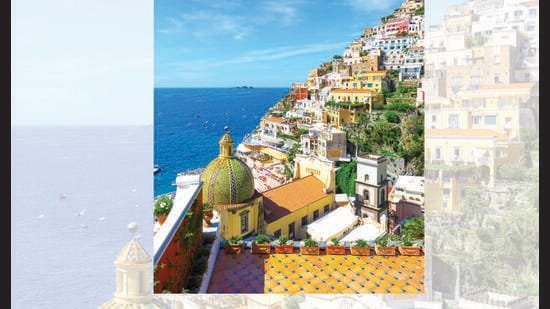
Never mind what Homer wrote, but that description pretty much sums up today’s Amalfi and the coast it gives its name to. It is so stunningly beautiful that you never want to do anything except luxuriate in the beauty and the history.
For the last couple of centuries, Amalfi has been the place the wealthy and the glamorous flock to. It was one of the stops on the Grand Tour, which young British aristocrats were required to embark on when they came of age. For wealthy Europeans, Amalfi and the islands around it (including, most famously, Capri) were the holiday destinations of choice on par with the French Riviera.
That’s still true, except that in today’s globalised and wealthy world, it’s not just the very rich who come to the Amalfi coast; the visitors come from all over the globe.

And if you are interested in history or sightseeing, there is a lot to see starting with Amalfi Cathedral.
Another Homer-worthy irony is that if you go looking for Ancient Greek temples or monuments in Greece, all you will find are ruins and structures recreated from collapsed columns. On the Amalfi coast, on the other hand, you will see Greek amphitheatres, temples etc preserved in very good condition.
In most of Europe and, in Italy in particular, history, religion and now, tourism are inextricably bound together. Just as so many of India’s best hotels were once palaces, the Italians have turned convents and monasteries into luxury hotels.

I have stayed in hotel rooms where the walls are adorned with frescoes that are centuries-old, and this time in Amalfi, we stayed in a hotel that dated back to the 13th century and was carved into the walls of a cliff overlooking the Mediterranean. In the same corridor as our room, an open, cliff-side courtyard led to the most historical part of the building, which included a functioning church. (There was actually a wedding being conducted while we were there. We did not worry. There are no drunken late-night sangeets at these weddings.)
The original monastery was built by Franciscan monks high on the hill to deter looters and invading armies, but clearly the friars liked a good view, because the building overlooks the blue waters of the Mediterranean and offers a gorgeous vista of the medieval town of Amalfi.
The monks lived simple lives, eating the vegetables they grew in their kitchen garden and making cheese from the milk of the goats they kept on the hill. Every now and then, they slaughtered one of the goats and held a feast.
Inevitably, the monastery ran out of money and the monks moved on. The building was left to the municipality, which ran it as a relatively modest hotel. Then, a few years ago, the Thai Anantara group took over the property and spent millions turning it into one of the world’s most unusual boutique luxury hotels.

It is still, very clearly, a monastic structure with walls that are a thousand years old, but by combining the monks’ smaller quarters to create larger rooms, the Convento Di Amalfi manages to ensure an air of stylish luxury. You can, of course, take the lift down the hill and drive to Ravello and the other famous towns on the coast, but I found the hillside location peaceful and relaxing because the Amalfi coast can be overrun by tourists and you have to know where the quieter and less crowded locations are.
But do not feel intimidated by European luxury. India has always been present here. We had sea-trade links with what is now Italy going back to the period before Christ was born and the locals regarded India as a fabulously wealthy and sophisticated land. The lemons that the Amalfi coast is famous for originally came from India. (The lemon is an Indian fruit.)
Our lemons got here in the second century AD but cultivation began in earnest in the Middle Ages, when Middle-Eastern traders flooded the region with lemons.

The monks grew lemons but they also grew basil (Alexander the Great took our tulsi to the West, where it was bred to create modern basil) and other herbs. I imagine they got a little bored up on the hill because they used the herbs from their kitchen garden to create Amaro, an Italian liqueur from the same family as Aperol or Fernet-Branca. In medieval Europe, monks were veteran booze-makers: Dom Perignon was a monk, and Benedictine, a French liqueur, is linked to Benedictine monks.
The Amalfi Aperol (still made in tiny quantities by the hotel) is unusual in that it is strongly flavoured with cardamom, another Indian import.
Sadly we have few hotels in India that are as beautiful and well-located as the Anantara Convento di Amalfi. But it is good to know that nearly two thousand years before modern Italy was created, India was regarded as the land of gold by the locals. And that part of our legacy still endures.
From HT Brunch, May 23, 2026
Follow us on www.instagram.com/htbrunch
